Home
» Today
»
Guy Fawkes Night Traditions Explained: Why Britain Lights Bonfires and Fireworks | Nov. 6, 2026
Guy Fawkes Night Traditions Explained: Why Britain Lights Bonfires and Fireworks | Nov. 6, 2026
Research timestamp: November 5, 2026, 5:20 p.m. UTC (November 6, 2026, 12:20 a.m. ICT in Bangkok).
Guy Fawkes Night, also called Bonfire Night or Firework Night, is marked in Britain on or around November 5. The date remembers the failure of the Gunpowder Plot, an attempt in 1605 to blow up the Houses of Parliament during the State Opening. Bonfires and fireworks became part of the early commemorations, while the familiar Guy effigy developed later. Today, many celebrations are community or family events, but the tradition began with a state-backed thanksgiving and carries a history shaped by anti-Catholic politics.
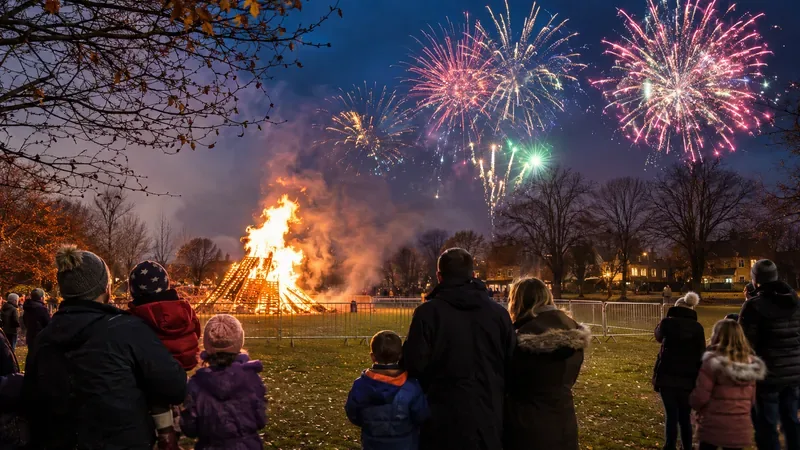
Illustrative scene of a community Bonfire Night gathering in Britain.
Highlights
November 5 marks the failed Gunpowder Plot of 1605, in which conspirators planned to destroy Parliament and kill King James I.
Parliament made the date an annual thanksgiving in 1606; bonfires, bell ringing, sermons, and fireworks became part of the observance.
Guy Fawkes was not the plot’s principal organizer, but his arrest while guarding the gunpowder made him the best-known figure.
Modern events often focus on fireworks and community gatherings, while older effigy customs and local practices vary.
Why is Guy Fawkes Night held around November 5?
In 1605, a group of conspirators planned to blow up the House of Lords during the State Opening of Parliament, when King James I and political leaders would be present. The plot was discovered before the planned attack. During a search of the Palace of Westminster on the night of November 4–5, guards found Guy Fawkes with gunpowder in a cellar. The National Archives describes 36 barrels; Fawkes was arrested before they could be used.
Fawkes became the name most people remember, but he was not the plot’s principal planner. UK Parliament identifies Robert Catesby as one of the central conspirators and describes Fawkes as one member of a wider group. The account of how officials first learned about the plot includes an anonymous letter to Lord Monteagle; Parliament notes that historians are uncertain whether that letter was genuine or a forgery. This is a useful reminder that the familiar story has details that are not settled beyond doubt.
After the plot failed, Parliament passed the Thanksgiving Act in January 1606, establishing annual services and sermons on November 5. The act remained in force until 1859. Commemorations grew beyond church services: people rang bells and lit bonfires, creating a public, visible way to mark the plot’s failure and the king’s survival. The bonfire therefore comes from the history of the annual observance, rather than from a single documented moment when someone decided to recreate the explosion.
The early meaning was political as well as religious. In the decades after the plot, the day could be used to express hostility toward Catholics, who were treated with suspicion and faced restrictions in Protestant England. UK Parliament says that effigies of the Pope or the devil appeared on bonfires in the 17th century. UK Parliament suggests that Guy Fawkes gradually replaced the Pope as the usual figure burned after laws against Catholic worship were removed. That history matters: Bonfire Night is now often a family celebration, but its older symbolism was not religiously neutral.
Parliament’s history of the commemoration traces how sermons, bells, bonfires, and effigies became part of the observance.
Why are fireworks part of Guy Fawkes Night?
Fireworks appeared in some of the earliest celebrations, according to UK Parliament. Their connection to the date is easy to understand: gunpowder was central to the plot, and fireworks turn controlled gunpowder into a public display of light and sound. English Heritage notes that fireworks use gunpowder too, although a modern display is not a literal reenactment of the planned attack. The old danger and the present-day spectacle are linked by materials and memory, but they have very different purposes.
Over time, fireworks became one of the main attractions. Towns and institutions may organize displays and bonfire parties, while some people celebrate on a smaller scale at home. Events are often held on November 5 or on a nearby evening that works for the local community. There is no single national program, and the exact mix of bonfires, fireworks, food, music, and family activities differs by place.
What does “Penny for the Guy” mean?
A “Guy” is an effigy associated with Guy Fawkes. Children traditionally made a model, carried it through the streets, and asked passersby for “a penny for the Guy.” UK Parliament also records 19th-century chants used while collecting money and firewood for Bonfire Night. English Heritage describes children carrying Guy models or wearing masks as part of 20th-century celebrations.
The custom is less central to many modern events than the bonfire and fireworks, and it is not practiced everywhere. Its history also reflects how the annual celebration changed: a state religious observance gradually became a popular public holiday tradition, with Fawkes himself taking the place of earlier effigies.
How is Bonfire Night celebrated today?
For many people, November 5 is now a seasonal gathering: families meet at an organized display, watch fireworks, and spend time around a community bonfire. Other celebrations may feature a funfair or food stalls, while some neighborhoods mark the date quietly or not at all. English Heritage describes the modern event as increasingly family-focused, with the spectacle often more prominent than the historical figure of Guy Fawkes.
Fireworks and open flames still require care. For England, Home Office guidance recommends attending an organized display where possible, supervising children, standing well back, and never returning to a lit firework, even if it appears not to have gone off. Check current local advice before setting off fireworks or lighting a bonfire; rules and restrictions can vary. The government’s fire safety guidance for celebrations gives practical precautions.
Frequently asked questions
Was Guy Fawkes the leader of the Gunpowder Plot?
No. Robert Catesby was a principal organizer. Fawkes became the best-known conspirator because he was found guarding the gunpowder beneath Parliament.
Do people still burn a Guy effigy?
Some celebrations include a Guy effigy, but it is not part of every event. Fireworks and community gatherings are often the main attractions today.
Why do people say “Remember, remember the fifth of November”?
The rhyme recalls the date of the failed 1605 plot and the annual commemoration that followed. It is a traditional verse, not a complete account of the event’s complicated history.