Home
» Share
»
Habit Stacking: A Practical System for Making Routines Stick
Habit Stacking: A Practical System for Making Routines Stick
You decide to stretch every morning, read every night, drink more water, or plan your day before opening email. The intention is clear. The problem is remembering to act at the right moment, especially once the novelty wears off.
Habit stacking is a practical way to reduce that problem. You attach a small new behavior to something that already happens reliably: after I do X, I will do Y. In behavioral-science terms, this resembles an implementation intention combined with repeated behavior in a stable context. The phrase “habit stacking” is a popular label, not a single standardized scientific protocol, so the useful question is not whether the label itself has been clinically validated. It is whether its underlying ingredients—clear cues, specific plans, repetition, and context stability—are supported by evidence.
A practical habit stack pairs a reliable existing cue with one small, clearly defined action that can be repeated in the same context.
Habit stacking in one sentence
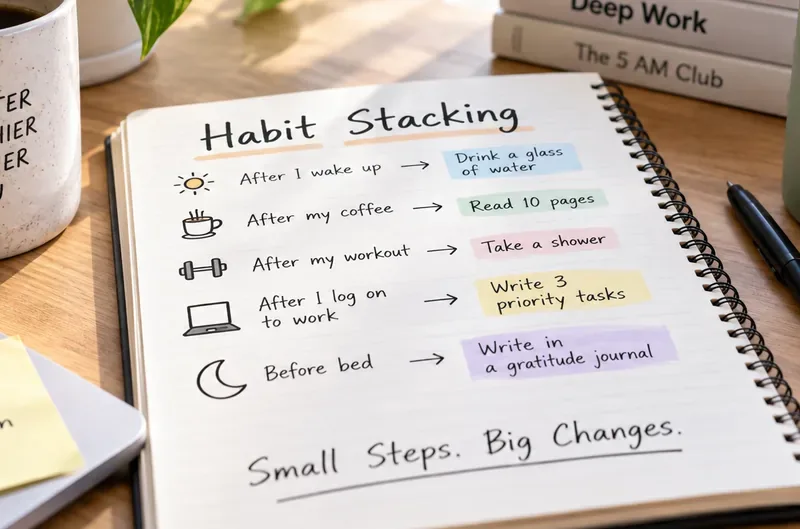
Use an action you already perform consistently as the cue for a small behavior you want to repeat. A simple template is: “After I [existing routine], I will [new behavior].”
That structure matters because habits are strongly tied to context. A major review of habit mechanisms describes habits as learned links between recurring context cues and responses. Once those links become strong, the context itself can help activate the response. See the original Psychological Review paper on habits and context-response associations.
What the research actually supports
Practical idea
Evidence behind it
What not to assume
Specify the cue and action in advance
Implementation-intention research uses an “if situation Y, then behavior X” structure. A 2006 meta-analysis of 94 independent tests found a positive effect on goal attainment.
A plan does not guarantee the behavior will become automatic.
Repeat the behavior in a stable context
Habit research links repetition in recurring contexts with stronger cue-response associations and increasing automaticity.
There is no universal number of repetitions that works for everyone.
Keep the action feasible enough to repeat
Real-world habit-formation studies show automaticity develops gradually and varies greatly by behavior and person.
Missing one opportunity does not mean the habit is “reset.”
The implementation-intention evidence comes from Gollwitzer and Sheeran’s original meta-analysis in Advances in Experimental Social Psychology. It found that plans specifying when, where, and how to act helped people translate intentions into action across many settings. Habit stacking borrows a similar logic by making the cue explicit.
For habit formation itself, Lally and colleagues followed people choosing a daily eating, drinking, or activity behavior in the same context for 12 weeks. Automaticity generally increased with repetition, but the time course varied substantially. The original study is available in the European Journal of Social Psychology.
Build the stack from the anchor, not from motivation
1. Pick an anchor that already happens reliably
A strong anchor is concrete and easy to notice. “After breakfast” is better than “in the morning.” “After I plug in my phone at night” is better than “before bed.” The cue should occur often enough to support the behavior and in a context where the new action is actually possible.
Good anchors are often transitions or completed actions: turning off an alarm, starting the coffee maker, brushing your teeth, sitting down at your desk, returning from lunch, closing your laptop, or putting a plate in the sink.
2. Make the new behavior smaller than your ambition
The first goal is reliable repetition, not an impressive performance. “After I make coffee, I will read one page” is easier to repeat than “I will read for 30 minutes.” “After I close my laptop, I will write one sentence about tomorrow’s priority” is more stack-friendly than “I will fully plan tomorrow.”
You can always continue beyond the minimum. The minimum is the version that protects the cue-response link on busy days.
3. Write the stack so there is no interpretation required
Use this format:
After I [specific anchor], I will [specific behavior].
Weak: “After work, I will exercise.”
Stronger: “After I put my work laptop on the charger, I will put on my walking shoes and walk for five minutes.”
If the sentence contains vague words such as “later,” “more,” “healthy,” or “productive,” define the behavior more precisely.
Quick-reference examples by goal
Goal
Existing anchor
Small stacked behavior
Hydration
After I start the coffee maker
Drink one glass of water
Mobility
After I brush my teeth
Do 30 seconds of gentle mobility
Reading
After I get into bed
Read one page
Work planning
After I log in for work
Write the day’s top priority
Learning
After lunch
Review one flashcard set for two minutes
Home organization
After I put dinner dishes away
Put away five out-of-place items
Reflection
After I plug in my phone at night
Write one sentence in a journal
These are examples, not prescriptions. The best anchor is the one that already occurs in your real day. If you rarely drink coffee, coffee is a poor anchor no matter how elegant the stack sounds.
Why some habit stacks fail
The anchor is unstable
If the cue disappears on weekends, travel days, or remote-work days, the new behavior may disappear with it. Choose a more universal cue or create separate weekday and weekend anchors.
The new behavior is too large
A stack that requires 30 minutes, special equipment, or significant emotional effort can become a scheduling problem rather than a cueing problem. Shrink the first action. The stack can trigger “put on running shoes”; the full workout can still be planned separately.
You stacked too many behaviors at once
A long chain looks efficient on paper, but each link creates another place for the sequence to break. Start with one added behavior. Once it feels dependable, add another only if the sequence remains practical.
The cue and action are physically disconnected
“After I turn on the shower, I will review my budget” is specific but awkward. Pair behaviors that fit the same location, tools, and moment. Environmental friction matters.
You are treating reminders as habits
An alarm can prompt behavior, but a true routine becomes more context-linked through repetition. A reminder may be useful during setup, yet the goal is for the real-world cue—such as closing a laptop or finishing lunch—to become meaningful.
How long does a habit stack take to feel automatic?
There is no scientifically supported universal “21-day” rule. In the 2010 Lally study, modeled time to reach 95% of an individual’s estimated automaticity plateau ranged from 18 to 254 days among participants whose data could be modeled. Missing one opportunity did not materially derail the process in that study.
A newer systematic review and meta-analysis published in 2024 found similarly wide variation across health-related habits. It reported median estimates around 59 to 66 days in the studies that measured time to habit formation, while means and individual ranges varied substantially. The review also emphasizes stable contexts, repetition, and the type of behavior as important factors. See the 2024 systematic review on time to form health habits.
The practical takeaway is simple: measure reliability, not the calendar. Ask whether the cue increasingly prompts the behavior with less deliberation.
Track the stack without turning tracking into the main project
A minimal log is enough. For two to four weeks, mark whether the behavior happened after its intended anchor. You are looking for patterns, not a perfect streak.
Done after the intended cue: the stack is working as designed.
Done later: motivation may be carrying the behavior, but the cue is weak.
Frequently missed: either the anchor is unreliable or the behavior is too demanding.
Easy but forgotten: make the cue more visible or move the needed object into the cue environment.
A stack can eventually become a short sequence: make coffee → drink water → review today’s priority → begin focused work. Expand only when the first added behavior is reasonably dependable. If you constantly need a reminder for step two, adding steps three and four usually creates a brittle routine rather than an efficient one.
Keep chains short enough that one interruption does not ruin the day. A useful rule is to identify the core behavior that matters most and treat later links as optional bonuses until they become stable.
Habit-stacking self-check
Anchor: Does the cue already happen on most days without effort?
Specificity: Can I tell exactly when the new behavior should start?
Size: Can I complete the minimum version even on a difficult day?
Fit: Are the cue and behavior in the same place or naturally connected?
Frequency: Does the cue happen often enough for the repetition I want?
Evidence: Am I judging success by repeated behavior rather than a motivational feeling?
Recovery: If I miss once, do I resume at the next normal cue instead of declaring the streak broken?
What habit stacking can—and cannot—solve
Habit stacking is most useful when the barrier is remembering or initiating a small repeatable behavior. It is less useful when the main barrier is lack of time, conflicting priorities, missing resources, pain, severe fatigue, or a task that requires substantial planning. In those cases, the solution may involve scheduling, environment redesign, support from other people, or professional guidance rather than a better cue.
The core idea is modest but powerful: make the desired action easier to start by attaching it to a dependable moment that already exists. Then repeat it in that context long enough for the cue and response to become familiar. That is a more realistic path to a durable routine than waiting for motivation—or racing toward an arbitrary number of days.