01. Historical Context
AI matters for Airbus because execution quality is now a valuation variable
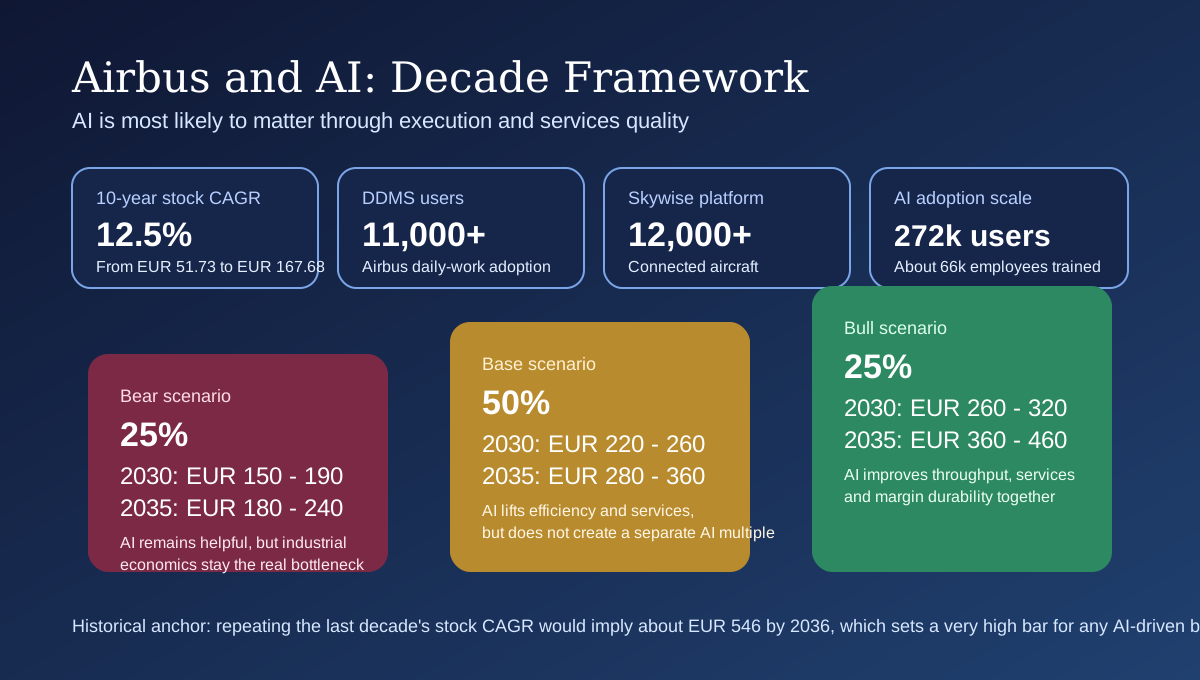
Airbus shares were at EUR 167.68 on May 15, 2026, after compounding at roughly 12.5% a year over the past decade from a May 2016 monthly close of EUR 51.73. That long-run performance was built on order-book strength, duopoly economics and cyclical recovery. AI only becomes financially meaningful for the next decade if it helps Airbus widen those advantages through faster engineering, more reliable production and higher-value services.
| Horizon | What AI must improve | Current evidence | What would strengthen the thesis | What would weaken the thesis |
|---|---|---|---|---|
| 1-2 years | Internal productivity and decision support | DDMS has 11,000+ users; Gemini rollout and secure GenAI tools are already deployed | Management links digital adoption to faster engineering cycles, fewer bottlenecks or better service KPIs | AI stays descriptive and helpful but does not move production or margin metrics |
| 2028-2030 | Factory throughput and services monetization | Skywise serves 12,000+ connected aircraft and Airbus calls digital the fastest-growing services segment | Digital attach rates, predictive maintenance and higher-margin support revenue deepen | Digital growth remains real but too small to influence group valuation |
| 2031-2035 | Durable margin and valuation support | Airbus is working with airworthiness authorities on AI standards and building a wider internal AI stack | AI becomes embedded in certification, lifecycle services and operating leverage | AI becomes a cost of staying current rather than a differentiated profit driver |
The key context is that Airbus is already running a real digital program, not merely discussing one. Its digital transformation page says DDMS is designed to connect platforms and data exchange across the company, while the FY 2025 board report says more than 11,000 people already use DDMS solutions in daily work. That makes AI relevant to the stock because Airbus' core constraint is industrial complexity.
At the same time, the market should not pretend AI can overpower physics. Airbus delivered only 114 commercial aircraft in Q1 2026 and 181 through April. If engines or parts do not arrive, software does not create finished aircraft. The long-term AI thesis for Airbus therefore lives in better throughput, less rework, more services revenue and stronger customer retention, not in a near-term miracle quarter.
02. Key Forces
Five ways AI could materially change the stock over the next decade
The first channel is manufacturing and engineering productivity. Airbus says DDMS is setting new standards for interconnecting platforms and improving collaboration, and the FY 2025 board report says more than 11,000 people already use DDMS solutions. If AI tools reduce documentation friction, speed design changes and limit production errors, the payoff will show up in better industrial cadence before it shows up in a headline AI revenue line.
The second channel is broad internal adoption. Airbus' FY 2025 board report said the company had made AI a central focus, rolled out the Gemini application for Workspace starting October 1, 2025, and deployed an on-premise generative AI platform for restricted data in Spain and Germany. The same board report summary says Gemini was deployed to more than 272,000 users and nearly 66,000 employees were trained in the ethical use of generative AI. Those figures do not prove monetization, but they do show Airbus is trying to scale AI across the organization rather than isolate it in a lab.
The third channel is digital services. Airbus said on April 1, 2026 that its new Skywise subsidiary will employ around 750 people worldwide and builds on a platform with more than 12,000 connected aircraft. Airbus also said digital is the fastest-growing segment across the services market. That is one of the clearest economic pathways from AI to valuation because services revenue is typically less cyclical and more margin-supportive than pure hardware revenue.
The fourth channel is predictive maintenance and customer operations. Airbus said in its May 2024 generative-AI story that Skywise has used technologies such as natural language processing since 2017 to improve predictive maintenance and limit aircraft breakdowns in service. That matters even more while IATA says the average aircraft age will remain above 15 years in 2026 because supply-chain issues are slowing fleet renewal. Older fleets create a bigger need for data-led maintenance and operations tools.
The fifth channel is strategic optionality. Airbus' board report says the company wants AI to contribute meaningfully to its business and results over the mid-to-long term, while also working with airworthiness authorities to define industry standards. If Airbus helps shape the certification and responsible-use framework for aerospace AI, it could enjoy a more durable moat in regulated, high-consequence applications than generic industrial software vendors can claim.
| Factor | Latest evidence | Current assessment | Bias |
|---|---|---|---|
| Factory productivity | 11,000+ DDMS users and active Industry 4.0 rollout | AI is already embedded in workflows that can matter for industrial execution | Bullish |
| Employee AI adoption | Gemini deployed widely; nearly 66,000 employees trained; secure GenAI used by 15,000+ employees in Spain and Germany | Broad adoption raises the odds that AI becomes operational rather than cosmetic | Bullish |
| Digital services monetization | Skywise serves 12,000+ connected aircraft and the new subsidiary will employ around 750 people | A credible revenue path exists, but Airbus does not yet disclose a clean stand-alone financial line | Cautiously Bullish |
| Regulatory path | Airbus says it is working with airworthiness authorities on AI standards | The long-term moat could be meaningful, but regulation also slows commercialization | Neutral |
| Valuation hurdle | Stock already compounded 12.5% annually over 10 years and trades around 25.4x trailing EPS | AI has to improve earnings quality, not just investor narratives | Neutral |
The important distinction is between AI as a margin enhancer and AI as a multiple catalyst. Airbus has stronger evidence for the first claim today than for the second. That still matters because even modest improvements in cycle time, quality control and service revenue can be powerful when applied across a backlog this large.
03. Countercase
Why the AI story can still disappoint investors
The biggest risk is that AI improves workflows without changing the financial model enough to matter for the stock. Airbus' own materials support that caution. In the May 2024 generative-AI story, the company said broad deployment would still take time because aerospace is heavily regulated. In Q1 2026, Airbus' group revenue fell 7% year over year, showing that physical delivery bottlenecks still dominate near-term economics.
A second risk is that the market overestimates how much AI can offset supply-chain friction. Even the best digital twin or document assistant cannot replace missing engines. Airbus' Q1 2026 backlog grew, but the company still had to manage around late deliveries from suppliers. If those frictions persist, AI can protect efficiency at the margin without preventing earnings volatility.
Third, macro expectations around AI can reverse. The IMF warned in April 2026 that a reassessment of assumptions surrounding AI-driven productivity is itself a downside risk for growth and markets. For Airbus, that means investors should avoid assuming the broader AI enthusiasm cycle will automatically support the stock's valuation every year of the decade.
| Risk | Latest evidence | Why it matters | Current bias |
|---|---|---|---|
| Slow monetization | Airbus highlights adoption and use cases, but not a separate AI revenue line | The stock cannot sustain an AI premium without visible financial output | Neutral |
| Physical bottlenecks dominate | Q1 2026 deliveries were 114 and revenue fell 7% year over year | Industrial constraints can swamp software gains for long periods | Bearish |
| Regulatory drag | Airbus says large-scale deployment still takes time because of safety and aerospace constraints | High-value use cases can take longer to certify and monetize | Neutral |
| Narrative overreach | IMF explicitly flags disappointment around AI productivity as a macro risk | If the broader AI trade cools, Airbus will still be valued mainly on industrial execution | Neutral to Bearish |
That is why the honest AI thesis for Airbus is narrower than the one applied to software or chip names. AI is more likely to improve return on execution than to create a brand-new category of demand for the shares.
04. Institutional Lens
What the best public evidence says about Airbus and AI
The institutional view is constructive but measured. Airbus is scaling real tools, real training and real digital infrastructure. The missing piece is a long enough track record of quantified financial benefits to support a dedicated AI re-rating by itself.
| Source | What it said | Updated | Why it matters here |
|---|---|---|---|
| Airbus FY 2025 board report | AI is a central focus; 11,000+ DDMS users; Gemini rollout underway; 15,000+ users on a secure on-prem GenAI platform; AI should contribute meaningfully over the mid-to-long term | 19 Feb 2026 filing | This is the strongest primary-source evidence that Airbus is building AI into operations rather than only marketing it |
| Airbus board report summary | Gemini AI app deployed to more than 272,000 users and nearly 66,000 employees trained in the ethical use of generative AI | FY 2025 reporting cycle | Shows scale of internal adoption, though not yet direct monetization |
| Airbus digital transformation page | DDMS aims to improve data exchange and collaboration, while AI is being explored across design, manufacturing and operations | Accessed May 2026 | Confirms where AI can influence the industrial model |
| Airbus Skywise launch | New Skywise subsidiary has 750 people and serves a platform with 12,000+ connected aircraft; Airbus calls digital the fastest-growing services segment | 1 Apr 2026 | Provides the clearest path from AI and data to revenue quality |
| Airbus GenAI story | Skywise has used NLP since 2017 for predictive maintenance; 600 GenAI use cases were identified in under a year | 28 May 2024 | Shows Airbus had AI foundations before the current generative-AI hype cycle |
| IATA global outlook | Aircraft shortages are keeping the average fleet age above 15 years and load factors high | 9 Dec 2025 | Supports demand for AI-enabled maintenance and operations tools |
| IMF World Economic Outlook | Disappointment around AI-driven productivity is a downside risk for growth and markets | 14 Apr 2026 | Reminds investors that AI optimism can reverse if macro payoff disappoints |
| mwb Research | 2026E EPS EUR 6.19, 2027E EPS EUR 7.75 and 2028E EPS EUR 8.48 in its April 29 model | 29 Apr 2026 | Useful reminder that current valuation still rests mainly on industrial earnings progression |
The clean institutional takeaway is that Airbus has enough real AI evidence to justify including it in a long-term thesis, but not enough published economics to justify valuing the shares like a pure AI beneficiary. For now, AI is a leverage layer on top of the core aerospace thesis.
05. Scenarios
What AI could mean for Airbus over the next decade
One useful anchor is the last decade's share-price record. If Airbus somehow repeated its roughly 12.5% annualized stock growth for another 10 years from the current EUR 167.68 level, the implied 2036 share price would be about EUR 546. That is possible only in a very optimistic world. A disciplined base case should assume a slower path because Airbus is larger, already trades at a quality multiple, and still depends on difficult industrial execution.
| Scenario | Probability | Trigger | 2030 range | 2035 range | When to re-check |
|---|---|---|---|---|---|
| Bull | 25% | AI materially improves engineering speed, production reliability and services monetization while Airbus hits its A320, A220 and A350 rate targets | EUR 260-320 | EUR 360-460 | Each full-year report from FY 2026 through FY 2028 |
| Base | 50% | AI remains a margin enhancer and services enabler, but the stock is still driven mostly by industrial execution and normal cyclical re-ratings | EUR 220-260 | EUR 280-360 | Each full-year report and any disclosed digital-services milestones |
| Bear | 25% | AI adoption is real but financially underwhelming, supply-chain friction persists and the market stops rewarding Airbus with a premium multiple | EUR 150-190 | EUR 180-240 | Whenever EPS revisions weaken materially or digital monetization remains undisclosed |
The most realistic conclusion is that AI can make Airbus a better company before it makes Airbus an AI stock. That still matters a great deal. In a complex industrial business, better planning, better document handling, better predictive maintenance and better service economics can create durable value over many years.
But investors should keep the order of importance clear. First comes production and delivery reliability. Second comes cash conversion. Third comes whether AI measurably improves those two variables or expands services revenue. If Airbus clears those hurdles, AI becomes a meaningful decade-long tailwind. If not, it remains useful but secondary.
References
Sources
- Yahoo Finance chart API for Airbus (AIR.PA), used for current price and 10-year history
- Airbus SE Report of the Board of Directors FY 2025
- Airbus digital transformation overview
- Airbus launch of Skywise subsidiary, published April 1, 2026
- Airbus web story on generative AI and Skywise, published May 28, 2024
- Airbus FY 2025 results, published February 19, 2026
- Airbus Q1 2026 results, published April 28, 2026
- IATA global airline outlook for 2026, published December 9, 2025
- IMF World Economic Outlook, April 2026
- mwb Research update on Airbus after Q1 2026, published April 29, 2026