01. Historical Context
How AI enters the valuation debate for Allianz
The market does not need a separate AI listing to reprice an insurer. If AI lowers servicing costs, improves claims handling, or sharpens underwriting, the effect should ultimately appear in the same income statement investors already follow.
The problem is that neither Allianz nor the market has fully quantified that payoff yet. The stock therefore needs to be judged against today's hard baselines, not against generic AI enthusiasm.
The key question is not whether management mentions AI. The key question is whether AI changes underwriting economics, expense discipline, customer retention, or capital efficiency enough to matter by the end of the decade.
| Horizon | Latest anchor | Current assessment |
|---|---|---|
| Current baseline | Management already points to AI and automation, but no separate AI revenue line is disclosed | Measured optimism |
| Operating baseline | Allianz P&C combined ratio at 91.0% | Where AI must show up |
| Decade view | AI matters only if it improves expense, claims, distribution, or retention economics | Proof required |
02. Key Forces
Five channels through which AI could actually matter
The first AI channel is operating leverage. For Allianz, the relevant question is whether AI lowers service cost, speeds claims handling, or improves pricing and fraud detection.
The second AI channel is customer experience. Management has already linked automation and AI to better efficiency, but the current investable baseline is still the ordinary insurance scorecard: 221% solvency, current underwriting metrics, and capital return.
The third AI channel is distribution. Better analytics and personalization can help cross-sell protection and retirement products, but no separate AI revenue bridge has been disclosed yet.
The fourth AI channel is market narrative. If investors start to pay a higher multiple for perceived AI optionality before the cost base improves, the stock can get ahead of itself.
The fifth AI channel is regulation and cyber. Insurance is a regulated trust business, so the return on AI will be capped if model-risk controls and remediation costs rise faster than efficiency gains.
| Factor | Latest data | Current Assessment | Bias |
|---|---|---|---|
| Valuation | Trailing P/E 12.02x; forward P/E 11.60x | Reasonable for a large European insurer, not distressed | Neutral to Bullish |
| Operating momentum | 2025 operating profit EUR 17.4 billion; 1Q 2026 operating profit EUR 4.517 billion | Running ahead of a flat macro backdrop | Bullish |
| AI operating proof | 1Q 2026 P&C combined ratio 91.0% | AI only matters if it lowers expense or improves claims handling versus these baselines | Neutral |
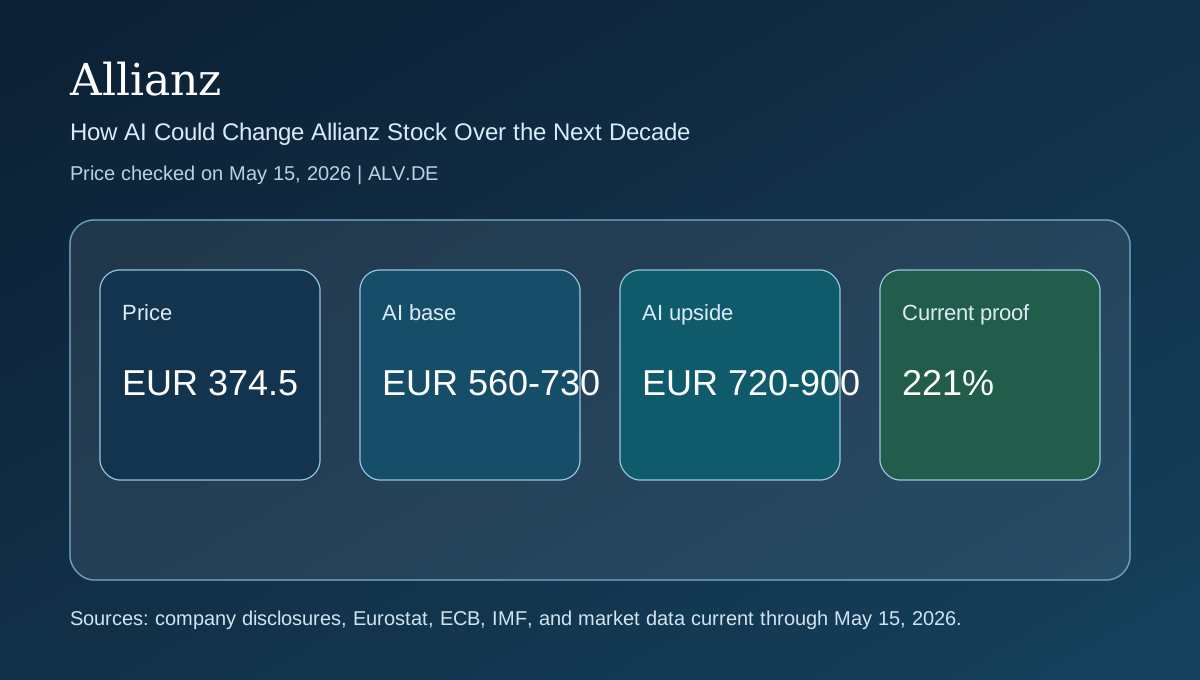
| Capital strength | Solvency II 221%; EUR 2.5 billion buyback | A strong capital base still supports dividends and buybacks | Bullish |
| Macro drag | Euro area CPI 3.0% in April 2026; GDP +0.1% q/q in 1Q 2026 | Higher claims inflation is the main external risk | Neutral |
03. Countercase
Why the AI story can still disappoint
The cleanest AI countercase is that Allianz gets the cost of AI before it gets the benefit. That can happen if technology spend rises but claims, expense, and retention metrics do not improve enough to matter.
A second risk is false precision. Insurance investors should be wary of attributing every future efficiency gain to AI when other factors such as pricing, mix, and ordinary cost control may be doing the heavy lifting.
A third risk is valuation overshoot. If the stock starts to trade more like an AI beneficiary than an insurer without a commensurate change in economics, downside can follow even if the business itself remains sound.
| Risk | Latest data | Break level | Current assessment |
|---|---|---|---|
| AI payoff risk | Management points to AI and automation, but no separate AI revenue target is disclosed | If expense or claims metrics do not improve by FY27 | Still unproven |
| Capital buffer | Solvency II at 221% | Below 210% | Comfortable |
| Regulation and cyber | AI adoption in insurance faces compliance, model-risk, and cyber controls | A step-up in remediation costs | Persistent overhang |
| Asset management cycle | 1Q 2026 third-party net inflows were EUR 45.2 billion | If flows turn negative for several quarters | Healthy today |
04. Institutional Lens
Institutional lens: what is disclosed and what is still missing
Allianz's own language on AI remains useful but limited. Management tied AI and automation to efficiency, yet stopped short of giving a separate AI revenue target or a formal AI margin bridge.
The macro anchor is less comfortable. The IMF cut its 2026 euro area growth view to 1.1% in April 2026, while Eurostat and the ECB both showed inflation pressure picking up again into April.
That is exactly why the stock should be judged against hard baselines such as solvency, expense discipline, and capital return. If AI is real, those numbers should eventually improve.
| Source | Updated | What it says | Why it matters |
|---|---|---|---|
| Allianz | February to May 2026 | Management linked AI and automation to better efficiency, but did not provide a stand-alone AI revenue target | AI should be treated as a margin lever until numbers prove otherwise |
| IMF Europe | April 17, 2026 | The IMF cut its 2026 euro area growth view to 1.1% as energy shock risk rose | Supports a cautious growth backdrop |
| Eurostat | April 30, 2026 | Euro area inflation was 3.0% in April 2026; energy inflation was 10.9% | Claims costs and discount rates remain live issues |
| ECB | Issue 3, 2026 | The ECB noted euro area GDP growth of 0.1% in 1Q 2026 and kept the deposit rate at 2.00% | No hard landing yet, but no easy macro tailwind either |
| Market data | May 15, 2026 | EUR 374.5 share price with 12.02x trailing P/E and 11.60x forward P/E | Valuation is no longer a deep-value story |
05. Scenarios
AI scenarios over the next decade
The AI scenario map should stay humble. A large insurer can benefit a lot from AI and still never deserve a technology multiple.
The real test is whether AI moves ordinary insurance metrics enough to influence valuation by the early 2030s. Until then, investors should keep the probability distribution wide.
| Scenario | Probability | Trigger | Target range | Review point | Action bias |
|---|---|---|---|---|---|
| Bull | 20% | Expense, claims, and service metrics improve by FY27 while management keeps capital strength intact | EUR 720-900 | Review after FY26 and FY27 results | Add only if the trigger is visible |
| Base | 55% | AI helps productivity, but the market still values the name as an insurer rather than a tech platform | EUR 560-730 | Review at each half-year report | Core holding or watchlist |
| Bear | 25% | AI spending becomes defensive, regulatory costs rise, or operating metrics do not improve | EUR 360-450 | Reassess immediately if the trigger appears | Reduce or stay patient |
References
Sources
- Allianz 1Q 2026 earnings release
- Allianz 4Q and 12M 2025 earnings release PDF
- Allianz Capital Markets Day 2024 targets
- Yahoo Finance 10-year chart data for ALV.DE
- Stock Analysis overview for Allianz SE
- Stock Analysis statistics for Allianz SE
- IMF Regional Economic Outlook for Europe, April 2026
- Eurostat flash estimate for euro area inflation, April 2026
- ECB Economic Bulletin Issue 3, 2026