01. Current Data
The current operating and valuation picture
| Metric | Latest figure | Why it matters |
|---|---|---|
| Share price | $298 | Sets the market starting point for all scenarios |
| Valuation | 36.18x trailing P/E | Shows how much future success is already priced in |
| Latest results | $111.2 billion revenue, up 17% year over year | Apple fiscal 2026 Q2 results, April 30, 2026 |
| EPS / margin signal | $2.01 diluted EPS, up 22% year over year | Measures whether the growth story is translating into shareholder economics |
| Capital allocation or guidance | $100 billion additional buyback authorization and 4% dividend increase | Helps define the next 12 to 24 months of the thesis |
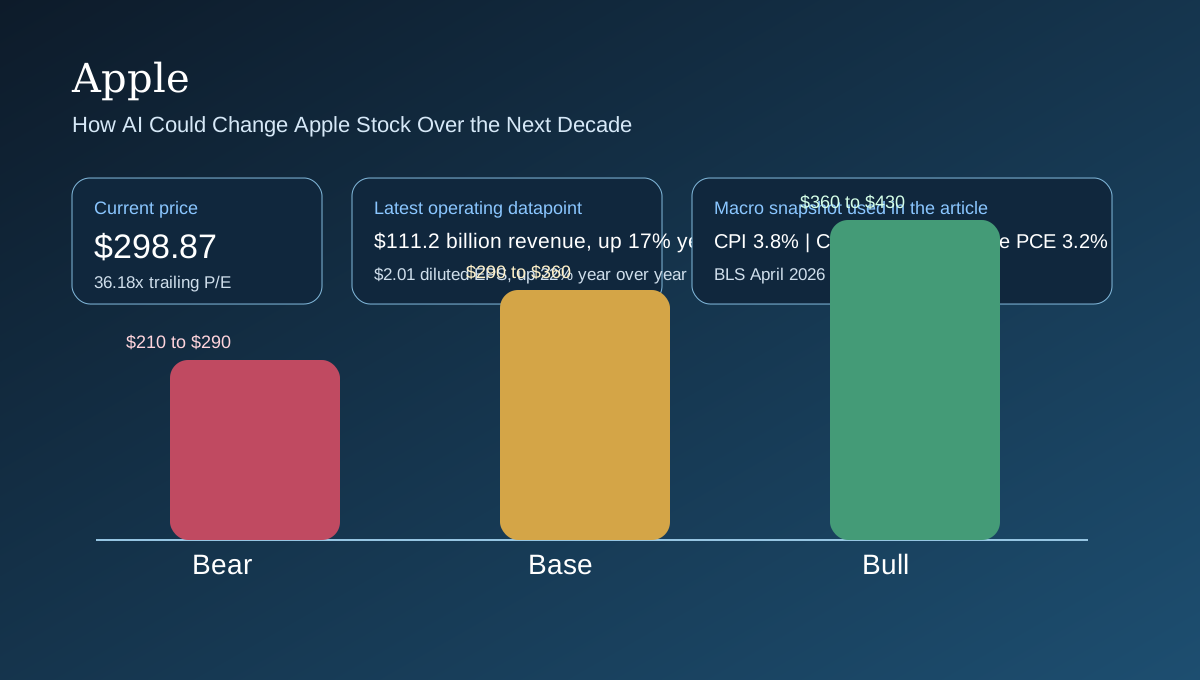
Apple should be analyzed from the current numbers outward, not from a generic narrative backward. The market is already telling you that this is a consequential business: the stock trades at $298.87, the company is valued at roughly $4.40 trillion market cap, and the latest published valuation measure available through current market data is 36.18x trailing P/E. That is a strong starting point, but it also means the stock is unlikely to be forgiving if the next operating data disappoints.
The company-specific operating picture is the real anchor. In the latest official results I found, $111.2 billion revenue, up 17% year over year. $2.01 diluted EPS, up 22% year over year. March-quarter record revenue and record iPhone revenue. $100 billion additional buyback authorization and 4% dividend increase. Those are not abstract signals. They show what is actually powering the current equity story and where investors will be most sensitive if the trend changes.
The macro overlay still matters because megacap stocks do not trade in isolation. Goldman Sachs 2026 U.S. GDP around 2.5%; IMF 2026 U.S. GDP 2.4%. April 2026 CPI 3.8% year over year; core CPI 2.8%. March 2026 headline PCE 3.5%; core PCE 3.2%. For a high-quality company with durable cash generation, that backdrop is manageable. For a richly valued stock, however, it still leaves room for multiple compression if inflation or real rates surprise in the wrong direction.
02. Key Factors
Five factors shaping the next move
The first factor is valuation discipline. A stock can keep rising while expensive, but it becomes less forgiving. In Apple's case, the current multiple means investors are implicitly assuming the business will continue delivering above-average quality or above-average growth. The second factor is estimate support. As long as management and the reported numbers keep validating the thesis, the stock can absorb a rich setup. If the earnings cadence slows, the same multiple quickly becomes a debate rather than a reward.
The third factor is AI exposure. For Apple, AI is not just a thematic talking point. It directly affects revenue mix, capex, margin durability, or competitive positioning. That is bullish when monetization is visible and dangerous when the market prices future benefits faster than operating results can catch up. The fourth factor is balance-sheet and cash-flow quality. Companies with stronger cash generation can fund AI, buybacks, and strategic pivots with less damage to shareholder economics.
The fifth factor is macro sensitivity. Even elite businesses are not immune to higher discount rates, slower enterprise budgets, weaker consumer demand, or regulatory pressure. That is why the best reading is usually neither perma-bullish nor perma-bearish. It is conditional: what would need to stay true for the stock to deserve the next rerating, and what would have to break before the stock becomes clearly vulnerable?
| Factor | Why it matters | Current Assessment | Bias | Current evidence |
|---|---|---|---|---|
| Valuation | Shows how much future success is already priced in | Demanding | - | 36.18x trailing P/E at a $4.40 trillion market cap means execution still has to stay strong |
| Recent earnings | Tests whether the operating story is still real | Positive | + | $111.2 billion revenue, up 17% year over year; $2.01 diluted EPS, up 22% year over year |
| AI exposure | Measures how much of the next leg depends on AI monetization | High but uneven | 0 | March-quarter record revenue and record iPhone revenue |
| Macro sensitivity | Captures rate and spending exposure | Mixed | 0 | Goldman Sachs 2026 U.S. GDP around 2.5%; IMF 2026 U.S. GDP 2.4%; April 2026 CPI 3.8% year over year; core CPI 2.8%; March 2026 headline PCE 3.5%; core PCE 3.2% |
| Balance of risk | Combines valuation, execution, and narrative crowding | Constructive but selective | 0 | Apple still looks like a premium quality compounder, but at more than 36 times trailing earnings the stock increasingly depends on sustained ecosystem monetization and product-cycle strength. |
03. Countercase
What could weaken the stock from here
The downside case for Apple should be connected to current evidence, not generic caution. One live risk is that inflation remains sticky enough to keep the rate backdrop less supportive than bulls want. With April 2026 CPI at 3.8% and March 2026 core PCE at 3.2%, the market still cannot assume a frictionless path to lower discount rates. That matters more when valuation is already full.
A second risk is that the stock's own success has raised the hurdle. The better the recent performance, the harder it becomes to impress investors. If revenue growth decelerates, if AI monetization broadens more slowly than expected, or if capex keeps climbing without visible return, the market can punish the stock even if the business remains good in absolute terms. A third risk is concentration of the thesis. The more one narrative dominates the premium case, the more fragile the setup becomes when that narrative is questioned.
The final risk is that the broader market stops rewarding the same style factors. High-quality compounders, AI leaders, and megacap platforms have all been major beneficiaries of the current cycle. If leadership rotates or regulation becomes more aggressive, a very good company can still see a lower stock price for longer than enthusiastic holders expect.
| Risk | Latest data point | Why it matters now | What would confirm it |
|---|---|---|---|
| Valuation pressure | 36.18x trailing P/E | A richer stock has less margin for error | A weaker report or rate repricing |
| Estimate risk | $111.2 billion revenue, up 17% year over year | The market needs good numbers to stay supportive | Slower revenue growth or softer guidance |
| AI monetization risk | March-quarter record revenue and record iPhone revenue | AI helps only if it becomes durable economics | More capex but weaker return signals |
| Macro/rates risk | March 2026 headline PCE 3.5%; core PCE 3.2% | Higher real rates can compress even strong stocks | Sticky inflation or tougher Fed pricing |
04. Institutional Lens
How current source material changes the thesis
The institutional section should stay concrete. For this batch, I am relying first on the company's own latest investor-relations release rather than pretending a bank note is more authoritative than the issuer's numbers. That gives us clean data on revenue, EPS, margin, segment growth, capex, or guidance. Where macro context matters, I am tying it to BLS, BEA, and IMF data rather than vague market commentary.
The practical conclusion is straightforward. Apple deserves a premium only if the next set of earnings keeps validating the current business momentum. If the company remains ahead on revenue quality, margin durability, and AI positioning, the premium can persist. If the market starts to see slowing growth, lower efficiency, or more expensive monetization, the stock can de-rate even if the company still looks excellent on a long-term basis.
The most useful institutional insight is therefore not a name-drop. It is the combination of current operating evidence and the macro regime in which investors are being asked to pay for future growth. That is what should guide scenario ranges from here.
| Source type | Concrete datapoint | Why it matters for the stock |
|---|---|---|
| Company IR release | $111.2 billion revenue, up 17% year over year | Shows whether current operating momentum is still intact |
| Company EPS / margin signal | $2.01 diluted EPS, up 22% year over year | Tells investors whether growth is converting into shareholder value |
| Guidance / allocation | $100 billion additional buyback authorization and 4% dividend increase | Defines the next review points for the thesis |
| Macro data | April 2026 CPI 3.8% year over year; core CPI 2.8% | Sets the valuation environment for all megacap equities |
05. Scenarios
Scenario analysis with probabilities and review points
The AI scenario is the most misunderstood because investors often confuse spending with value creation. In the best case, AI expands the revenue pool and raises productivity enough to support margins or even widen them. In the middle case, AI helps, but mainly protects the existing franchise. In the worst case, AI becomes a costly arms race that the market priced too generously too early.
That means each quarterly update should be treated as a review point. Investors need to ask whether the company is merely talking about AI or showing actual economic evidence of it. The answer determines whether the stock deserves a premium multiple or only a good business multiple.
| Scenario | Probability | Range / implication | Trigger | When to review |
|---|---|---|---|---|
| AI upside case | 40% | AI expands revenue pool and operating leverage | Trigger: accelerating AI revenue, strong demand, and manageable capex efficiency | Review every earnings cycle |
| Measured payoff | 40% | AI helps but mostly supports the existing business rather than re-rating it | Trigger: solid adoption but slower monetization than bulls expect | Review after each annual report |
| AI overbuild risk | 20% | Capex outruns return on investment and valuation cools | Trigger: margin pressure or weaker customer monetization data | Review if AI commentary remains strong but profits lag |
References