01. Historical Context
AI already changed the earnings debate around ASML
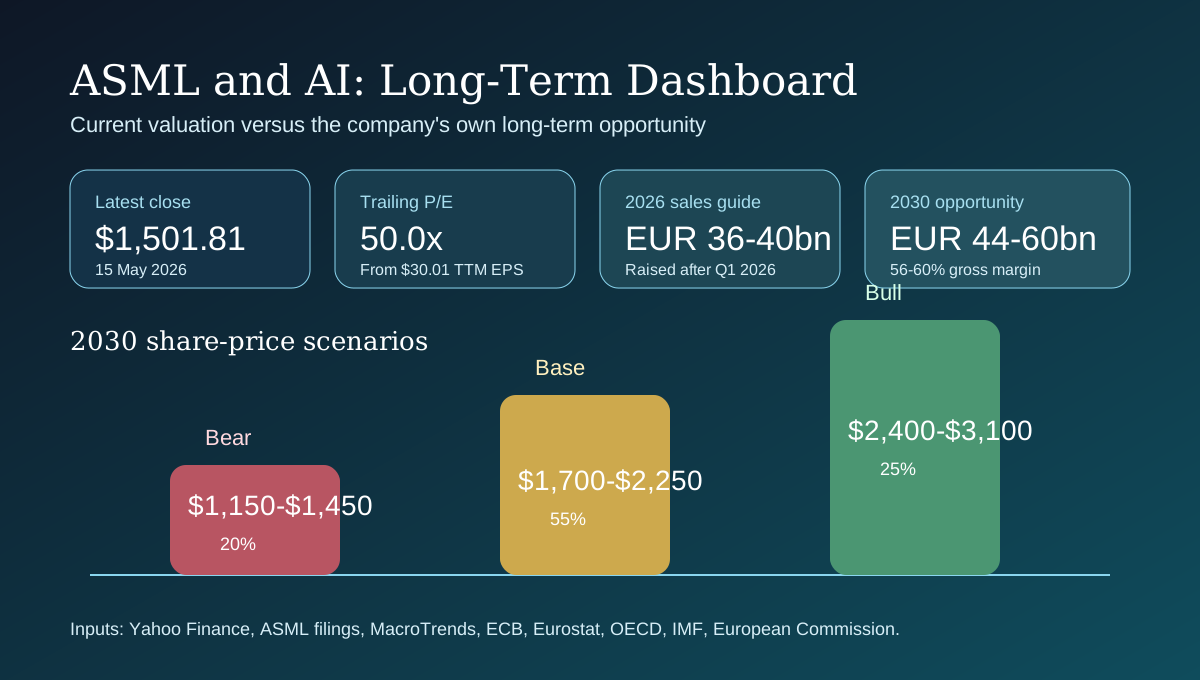
ASML is no longer a hypothetical AI beneficiary. In its 15 April 2026 Q1 results, management said the semiconductor industry's growth outlook was solidifying because of ongoing AI-related infrastructure investment, that demand for chips was outpacing supply, and that customers were accelerating capacity expansion plans for 2026 and beyond. That is a direct business statement from the company rather than an external narrative layered on top of the stock.
| Horizon | What matters most | What would strengthen the thesis | What would weaken the thesis |
|---|---|---|---|
| 1-3 months | Q2 delivery, export control messaging, and order confidence | ASML stays on track for EUR 8.4-9.0bn Q2 sales with 51-52% gross margin | Management tempers demand language or flags delayed customer spending |
| 6-18 months | Whether AI demand stays broad across Logic, DRAM and service revenue | EUV, DUV and Installed Base Management all grow into 2027 | AI demand remains too narrow or customers digest capacity after 2026 |
| To 2030 | Whether ASML converts AI into sustained lithography intensity and better mix | Revenue tracks toward the EUR 44-60bn 2030 company opportunity | Growth slows toward the low end while the multiple compresses |
The stock history explains why expectations are demanding. Yahoo Finance data show ASML closed at $1,501.81 on 15 May 2026 versus $99.21 in June 2016, a 1,413.77% gain and a 31.22% 10-year CAGR. MacroTrends shows revenue climbed from $7.52 billion in 2016 to $36.96 billion in 2025, while annual diluted EPS rose from $3.81 to $27.96 over the same period. That works out to roughly 19.36% revenue CAGR and 24.79% EPS CAGR across nine annual periods.
The implication is important. ASML does not need AI to become relevant; AI needs to keep extending a business that already compounded exceptionally well. The long-term stock thesis therefore depends on whether AI expands the addressable revenue pool enough to justify both continued earnings growth and a still-premium valuation.
02. Key Forces
Five ways AI could materially change the thesis
The first channel is direct capacity demand. In Q1 2026, ASML reported EUR 8.8 billion of sales, EUR 2.8 billion of net income and EUR 7.15 of basic EPS. Management said AI-related infrastructure investments were pushing demand above supply and driving customers to add capacity aggressively. That is the most concrete AI linkage in the stock today.
Second, AI is expanding demand on both sides of ASML's portfolio. In the investor call transcript, management said advanced Logic customers were adding capacity across multiple nodes to support next-generation high-performance computing and mobile demand, while Memory customers were sold out for the rest of the year and expected supply limitations to persist beyond 2026. That matters because ASML earns more when AI drives both advanced logic and HBM-related memory capex rather than only one side of the market.
Third, AI can improve mix as well as volume. Q1 net system sales included more than EUR 4.1 billion of EUV sales, including two High-NA systems, while Installed Base Management sales came in at EUR 2.5 billion. If customers keep pushing output, upgrades and service can become a larger and higher-margin revenue stream instead of a side business.
Fourth, AI raises ASML's long-range opportunity. ASML's 2025 Annual Report says the company sees a 2030 revenue opportunity of approximately EUR 44-60 billion with gross margin of 56-60%, based on different market and lithography-intensity scenarios. That is management's own framework for how deeper AI, logic and DRAM demand could widen the revenue pool over time.
Fifth, public policy is starting to reinforce the ecosystem. The European Commission said on 9 February 2026 that NanoIC, Europe's largest Chips Act pilot line, opened with EUR 700 million in EU funding, EUR 700 million from national and regional governments, and the remainder from ASML and other industry partners. The Commission also states the Chips Act is intended to strengthen research, manufacturing, packaging and resilience by 2030. That does not create ASML orders on its own, but it does support a more durable European semiconductor base around the company.
| Factor | Why it matters | Current assessment | Bias |
|---|---|---|---|
| AI demand | Drives customer capex and lithography intensity | Management says demand still exceeds supply and orders remain very strong | Bullish |
| Business mix | EUV and service carry higher strategic value | Q1 included over EUR 4.1bn EUV system sales and EUR 2.5bn Installed Base Management revenue | Bullish |
| Valuation | Sets the hurdle rate for future returns | Trailing P/E is about 50x, high for a capital equipment company | Bearish |
| Execution | Roadmap delivery matters more than the AI narrative alone | High-NA shipments, source power and productivity roadmap are progressing | Neutral to bullish |
| Policy and geopolitics | Export controls can affect revenue timing and customer mix | Management says 2026 guidance already accommodates potential export-control outcomes | Neutral |
The AI thesis is strongest when all five forces work together: broad customer capex, richer product mix, roadmap execution, policy support, and enough earnings growth to keep the multiple from becoming the whole story.
03. Countercase
Why the AI story can still disappoint investors
The first risk is valuation. MacroTrends shows ASML's P/E ratio at 50.55 on 7 May 2026, and a simple calculation using the latest $1,501.81 price and $30.01 TTM EPS still leaves the stock near 50 times trailing earnings. That means even strong business execution may not produce strong stock returns if the market decides the AI enthusiasm is fully priced.
The second risk is timing mismatch. In the Q1 2026 investor call, CFO Roger Dassen said free cash flow was negative EUR 2.6 billion in the quarter largely because of the timing of down payments. That is not a structural problem, but it is a reminder that reported cash generation can stay uneven even while the long-term AI thesis is intact.
Third, export controls remain a real operating variable. ASML explicitly said the bandwidth in its 2026 guidance accommodates potential outcomes of ongoing discussions around export controls. If those outcomes become more restrictive than expected, the issue may hit shipment timing, customer mix, or the path from backlog to recognized revenue.
| Risk | Latest data point | Why it matters | Current assessment |
|---|---|---|---|
| Valuation risk | About 50x trailing earnings | Leaves little room for even modest disappointments | Bearish |
| Cash-flow timing | Q1 2026 free cash flow was negative EUR 2.6bn | Can complicate the optics of the growth story between shipments and cash receipts | Neutral |
| Policy risk | 2026 guidance includes potential export-control outcomes | Can affect shipment timing and regional mix | Neutral to bearish |
| Macro rate risk | Euro area inflation rose to 3.0% in April 2026 and the ECB kept the deposit rate at 2.00% | Higher-for-longer rates would compress premium growth multiples | Bearish |
The bearish interpretation is not that AI demand disappears. It is that AI demand remains strong while the stock's multiple stops expanding, or contracts, because investors begin demanding more cash conversion and less narrative premium.
04. Institutional Lens
What serious research and official data imply for ASML
ASML's own reporting is the most useful institutional lens here. On 15 April 2026 the company raised its 2026 sales guide to EUR 36-40 billion from the EUR 34-39 billion range it gave in January, while keeping gross margin guidance at 51-53%. In January 2026 it also reported a 2025 backlog of EUR 38.8 billion and 2025 net bookings of EUR 28.0 billion. Those are the most direct indicators of whether AI demand is becoming real revenue.
For the broader AI backdrop, OECD said in April 2026 that AI could add 0.5 to 1.0 percentage point to annual labour-productivity growth in G7 economies over the next decade in a central scenario. IMF's April 2025 paper on AI and productivity in Europe estimated about 1% cumulative productivity gains over five years for Europe as a whole under its baseline assumptions. Those numbers are moderate at the macro level, which reinforces the idea that ASML's AI upside comes first through semiconductor capex, not through a broad macro boom.
Goldman Sachs Research has argued that generative AI could lift global GDP by 7% and raise productivity growth by 1.5 percentage points over a 10-year period. That is a broad macro estimate, not an ASML forecast, but it helps explain why investors still pay a premium for core AI infrastructure suppliers such as lithography leaders.
| Source family | What it said | Updated | Why it matters here |
|---|---|---|---|
| ASML | 2026 sales guide raised to EUR 36-40bn; Q2 guide EUR 8.4-9.0bn; AI demand still lifting customer capex | 15 April 2026 | Primary proof that AI is already affecting revenue visibility |
| ASML Annual Report | 2030 revenue opportunity of EUR 44-60bn with 56-60% gross margin | 2025 Annual Report | Frames the long-term upside if AI keeps increasing lithography intensity |
| OECD | AI could add 0.5-1.0 percentage point to annual labour-productivity growth in G7 economies | April 2026 | Supports a real macro tailwind, but not a reason to ignore valuation |
| IMF | Europe-wide AI productivity gain around 1% cumulatively over five years in the baseline | 4 April 2025 | Suggests macro gains may stay moderate even while ASML-specific demand is strong |
The main conclusion from credible sources is consistent: ASML has authentic AI exposure and a visible long-range revenue opportunity, but investors still need to separate business strength from the price already paid for that strength.
05. Scenarios
What AI could mean for ASML through 2030
The ranges below are author scenarios, not third-party targets. They are anchored to the latest share price, 10-year stock compounding, the current trailing P/E, management's 2026 and 2030 revenue outlook, and the current macro corridor from ECB and Eurostat data.
| Scenario | Probability | Range | Trigger conditions | When to review |
|---|---|---|---|---|
| Bear | 20% | $1,150-$1,450 | Revenue trends toward the low end of the 2030 opportunity, export controls bite harder, and the multiple de-rates toward mature semicap levels | Reassess after each annual report and any export-control change that alters customer access |
| Base | 55% | $1,700-$2,250 | ASML converts AI demand into sustained Logic, DRAM and service growth, but valuation normalizes gradually as earnings compound | Reassess after each Q1 and Q4 result cycle and when 2027-2028 capacity plans become clearer |
| Bull | 25% | $2,400-$3,100 | AI keeps tightening supply, customers accelerate EUV and High-NA adoption, and ASML tracks toward the high end of its 2030 revenue and margin opportunity | Reassess if revenue trajectory begins to imply a path toward or above EUR 60bn by 2030 |
The base case assumes ASML keeps growing, but not at the extraordinary stock CAGR of the last decade. That is the most disciplined way to use the 10-year record: it proves ASML can compound, but it does not prove a 31% annual stock return can repeat from a much larger revenue and market-cap base.
For investors, the practical question is not whether ASML belongs in the AI value chain. It clearly does. The real question is whether future earnings growth can stay large enough and long enough to keep outrunning a premium starting multiple.
References
Sources
- Yahoo Finance chart API for ASML 10-year monthly history
- Yahoo Finance chart API for ASML recent daily prices and 52-week range
- ASML Q1 2026 financial results
- ASML Q1 2026 investor call transcript
- ASML Q4 2025 and full-year 2025 financial results
- ASML 2025 Annual Report financials and 2030 opportunity
- MacroTrends ASML revenue history
- MacroTrends ASML diluted EPS history
- MacroTrends ASML P/E ratio history
- European Commission on NanoIC and Chips Act pilot-line funding
- European Chips Act overview
- OECD Foundations for Growth and Competitiveness 2026
- IMF Working Paper: AI and Productivity in Europe
- Goldman Sachs Research on generative AI and global GDP
- Eurostat flash estimate for euro area inflation in April 2026
- ECB monetary policy decision, 30 April 2026