01. Historical Context
AstraZeneca in context: what the current valuation is actually asking investors to believe
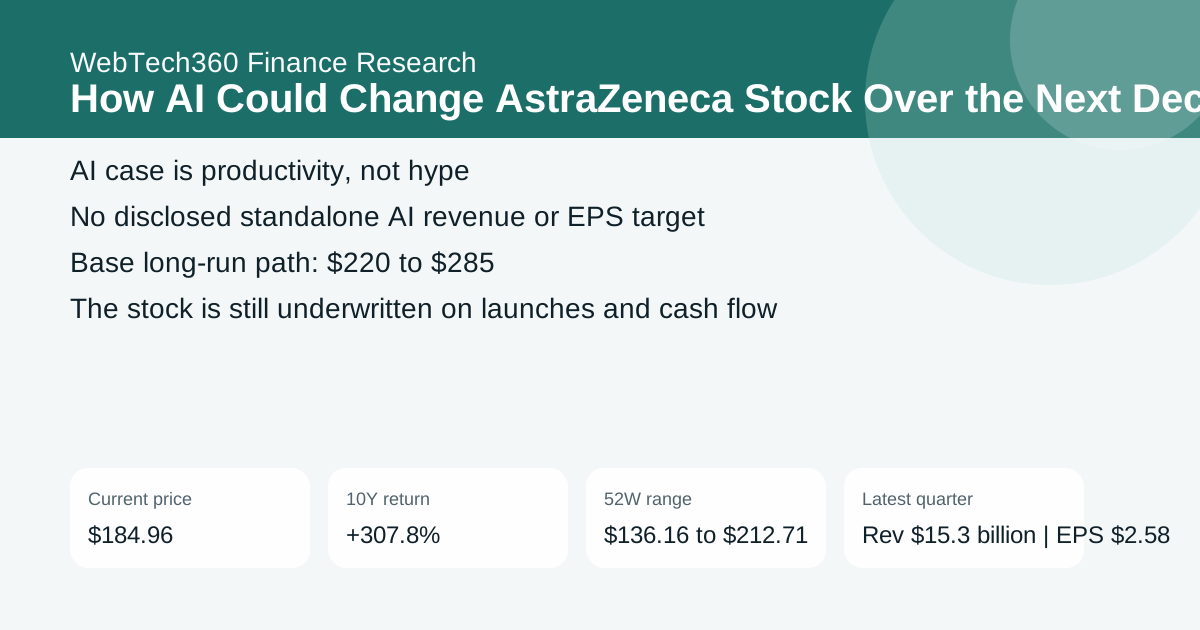
At $184.96 on May 14, 2026, the ADR already discounts a lot of success. The stock is up +307.8% from $45.36 on June 1, 2016 and has compounded at roughly 15.2% a year over the past decade.
The hard data still supports a quality story. AstraZeneca reported FY2025 revenue of $58.7 billion with +18% at constant exchange rates and core EPS of $9.16. In Q1 2026, revenue reached $15.3 billion (+13% reported, +8% at CER) and core EPS reached $2.58 (+4% reported, +5% at CER).
That is why the current debate is not whether the company is good. It is whether future launches, line extensions and indication expansions are strong enough to justify valuation that still sits near 20.2x on FY2025 core EPS and roughly 18x forward.
| Horizon | What matters now | What would strengthen the thesis | What would weaken the thesis |
|---|---|---|---|
| Next 6 months | Guidance credibility, key events, and FX | Quarterly results keep beating the implied pace | Guidance slips or a major event turns negative |
| 12-24 months | Launch quality, cash conversion, and balance-sheet pressure | New products outgrow legacy drag | Cash flow or divisional execution weakens |
| To 2030 | Sustainable EPS compounding and the multiple investors will still pay | Execution proves durable enough to hold the valuation | Execution weakens and the market stops paying a premium |
02. Key Forces
Five forces that matter most from here
AstraZeneca said in its 2025 data-science overview that AI is being embedded across discovery and development, but the company has not disclosed a standalone EPS uplift from AI adoption.
The second point is economic. AstraZeneca already produced FY2025 revenue of $58.7 billion and Q1 2026 revenue of $15.3 billion. For a company of this size, even a useful AI program has to move approval velocity, trial productivity or asset selection materially before it changes valuation in a big way.
Third, AI matters most if it improves the pipeline against time. The stock currently trades at about 20.2x on core FY2025 earnings, so investors should ask whether AI can help the company defend that multiple.
Fourth, AI could help margin structure indirectly by reducing failed projects or improving patient-selection efficiency. But AstraZeneca has not published a discrete AI revenue target or EPS uplift.
Fifth, the market is likely to overreact to AI language in both directions. The better discipline is to wait for evidence such as faster development decisions or stronger late-stage readouts.
| Factor | Current assessment | Bias | What would improve it | What would weaken it |
|---|---|---|---|---|
| Operating momentum | Latest quarter revenue was $15.3 billion after FY2025 revenue of $58.7 billion. | Constructive | Another quarter of volume and mix-driven growth | A guidance cut or weaker divisional mix |
| Earnings quality | Latest quarter core EPS was $2.58. | Constructive | Cash conversion and margin stability | One-off items start masking softer underlying demand |
| Balance sheet / cash flow | The market wants proof that earnings translate into clean cash. | Neutral | Lower leverage or better free cash flow | More cash drain, debt pressure, or legal outflows |
| Valuation | The stock trades around 20.2x on the latest core earnings base and 18x forward by current assumptions. | Neutral to rich | EPS upgrades without another multiple jump | Any sign the market already paid for perfection |
| Catalyst path | Management said in Q1 2026 that it was preparing for multiple launches and further readouts this year while remaining on track for its 2030 ambition. | Event-driven | Clear approvals, launches, or legal de-risking | A regulatory setback or delayed decision |
03. Countercase
What would break the thesis
The cleanest risk is valuation compression. Using FY2025 reported EPS of $6.60, the ADR is near 28.0x trailing earnings. Even on core EPS, the multiple is about 20.2x.
Pipeline risk is no longer theoretical. On April 30, 2026, the FDA Oncologic Drugs Advisory Committee voted 6-3 against camizestrant in the SERENA-6 setting. That does not break the long-term thesis on its own, but it shows how quickly market confidence can wobble when one of the next-wave assets disappoints.
There is also a replacement risk from loss of exclusivity and pricing pressure. If launches fail to offset those headwinds, the stock can de-rate even if headline revenue still rises.
Macro is a second-order risk rather than the main driver, but a higher discount rate still matters for a stock already priced as a premium compounder.
| Risk | Current data point | Why it matters now | Review trigger |
|---|---|---|---|
| Valuation fatigue | 28.0x trailing reported P/E and 20.2x trailing core P/E. | The stock is expensive enough that merely meeting expectations may not be enough. | A lower multiple without business deterioration would improve the setup. |
| Regulatory friction | Camizestrant received a 6-3 negative ODAC vote on April 30, 2026. | The pipeline is valuable, but not every late-stage asset will convert cleanly. | Watch the final FDA decision and any change to label scope. |
| Patent / pricing pressure | Management still frames 2026 as a year of multiple launches and offsetting LOE pressure. | If replacement assets slip, the market will likely punish the stock before reported revenue fully shows it. | Re-check after each quarterly launch update and the FY2026 report. |
| Macro / FX | IMF projects 3.1% global growth in 2026 and 4.4% headline inflation. | Higher rates and FX swings can hit reported pharma numbers even when CER trends hold. | Review after major central-bank shifts or if USD strength changes reported growth. |
04. Institutional Lens
What current institutional work adds to the analysis
Primary-source discipline matters even more in AI analysis because the hype cycle is intense.
Management still communicates the business in ordinary terms: mid- to high-single-digit Total Revenue growth at CER and low-double-digit core EPS growth at CER.
The institutional conclusion is therefore moderate: AI is a plausible long-run positive for AstraZeneca, but the stock should still be underwritten on launches, margins and cash flow until the company quantifies more.
| Source | Latest update | What it said | Why it matters |
|---|---|---|---|
| Company results | April 29, 2026 | Latest quarter delivered revenue of $15.3 billion and core EPS of $2.58. | This is the cleanest read on whether the base case is intact. |
| Annual results | February 10, 2026 | FY2025 revenue was $58.7 billion and the full-year earnings base was $9.16 core EPS with reported EPS of $6.60. | It anchors valuation work and avoids projecting from a single quarter. |
| Reuters / consensus | April-May 2026 | Reuters reported on April 29, 2026 that LSEG consensus still implies 2026 sales growth of 7.2% and profit growth of 11.2%, while analysts continue to model roughly $80 billion of sales by 2030. | This is the best public cross-check on how much good news the market already prices in. |
| IMF | April 14, 2026 | IMF said on April 14, 2026 that global growth is projected at 3.1% in 2026 and 3.2% in 2027, with headline inflation rising to 4.4% in 2026 before easing again in 2027. That matters mainly through discount rates and FX. | Macro does not drive product cycles directly, but it changes discount-rate tolerance and FX noise. |
05. Scenarios
Scenario analysis investors can actually use
Base case, probability 55%: AI helps but remains mostly an internal productivity lever. In that setup, the stock still follows something like the $220 to $285 2030 range rather than getting a distinct AI re-rating.
Bull case, probability 20%: AI meaningfully raises pipeline productivity and improves asset selection enough to support better-than-expected EPS compounding, pushing the stock toward the upper half of $300 to $375 by the turn of the decade.
Bear case, probability 25%: investors attach an AI premium that operating data never justifies. In that scenario, any disappointment in launches or trials can force a sharp multiple reset even if the core business remains healthy.
| Scenario | Probability | Stock implication | Measurable trigger | Review date | Suggested posture |
|---|---|---|---|---|---|
| AI productivity upside | 20% | Could support the upper end of $300 to $375 | Faster development cadence or repeated evidence of better portfolio selection | Annual R&D and full-year results | Treat AI as upside optionality, not base valuation |
| AI helps but does not re-rate | 55% | Keeps the stock in the broad $220 to $285 path | Guidance still driven by normal commercial execution | Every full-year report | Stay disciplined on valuation |
| AI premium unwinds | 25% | Can push the stock back toward $150 to $200 | No quantifiable evidence while the market still pays for the story | Any year with slower launches or weaker margins | Do not pay for AI twice |
References
Sources
- Yahoo Finance chart data for AstraZeneca ADR (AZN), including latest price and 10-year monthly history
- AstraZeneca FY and Q4 2025 results, February 10, 2026
- AstraZeneca Q1 2026 results announcement, April 29, 2026
- Reuters on AstraZeneca Q1 2026 results and LSEG growth expectations, April 29, 2026
- Reuters on the negative camizestrant advisory-panel vote, May 1, 2026
- IMF World Economic Outlook, April 2026
- AstraZeneca on AI-enabled drug discovery and development