01. Historical Context
AI is amplifying a business that already compounds at scale
Broadcom entered the AI cycle from a position of strength rather than reinvention. Official company disclosures show fiscal 2016 revenue of $13.24 billion and fiscal 2025 revenue of $63.89 billion, while the stock's adjusted monthly close rose from $11.89 in June 2016 to $425.19 on May 15, 2026, according to Yahoo Finance chart data. That record matters because it shows the market has been rewarding Broadcom's long-term combination of acquisition integration, high margins, and disciplined capital allocation well before AI became the dominant equity theme.
| Horizon | What matters most | Current assessment | Bias |
|---|---|---|---|
| Next 3 months | Q2 FY2026 results on June 3, 2026 and whether AI revenue meets the $10.7B guide | Expectations are high and the bar is measurable | Neutral |
| 6-18 months | Whether FY2026 revenue can approach the $107.0B Street average and sustain margins near management's 68% EBITDA guide | Demand backdrop remains favorable, but valuation leaves little room for error | Moderately Bullish |
| To 2030 | Whether Broadcom captures a larger share of AI networking, custom silicon, and private AI software spending | Business quality supports the thesis if capex converts into durable earnings | Bullish |
The AI angle is therefore not a clean-sheet story. It is an extension of Broadcom's existing franchise in switching, connectivity, custom silicon, and infrastructure software. Broadcom's March 4, 2026 earnings release reported Q1 FY2026 AI semiconductor revenue of $8.4 billion, up 106% year over year, and guided to $10.7 billion for Q2. If that trajectory holds, AI stops being a side narrative and becomes one of the largest earnings engines inside the company.
The stock also carries a much different starting point than it did earlier in the cycle. StockAnalysis showed Broadcom at 82.87x trailing earnings and 31.49x forward earnings on May 15, 2026. That valuation can still work if AI keeps expanding Broadcom's addressable market and free cash flow, but it sharply raises the cost of any execution miss.
02. Key Forces
Five ways AI could materially change the long-term thesis
The first channel is direct AI semiconductor demand. Broadcom's Q1 FY2026 AI revenue of $8.4 billion and Q2 guide of $10.7 billion point to a business that is already operating at a scale most peers are still trying to reach. That matters because AI accelerators and networking silicon carry much stronger pricing power than a vague software-adjacent AI story.
The second channel is the networking layer. Goldman Sachs Research wrote on May 12, 2026 that optical networking could see a 9x total addressable market unlock to $154 billion as AI infrastructure ramps and computing power per rack rises. Broadcom is directly exposed to that build-out through Ethernet switches, optical DSPs, and connectivity components, which makes the networking stack one of the cleanest ways AI could widen Broadcom's moat.
The third channel is hyperscaler capex. Goldman Sachs said on December 18, 2025 that Wall Street's consensus estimate for 2026 hyperscaler capital spending had risen to $527 billion from $465 billion at the start of the third-quarter earnings season, and that historical patterns suggested as much as $200 billion of upside to those estimates. Broadcom does not need all of that to materialize, but it does need the largest cloud buyers to keep funding custom silicon and high-bandwidth networking at scale.
The fourth channel is software monetization. Broadcom's VMware Cloud Foundation 9.1 release on May 5, 2026 cited a company survey showing 56% of organizations were running or planning to run production inferencing in a private cloud. That is relevant because Broadcom's post-VMware story improves if AI drives more private-cloud spending into infrastructure software that carries recurring revenue characteristics.
The fifth channel is execution credibility. Broadcom announced on March 12, 2026 that Tomahawk 6, its 102.4 Tbps switch family, had moved into production volume, and on March 11, 2026 it announced the industry's first 400G/lane optical DSP. Those releases matter less as headlines than as proof that Broadcom can translate an AI roadmap into shipping products fast enough to win the revenue pool that investors are already discounting.
| Factor | Latest evidence | Current assessment | Bias |
|---|---|---|---|
| AI demand | Q1 FY2026 AI revenue was $8.4B and Q2 guide is $10.7B | Demand is real, large, and accelerating | Bullish |
| Networking opportunity | Goldman Sachs, May 12, 2026: optical networking TAM could expand to $154B | Broadcom is well positioned in a high-value layer of AI infrastructure | Bullish |
| Software leverage | VCF 9.1 targets private AI deployment; 56% of surveyed organizations are running or planning private-cloud inferencing | VMware can add a second AI monetization leg beyond chips | Moderately Bullish |
| Valuation | 82.87x trailing P/E and 31.49x forward P/E on May 15, 2026 | Premium multiple already embeds strong execution | Bearish |
| Street expectations | Average target $457.79, median $480, high $582, 29 analysts at StockAnalysis | Upside exists, but consensus is already constructive | Neutral |
The interaction among these factors matters more than any single data point. A company can post strong AI growth and still underperform if the valuation is already too extended, while a premium multiple can remain justified if networking demand, software attach, and free cash flow all keep surprising higher together. Broadcom's long-term AI case is strongest when investors can point to both revenue scale and margin durability at the same time.
03. Countercase
What could stop AI from becoming a decade-long re-rating
The main risk is not that AI demand disappears, but that the market has pulled too much of the payoff forward. Goldman Sachs noted on December 18, 2025 that the average stock in its AI infrastructure basket had returned 44% year to date even though the consensus two-year forward EPS estimate for the group had risen only 9%. That gap is a warning that infrastructure winners can still be excellent businesses and expensive stocks at the same time.
Macro conditions are the second risk. The Bureau of Labor Statistics reported on May 12, 2026 that April CPI rose 3.8% year over year, up from 3.3% in March. The Bureau of Economic Analysis reported on April 30, 2026 that March PCE inflation was 3.5% year over year and core PCE was 3.2%, while first-quarter 2026 GDP grew at a 2.0% annualized pace and the quarterly PCE price index ran at 4.5%. If inflation remains sticky, richly valued AI infrastructure stocks can de-rate even if the demand story stays intact.
The third risk is that AI economics broaden more slowly than AI spending. Goldman Sachs itself highlighted on December 18, 2025 that AI infrastructure share prices had run far ahead of the group's two-year forward EPS revisions. Broadcom is better protected than many AI-adjacent names because it sells scarce hardware and increasingly relevant software, but it is still exposed if customers begin to ask harder return-on-investment questions after the initial build-out wave.
| Risk | Latest data | Why it matters now | Current assessment |
|---|---|---|---|
| Valuation compression | Forward P/E 31.49, trailing P/E 82.87 | Broadcom is priced for strong follow-through, not just decent execution | High risk |
| Rates and inflation | April CPI 3.8%; March core PCE 3.2%; Q1 PCE price index 4.5% | Hot inflation keeps the discount rate debate alive | Moderate risk |
| Capex fatigue | Goldman sees $527B of 2026 hyperscaler capex with room for more | If those budgets flatten, networking and custom silicon expectations fall quickly | Moderate risk |
| Consensus crowding | 29 analysts rate the stock Strong Buy on average, with a $457.79 target | A crowded bullish setup raises the penalty for a miss | Moderate risk |
The point of the countercase is not that AI cannot work for Broadcom. It is that the market has moved from asking whether Broadcom belongs in the AI trade to asking how much more upside still remains after a decade of exceptional execution and another year of rapid multiple expansion. That is a harder question.
04. Institutional Lens
What the best public research is saying right now
Broadcom's own numbers remain the core anchor. On March 4, 2026, the company reported Q1 FY2026 revenue of $19.311 billion, non-GAAP EPS of $2.05, adjusted EBITDA of 68% of revenue, and AI semiconductor revenue of $8.4 billion, then guided for Q2 revenue of about $22.0 billion and AI semiconductor revenue of $10.7 billion. That is the single most important institutional datapoint in the current bull case.
Goldman Sachs Research has been constructive on the infrastructure side of AI, but with useful nuance. On May 12, 2026 it argued that optical networking could unlock a $154 billion market, and on December 18, 2025 it said 2026 hyperscaler capex expectations had already climbed to $527 billion, with historical precedent pointing to possible upside beyond that. Those are bullish demand signals for Broadcom's networking franchise, but Goldman also explicitly flagged that valuations can run ahead of earnings in the AI infrastructure complex.
FactSet's May 8, 2026 earnings update adds context on market conditions rather than Broadcom alone. FactSet said 84% of S&P 500 companies reporting Q1 results had beaten EPS estimates and that the forward 12-month P/E for the index stood at 21.0, above both the five-year and ten-year averages. In other words, the market is still rewarding growth, but it is doing so from an already full valuation backdrop. That is favorable for Broadcom as long as AI earnings keep landing, and dangerous if they do not.
| Source | Latest update | What it said | Why it matters for Broadcom |
|---|---|---|---|
| Broadcom | March 4, 2026 | Q1 FY2026 AI revenue was $8.4B, up 106% year over year; Q2 AI guide is $10.7B | Confirms that AI is already a large reported business, not a concept |
| Goldman Sachs Research | May 12, 2026 | Optical networking could see a 9x TAM unlock to $154B | Supports the long runway for Broadcom's AI networking stack |
| Goldman Sachs Research | December 18, 2025 | Consensus 2026 hyperscaler capex rose to $527B, with possible upside beyond that | Explains why demand expectations for custom silicon and switching remain elevated |
| FactSet | May 8, 2026 | S&P 500 forward P/E was 21.0; 84% of reporters beat EPS estimates | Growth stocks still have support, but the broader market multiple is not cheap |
| IMF | April 2, 2026 | U.S. growth is projected at 2.4% in 2026, unemployment near 4%, core PCE back to 2% in 1H27 | A soft-landing macro path would be friendlier to Broadcom's premium multiple |
The institutional conclusion is clear. The demand case for AI infrastructure remains strong, but the market already knows it. For Broadcom, the next decade upside depends on sustaining reported AI revenue growth, extending product leadership deeper into networking and optics, and converting VMware into a more meaningful private-AI software franchise.
05. Scenarios
Scenario ranges, probabilities, and review points
The ranges below are house scenarios, not third-party targets. They are built from Broadcom's reported FY2025 and Q1 FY2026 results, current Street consensus for FY2026 revenue of $107.0 billion and EPS of $11.55, the FY2027 consensus revenue of $164.8 billion and EPS of $18.25, and Broadcom's current premium valuation versus the market. The goal is not precision. The goal is to define what would need to happen for the stock to earn the next leg higher or fail to do so.
| Scenario | Probability | Measurable trigger | Indicative price range | Review point |
|---|---|---|---|---|
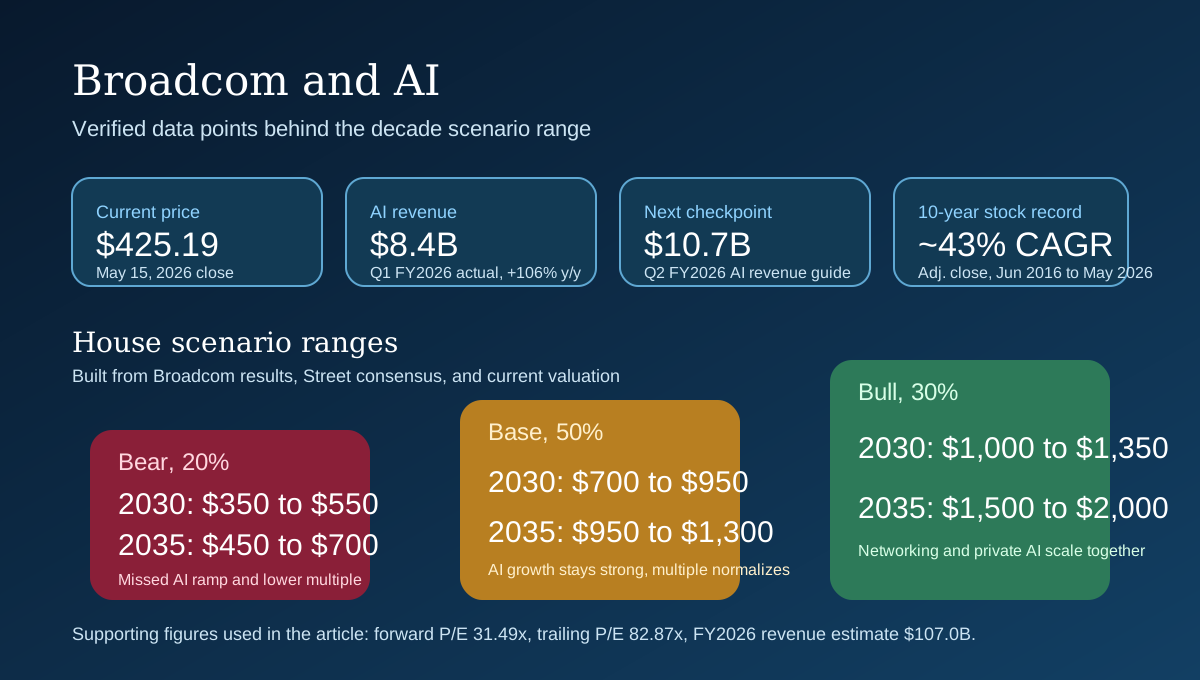
| Bear | 20% | Q2 FY2026 AI revenue misses the $10.7B guide, FY2026 EPS consensus falls below $10, and valuation compresses toward the low 20s on forward earnings | 2030: $350 to $550; 2035: $450 to $700 | Reassess after June 3, 2026 results and again after each Q4 report |
| Base | 50% | Broadcom broadly meets FY2026 and FY2027 consensus, AI networking remains a core hyperscaler spend bucket, and the multiple settles around 26x to 30x forward earnings | 2030: $700 to $950; 2035: $950 to $1,300 | Reassess every June and December as AI revenue and EPS revisions update |
| Bull | 30% | AI revenue keeps compounding above company average, VMware private-AI software scales, and Broadcom captures more of the optical and switching opportunity Goldman highlighted | 2030: $1,000 to $1,350; 2035: $1,500 to $2,000 | Reassess after each beat-and-raise cycle and each major hyperscaler capex season |
For investors, the practical takeaway is straightforward. Broadcom still looks like a credible long-duration AI compounder, but it is no longer a cheap one. The stock can justify a higher decade range if AI revenue keeps becoming a larger share of total earnings, if networking content rises with each generation of AI clusters, and if VMware helps Broadcom monetize the private-AI build-out rather than merely participate in it. If those conditions fade, valuation discipline matters more than narrative confidence.
References
Sources
- Broadcom Inc. Announces First Quarter Fiscal Year 2026 Financial Results and Quarterly Dividend, March 4, 2026
- Broadcom Inc. Announces Fourth Quarter and Fiscal Year 2025 Financial Results and Quarterly Dividend, December 11, 2025
- Broadcom Now Shipping World's First 102.4 Tbps Switch in Production Volume, March 12, 2026
- Broadcom Delivers Industry's First 400G/lane Optical DSP for Next-Generation AI Networks, March 11, 2026
- Broadcom Announces VMware Cloud Foundation 9.1, Enabling Secure and Cost-Effective Infrastructure for Production AI, May 5, 2026
- Goldman Sachs Research, Optical Networking: The Next Mega Trend in AI Infrastructure, May 12, 2026
- Goldman Sachs, Why AI Companies May Invest More than $500 Billion in 2026, December 18, 2025
- FactSet, S&P 500 Earnings Season Update: May 8, 2026
- IMF Executive Board Concludes 2026 Article IV Consultation with the United States, April 2, 2026
- U.S. Bureau of Labor Statistics, Consumer Price Index News Release for April 2026, May 12, 2026
- U.S. Bureau of Economic Analysis, Personal Income and Outlays, March 2026, April 30, 2026
- U.S. Bureau of Economic Analysis, GDP (Advance Estimate), 1st Quarter 2026, April 30, 2026
- StockAnalysis, Broadcom Statistics & Valuation, accessed May 16, 2026
- StockAnalysis, Broadcom Stock Forecast & Analyst Price Targets, accessed May 16, 2026
- Yahoo Finance chart API for AVGO 10-year monthly price history, accessed May 16, 2026