01. Historical Context
How AI enters the valuation debate for Eli Lilly
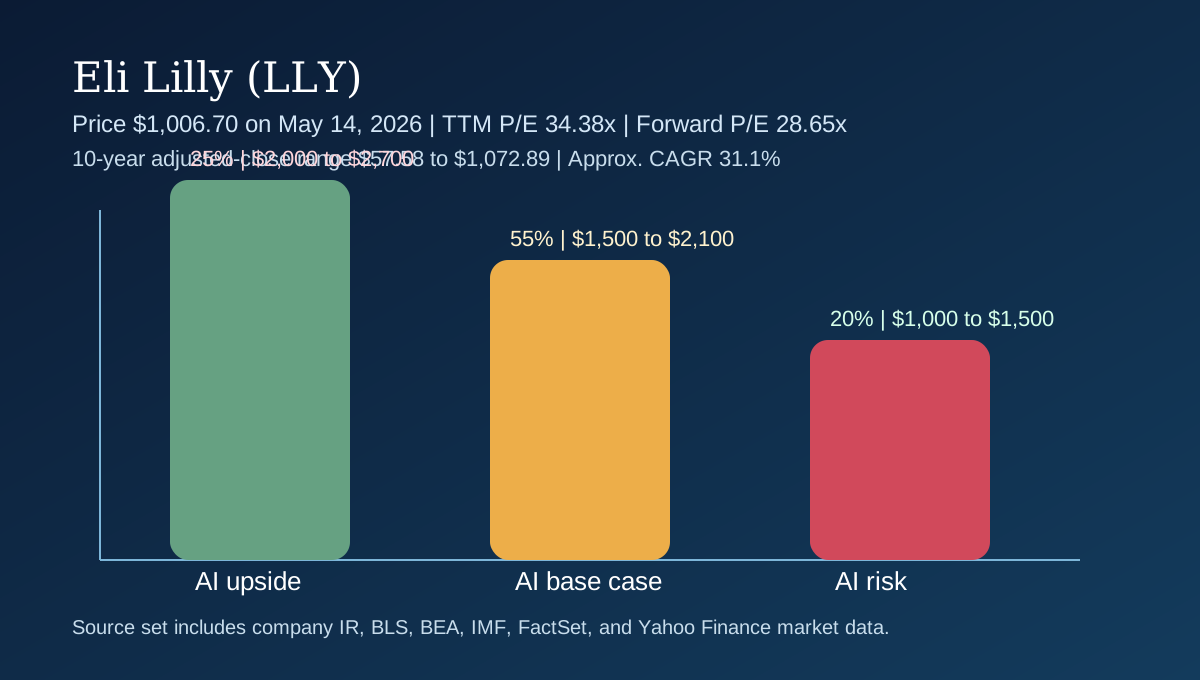
Eli Lilly closed at $1,006.70 on May 14, 2026. Over the last 10 years, adjusted monthly closes ranged from $57.58 to $1,072.89, for an approximate 31.1% compound annual return. That is the price history of a company that moved from a traditional pharma profile into a market-defining growth story.
| Horizon | What matters most | What would strengthen the thesis | What would weaken the thesis |
|---|---|---|---|
| 1-3 months | Estimate revisions, reimbursement headlines, and post-guidance price behavior | Raised 2026 guidance starts pulling 2027 EPS estimates higher | The stock stalls even after beats, signaling valuation fatigue |
| 6-18 months | Volume growth, realized pricing, and launch execution across incretins | Foundayo, Mounjaro, and Zepbound all expand the revenue base together | Growth remains concentrated while price realization weakens |
| To 2030 and beyond | Pipeline depth and manufacturing scale | Lilly adds new franchises without losing the obesity leadership premium | The market starts treating Lilly as a single-theme obesity trade |
The business data explain why. Lilly generated $65.18 billion of revenue in 2025, then delivered another $19.8 billion in Q1 2026 alone, up 56% year over year, while raising 2026 guidance to $82.0 billion to $85.0 billion and non-GAAP EPS to $35.50 to $37.00. The market is paying for continuing revision strength, not just for current scale.
AI does not replace the core thesis. For Eli Lilly, AI only matters if it changes the economics that already drive the stock: trial design, manufacturing planning, and commercial targeting. The right baseline is the current business model, not a generic technology narrative.
02. Key Forces
Five AI channels that matter, and the ones that do not
The first AI channel is trial productivity. For Lilly, faster protocol design, patient screening, and site selection matter only if they shorten time-to-data across a pipeline large enough to influence enterprise value. That is where AI can matter more than it would for a mature consumer business.
The second AI channel is manufacturing and supply planning. Lilly's obesity franchise is supply sensitive, so better forecast accuracy and plant planning can support growth indirectly by improving product availability and reducing launch friction.
The third AI channel is commercial execution. LillyDirect, large field forces, and disease-awareness campaigns create scope for AI-driven targeting, but investors should still insist on measured outcomes such as higher conversion or lower SG&A intensity, not just digital engagement statistics.
The fourth AI channel is R&D portfolio selection. In a company that already produces high-value clinical data, AI can help management allocate capital across programs more efficiently. That matters because Lilly's valuation depends on sustaining a multi-product, multi-indication growth engine well beyond one obesity cycle.
The fifth AI channel is market psychology. At 28.65x forward earnings, Lilly does not need AI excitement to justify the stock. AI only deserves valuation credit if it clearly accelerates drug development, manufacturing throughput, or launch productivity relative to peers.
| Factor | Current data | Current assessment | Bias |
|---|---|---|---|
| Valuation | Trailing P/E 34.38x; forward P/E 28.65x versus S&P 500 20.9x | Premium is lower than peak levels but still demanding | Neutral |
| Guidance | 2026 revenue $82.0 billion to $85.0 billion; non-GAAP EPS $35.50 to $37.00 | Raised guidance materially improved the base case | Bull |
| Product momentum | Q1 revenue $19.8 billion (+56%); Mounjaro $8.66 billion; Zepbound $2.31 billion | Still exceptional | Bull |
| Macro | CPI 3.8%; PCE 3.5%; core PCE 3.2%; GDP 2.0% | Higher-for-longer rates can still pressure multiples | Neutral |
| Execution concentration | Key products revenue $13.4 billion in Q1 2026 | Powerful growth engine, but concentration risk is real | Neutral to Bull |
This setup should be read as a probability distribution, not a slogan. The stock can still work from here, but the next return profile will be determined by how these factors interact, not by brand strength alone.
03. Countercase
What would break the thesis
The first AI risk is that investors over-credit a support function. AI can improve execution, but Lilly's value still depends primarily on molecules, approvals, and commercial adoption. If the market pays a second premium for AI on top of an existing pharma-growth premium, expectations can outrun reality.
The second AI risk is that internal productivity gains are hard to verify externally. Unless Lilly discloses faster cycle times, better trial completion, or lower commercial friction, investors may have no clean way to distinguish genuine AI leverage from normal operating excellence.
The third AI risk is compliance and data governance. In healthcare, AI deployment has tighter constraints than in digital advertising or consumer apps, so the payoff can be slower and more operational than investors initially expect.
The fourth AI risk is valuation overlap. A stock at 28.65x forward earnings does not need another narrative premium layered on top of the obesity and pipeline story; if that happens, de-rating risk rises.
| Investor type | Main risk | Suggested posture | What to monitor next |
|---|---|---|---|
| Already profitable | Giving back gains on a valuation reset | Keep a core, but cut exposure if revisions stop improving | 2026 and 2027 EPS revisions after each quarter |
| Currently losing | Confusing a slower stock with a weaker company | Average only if guidance and pipeline evidence remain strong | Revenue mix, pricing, and manufacturing commentary |
| No position | Chasing a premium healthcare leader after a beat | Scale in only when price and estimate trends align | Forward P/E, reimbursement headlines, and product uptake |
The point of the countercase is not to force a bearish conclusion. It is to define the specific evidence that would make the current base case too optimistic.
04. Institutional Lens
What the current institutional data actually say
Lilly's institutional setup is stronger than the broad macro narrative because company data have been overpowering market noise. On April 30, 2026, Lilly raised 2026 guidance to $82.0 billion to $85.0 billion of revenue and $35.50 to $37.00 of non-GAAP EPS after Q1 revenue grew 56% to $19.8 billion. Institutional investors care about that because it is a revision event, not just a beat.
Macro still matters. IMF lowered the global growth path to 3.1% for 2026 and 3.2% for 2027 on April 14, 2026, while BLS and BEA showed CPI at 3.8% and headline PCE at 3.5%. That backdrop argues against indiscriminate multiple expansion, which is why Lilly's stock can still be volatile even when the operating story is excellent.
FactSet's May 1, 2026 earnings update showed the Health Care sector as one of the largest positive contributors to revenue growth since March 31, even though the sector's earnings picture was mixed. That distinction matters for Lilly: the company is driving strong top-line momentum in a market that is still selective about how much premium it will pay for growth.
| Source | Latest update | What it says | Why it matters here |
|---|---|---|---|
| IMF | April 14, 2026 | Global growth projected at 3.1% for 2026 and 3.2% for 2027 | Defines the macro corridor for demand and discount rates |
| BLS | May 12, 2026 | CPI 0.6% month over month and 3.8% year over year in April 2026; core CPI 2.8% | Shows how much rate pressure may still matter for valuation |
| BEA | April 30, 2026 | Headline PCE 3.5% and core PCE 3.2% in March 2026; GDP 2.0% annualized in Q1 2026 | Tracks inflation persistence and growth resilience |
| FactSet | May 1, 2026 | 84% of reporting S&P 500 companies beat EPS; blended Q1 growth 27.1%; forward P/E 20.9x | Measures whether the tape still rewards premium equities |
| Eli Lilly | April 30, 2026 | Q1 revenue $19.8 billion; 2026 non-GAAP EPS guidance $35.50 to $37.00 | Company baseline for scenario ranges |
| FDA | April 1, 2026 | Approved Foundayo (orforglipron) for obesity and overweight with comorbidities | Expands the oral GLP-1 pathway in the base and bull cases |
The useful takeaway is that institutional data are not pointing in one direction only. They support owning quality, but they do not support ignoring valuation or timing risk.
05. Scenarios
Actionable scenarios with probabilities, triggers, and review points
The AI angle should be judged by whether it improves pipeline productivity or commercial efficiency fast enough to matter at enterprise scale.
That is a higher bar than a normal narrative catalyst, so the scenarios below intentionally stay tied to observable outcomes.
| Scenario | Probability | Target range | Activation trigger | Review point |
|---|---|---|---|---|
| AI upside | 25% | $2,000 to $2,700 | AI shortens trial cycles, improves patient finding, and increases commercial productivity enough to add durable operating leverage to Lilly's pipeline engine. | Recheck against disclosed R&D productivity and launch cadence. |
| AI base case | 55% | $1,500 to $2,100 | AI helps execution, but the stock still depends far more on drug launches, manufacturing scale, and reimbursement than on an AI rerating. | Recheck after each major investor meeting. |
| AI risk | 20% | $1,000 to $1,500 | AI remains incremental, not transformative, while investors keep demanding proof that tools change time-to-market or SG&A efficiency. | Recheck if AI messaging rises but operating leverage does not. |
The scenarios are intentionally range-based because a stock this widely followed can overshoot in both directions. What matters is whether the evidence set is moving toward the bull, base, or bear path when each review point arrives.
That approach makes the article more useful in practice: it gives readers a checklist for when to add, when to wait, and when to reduce risk.
References
Sources
- Yahoo Finance 10-year monthly chart data for Eli Lilly (LLY)
- Yahoo Finance quote page for Eli Lilly (valuation measures and analyst targets)
- Eli Lilly Q4 2025 earnings release and initial 2026 guidance
- Eli Lilly Q1 2026 earnings release and raised 2026 guidance
- Eli Lilly investor relations income statement summary
- FDA approval announcement for Foundayo (orforglipron)
- BLS Consumer Price Index News Release for April 2026
- BEA Personal Income and Outlays for March 2026
- BEA GDP advance estimate for Q1 2026
- FactSet S&P 500 Earnings Season Update, May 1, 2026
- FactSet estimate revision update, May 5, 2026
- IMF World Economic Outlook, April 2026