01. Historical Context
How AI enters the valuation debate for HSBC Holdings
HSBC is one of the few large global banks that now gives investors enough disclosed AI detail to treat the topic as financially relevant. The stock at 1,317p still trades like a bank, not like an AI proxy, which is the right starting point.
The official disclosures are concrete. HSBC says it already has more than 600 AI use cases in operation, more than 20,000 developers using coding assistants with 15% efficiency gains, and a generative AI servicing assistant supporting 3 million client interactions a year while 88% of clients rate the bank easy to deal with. HSBC also announced AI partnerships with Mistral AI in December 2025 and Harvey AI in February 2026.
That matters because a bank of HSBC's scale does not need AI to invent a new business model to create value. It only needs AI to improve productivity, speed and client conversion across a very large installed base.
| Horizon | What matters now | Current datapoint | What would strengthen the thesis |
|---|---|---|---|
| 1-3 months | Quarterly execution versus guidance | HSBC reported Q1 2026 profit before tax of USD 9.4 billion, profit after tax of USD 7.4 billion, revenue of USD 18.6 billion and annualised RoTE of 17.3%. | The next result still tracks or beats management guidance. |
| 6-18 months | Valuation versus estimates | MarketScreener showed HSBC on about 13.2x 2025 earnings, 11.2x 2026 earnings and 9.84x 2027 earnings. Using the current London price and those forward P/E ratios implies roughly 117.6p of 2026 EPS and 133.8p of 2027 EPS, or about 13.8% growth. | Consensus earnings keep rising while the stock does not need an aggressive rerating. |
| To 2035 | Structural profitability | 10-year range 300.5p to 1,393.1p; 10-year CAGR 11.0%. | Capital returns, book-value growth and operating discipline remain intact. |
02. Key Forces
Five ways AI could materially change the thesis
The first AI channel is developer productivity. A 15% coding-efficiency gain across more than 20,000 developers compounds into faster systems change and lower friction across the bank.
The second is client servicing. Supporting 3 million interactions a year is already big enough to affect turnaround times and client retention economics.
The third is risk and credit workflow. HSBC says it is using generative AI to support credit-analysis write-ups, which matters because underwriting speed affects lending throughput and client experience.
The fourth is cost leverage. Large banks rarely get a dramatic one-quarter boost from AI, but they can get persistent medium-term savings if workflows are redesigned successfully.
The fifth is revenue quality. Better service and better credit workflow can help fee growth and relationship depth in wealth and corporate banking even if AI is not sold directly to customers.
| Factor | Current Assessment | Bias | Why it matters now |
|---|---|---|---|
| AI scale | 600+ AI use cases in operation | Bullish | This is not pilot-stage experimentation. |
| Developer productivity | 20,000+ developers using coding assistants with 15% efficiency gains | Bullish | A scaled productivity benefit can matter meaningfully over time. |
| Client service | 3 million annual client interactions supported; 88% of clients rate HSBC easy to deal with | Bullish | This can support retention and fee growth. |
| Credit workflow | AI already supports credit-analysis write-ups | Bullish | Better process speed matters in banking. |
| Direct monetization | No stand-alone AI revenue line | Neutral | Value still needs to show up through margins, costs and client metrics. |
03. Countercase
Why the AI story can still disappoint investors
The AI bear case is that productivity gains stay real but modest. Banks can save time without changing earnings quality enough to warrant a higher multiple.
A second risk is compliance friction. The larger the bank, the more governance, legal and model-risk layers stand between a pilot and a group-wide economic payoff.
A third risk is that AI arrives during a softer rate and credit cycle, which makes it harder for investors to separate technology gains from ordinary banking noise.
| Risk | Latest datapoint | Current assessment | Bias |
|---|---|---|---|
| Revenue translation | Still indirect | Unproven as a stand-alone stock driver | Neutral |
| Governance burden | Large bank, heavy controls | Real implementation drag | Neutral |
| Cycle interference | NII and ECL still dominate near-term earnings | AI benefits can be obscured | Neutral |
| Scale advantage | HSBC already deploys AI at meaningful volume | Important offset | Bullish offset |
04. Institutional Lens
What the better AI evidence actually supports
HSBC's AI case is grounded in its own disclosures, which is the right way to handle this topic. The company has scale metrics, productivity metrics and active partnerships rather than vague innovation language.
The IMF's April 2026 warning that disappointment over AI productivity remains a macro downside risk is still relevant. Investors should assume the same skepticism applies at company level until savings and revenue quality show up clearly in reported numbers.
The institutional conclusion is balanced: AI can improve HSBC's operating profile over time, but the stock still has to earn that through better costs, better service metrics and better cross-sell economics.
| Source | Latest update | What it says | Why it matters here |
|---|---|---|---|
| MarketScreener, May 2026 | MarketScreener's May 2026 HSBC consensus page showed 17 analysts with an average target price of USD 18.87 on the ADR, versus USD 18.20 at the quoted last close, with a high target of USD 23.06 and a low target of USD 10.54. | The Street is constructive, but the average target only implies modest ADR upside from recent trading levels. | That tells you HSBC is not a deep-value cleanup story anymore; execution matters more than multiple rescue. |
| Bank of England, April 2026 | Bank Rate was maintained at 3.75% by an 8-1 vote. | The BoE is still not rushing into a deep easing cycle. | That helps explain why HSBC's banking NII guidance stayed robust. |
| ONS, March 2026 | UK CPIH was 3.4% and UK GDP rose 0.6% over the three months to March. | Inflation is still above target, but growth has not rolled over. | That is supportive for deposit-rich UK banking franchises, though it does not remove credit risk. |
| IMF, April 2026 | Global growth is projected at 3.1% in 2026 and 3.2% in 2027, with downside risks dominating. | The IMF sees a slower but still positive global backdrop, with war, fragmentation and tighter conditions as the main threats. | That matters for HSBC because Asia, the UK and global trade flows all drive its earnings mix. |
05. Scenarios
What AI means for long-term investors
For investors, the correct way to model AI at HSBC is as a multiplier on the existing bank rather than as a separate theme. The valuation benefit should appear gradually through efficiency, client satisfaction and process speed.
Review the thesis when HSBC starts giving more measurable AI-linked cost or service disclosures, and when investors can compare those gains against the next full rate cycle.
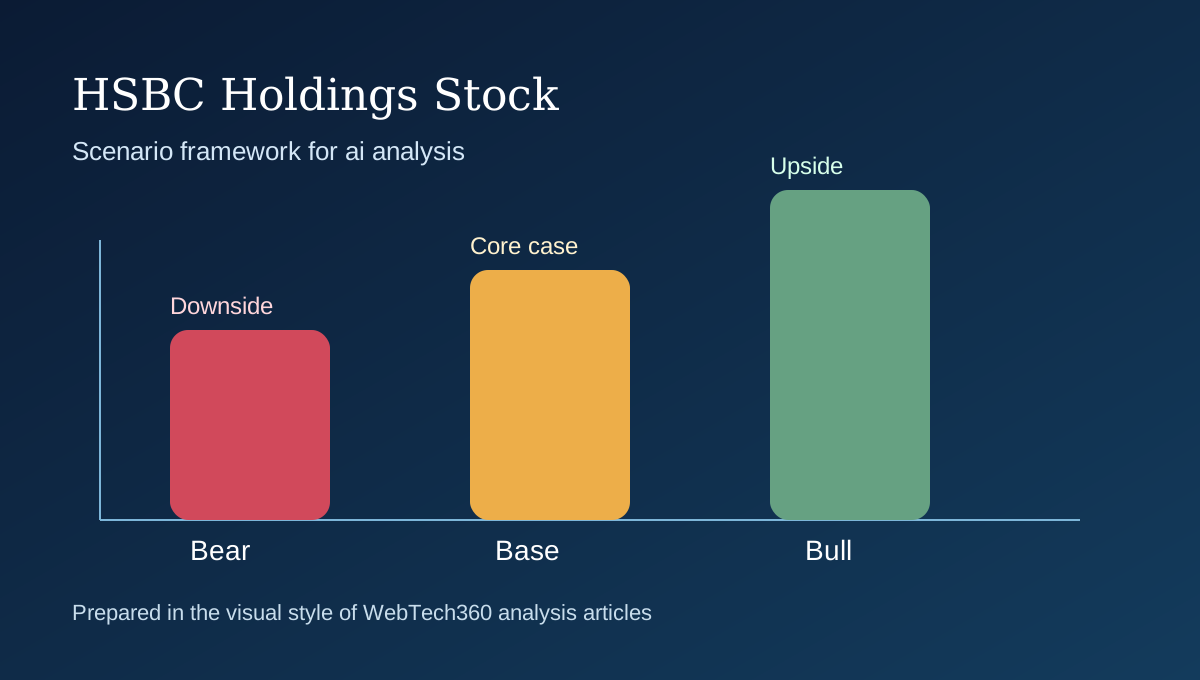
| Scenario | Probability | Target range | Trigger | When to review |
|---|---|---|---|---|
| AI upside | 30% | 1,900p to 2,400p by 2035 | AI meaningfully improves efficiency, client retention and underwriting speed, supporting better long-term returns on equity. | Review annually and after strategic updates. |
| AI base case | 50% | 1,550p to 2,000p by 2035 | AI helps productivity, but the stock still trades mainly on normal banking variables. | Review after each annual report. |
| AI disappointment | 20% | 1,100p to 1,500p by 2035 | AI gains prove too incremental to offset ordinary banking-cycle pressures. | Review if disclosures stay vague and benefits remain hard to measure. |
References
Sources
- Yahoo Finance chart endpoint for HSBC Holdings (HSBA.L), used for current price and 10-year range
- HSBC Holdings plc 1Q 2026 Earnings Release, published May 5, 2026
- HSBC Holdings plc Annual Results 2025, published February 25, 2026
- HSBC 1Q 2026 quick read
- Bank of England Monetary Policy Summary, April 2026
- ONS Consumer price inflation, UK: March 2026
- ONS GDP monthly estimate, UK: March 2026
- IMF World Economic Outlook, April 2026
- MarketScreener HSBC analyst consensus
- MarketScreener HSBC valuation page
- HSBC page on transforming HSBC with AI
- HSBC and Mistral AI partnership announcement, published December 1, 2025
- HSBC announcement on Harvey AI, published February 12, 2026