01. Historical Context
IBEX 35 is not a pure AI benchmark, so AI has to work through the index's existing winners
The AI debate for IBEX 35 starts with index math. BME's public factsheet, updated on 19 December 2025, shows Santander at 16.99% of the index, Iberdrola at 13.93%, BBVA at 13.05% and Inditex at 11.91%. Those four names alone account for 55.88% of the benchmark. If AI improves Spanish equity returns over the next decade, it will most likely do so by raising productivity, risk control, customer targeting, and infrastructure demand inside those large incumbents rather than by turning the benchmark into a direct AI proxy.
| Horizon | What matters most | What would strengthen the thesis | What would weaken the thesis |
|---|---|---|---|
| 1-3 years | Corporate adoption, subsidy deployment, and earnings proof | Spanish firms keep lifting AI usage, RedIA projects convert into orders, and heavyweights show measurable productivity gains | AI spending rises, but margins and free cash flow do not improve |
| To 2030 | Diffusion beyond large corporates | AI use spreads from large firms into mid-sized and smaller companies while grid and semiconductor projects stay funded | Adoption remains concentrated in a few large companies and public programmes stall |
| To 2035 | Whether AI changes index-level earnings growth | Financials, utilities, travel tech, and telecoms all convert AI into durable cost or revenue advantages | Benefits stay too narrow to offset the index's heavy bank and energy concentration |
The valuation starting point is supportive, but the public data are incomplete in one important respect. On 16 January 2026, BME said Spanish equities were trading on 13 times earnings, 2.3 points below their 37-year average, with an average dividend yield of 4.1%, one of the highest in the world. The public factsheet does not publish a live index-level forward EPS estimate, so the clean public valuation anchors remain P/E, dividend yield, sector mix, macro data, and the latest results from the benchmark's heaviest constituents.
Price history also matters. Yahoo Finance chart data show IBEX 35 at 17,622.7 on 15 May 2026, 5.12% below its 52-week high of 18,573.8 and 28.28% above its 52-week low of 13,737.2. The index is therefore not starting from a distressed base. AI needs to improve the long-run earnings path enough to sustain gains from a level that is already near cycle highs.
02. Key Forces
Five ways AI could materially change the decade-long thesis
First, Spain's corporate AI adoption is rising, but it is still far from economy-wide. ONTSI said in April 2025 that 11.4% of Spanish companies with 10 or more employees used AI in 2024, up from 9.6% in 2023. The same report showed a large dispersion by size: 44% of large companies used AI, versus 20.6% of medium-sized firms, 8.6% of small firms, and 7% of micro-enterprises. That gap is the core opportunity and the main constraint. The IBEX 35 benefits much more if AI spreads into the supplier base and the domestic economy than if it stays concentrated in large corporates.
Second, Spain already has a broader digital base than the pure AI number suggests. ONTSI's European comparison tool shows that 62.4% of Spanish businesses used AI, cloud computing, or data analytics in 2025, versus 63.2% for the EU27. That is useful because AI diffusion rarely begins from zero. Existing cloud, data, and analytics capability makes later AI adoption cheaper and faster.
Third, public policy is leaning into the theme. Spain's government approved PERTE Chip with a public budget of EUR 12.25 billion through 2027 to build domestic microelectronics and semiconductor capacity. Red.es said on 9 October 2025 that its RedIA programme received 1,048 applications worth more than EUR 884 million, with an average project size of EUR 839,000. On 3 March 2026, the government also announced EUR 100 million for Spanish companies developing projects tied to European digital sovereignty through IPCEI-AI. Those figures do not guarantee stock-market upside, but they do show that AI investment is being pushed through both industrial policy and corporate funding channels.
Fourth, the listed benchmark already contains businesses that could monetize AI indirectly. Santander reported on 29 April 2026 that first-quarter underlying profit was EUR 3.6 billion, revenue rose 4%, costs fell 3%, and underlying EPS increased 17% as transformation efforts continued. BBVA said on the same day that first-quarter attributable profit was EUR 2.989 billion, up 10.8% in current euros. Iberdrola reported adjusted net profit of EUR 1.865 billion, up 11%, and upgraded its full-year adjusted net profit growth guidance to more than 8%, helped by network investment. Inditex said in its 2025 annual report that revenue reached EUR 39.9 billion, net profit EUR 6.2 billion, and that it was integrating the latest technology across stores, e-commerce, and logistics. None of that proves an AI rerating today. It does show that several large IBEX constituents already have the scale and operating discipline needed to turn AI from a tool into earnings leverage.
Fifth, the macro productivity upside is real but modest unless adoption broadens. IMF Working Paper 2025/067 found that Europe's medium-term productivity gains from AI are likely to be around 1% cumulatively over five years in the baseline case. The same IMF research said national and EU rules around AI safety, data privacy, and occupation-level requirements could reduce those gains by over 30% under a lower-exposure scenario. In a separate speech on 3 February 2026, IMF Managing Director Kristalina Georgieva said AI could lift global productivity by up to 0.8 percentage points per year with the right policies. That is the decade-long upside range investors are trying to price, but the public research is clear that the base case is still conditional.
| Factor | Why it matters | Current assessment | Bias |
|---|---|---|---|
| Index mix | Determines whether AI can move the whole benchmark or only selected stocks | Financials are 36.34% of the index and oil and energy 20.04%; top four weights total 55.88% | Neutral to bearish |
| Corporate adoption | Broad use is needed for economy-wide productivity gains | 11.4% of Spanish firms with 10+ employees used AI in 2024, up from 9.6% in 2023 | Neutral |
| Policy support | Public funding can accelerate infrastructure and experimentation | PERTE Chip totals EUR 12.25bn and RedIA attracted 1,048 projects worth more than EUR 884m | Bullish |
| Listed execution | Heavyweights need to convert technology into profit, not just capex | Santander, BBVA, Iberdrola, and Inditex all reported solid recent operating or profit growth | Neutral to bullish |
| Productivity evidence | Institutional research sets the realistic ceiling for index-level upside | IMF baseline is about 1% cumulative productivity gain over 5 years for Europe, with large regulatory sensitivity | Neutral |
The most realistic AI bull case for IBEX 35 is therefore a layered one. Infrastructure and capital-light digital leaders deliver first, banks and utilities use AI to improve productivity and risk management next, and only then does the broader domestic economy raise the benchmark's long-run earnings trend.
03. Countercase
Why the AI story can still disappoint long-term investors
The first risk is slow diffusion. Spain may have an improving digital base, but only 11.4% of companies with 10 or more employees used AI in 2024. The gap between 44% adoption in large firms and 8.6% in small firms shows how much real-world rollout is still missing. If AI stays concentrated in big incumbents, the IBEX 35 will still have beneficiaries, but the benchmark-wide effect will be much smaller than a broad AI narrative suggests.
The second risk is that regulation and governance reduce the speed of monetization. Spain has tried to position itself as an early, rules-based AI jurisdiction through AESIA, the Spanish AI supervisory agency, and through pilot environments around AI oversight. That can build trust, but it can also slow deployment if compliance costs rise faster than measurable productivity gains. IMF research is explicit that regulation can materially reduce the growth dividend.
The third risk is benchmark concentration. The IBEX 35 remains dominated by banks, utilities, consumer leaders, and cyclical sectors. Even if AI helps Indra, Amadeus, Telefonica, or selected industrial names, the overall index will still be driven heavily by bank margins, energy regulation, consumer demand, and the euro area macro cycle. AI has to improve those bigger pools of earnings to change the index meaningfully.
The fourth risk is the current macro backdrop. INE said Spain's CPI inflation was 3.2% in April 2026 and HICP was 3.5%, while Eurostat estimated euro area inflation at 3.0%, with energy inflation at 10.9%. Banco de España's March 2026 projections put Spanish GDP growth at 2.3% for 2026 and HICP at 3.0%. If inflation stays sticky, discount rates do not fall much further and the market becomes less willing to pay for long-dated AI optimism.
| Risk | Latest data point | Why it matters | Current assessment |
|---|---|---|---|
| Adoption gap | 11.4% of firms with 10+ employees use AI; small firms are only at 8.6% | Shows how far Spain still is from economy-wide deployment | Bearish |
| Regulatory drag | IMF says European productivity gains could be reduced by more than 30% in a lower-exposure regulatory scenario | Limits how fast AI can lift earnings at scale | Bearish |
| Benchmark concentration | Financials are 36.34% of IBEX 35 and the top four weights account for 55.88% | Narrow AI winners may not be large enough to rerate the whole index quickly | Neutral to bearish |
| Macro and inflation | Spain CPI 3.2%, Spain HICP 3.5%, euro area inflation 3.0%, ECB deposit facility 2.00% | Sticky inflation can delay easier policy and cap long-duration reratings | Bearish |
| Execution gap | RedIA attracted 1,048 proposals worth more than EUR 884m, but applications are not the same as listed earnings | Interest is strong, but the profit conversion test still lies ahead | Neutral |
The long-term AI thesis only becomes robust when these risks remain manageable and the proof points broaden across more than a handful of constituents. Without that, AI helps a slice of the index rather than reshaping the benchmark.
04. Institutional Lens
What serious public and institutional research actually says
The cleanest institutional read-through is more restrained than the market narrative. IMF work supports a positive but moderate Europe-wide productivity uplift. Banco de España still sees Spain outperforming much of the euro area, but with inflation above target in 2026. BME sees Spanish equities as cheap relative to history and to other developed markets. J.P. Morgan Asset Management sees European earnings revisions stabilising and banks still offering strong cash returns. Put together, those sources support a disciplined bull case for AI in the IBEX 35, not a euphoric one.
One point matters especially for valuation discipline: public BME materials and public bank commentary do not provide a clean, up-to-date index-level forward EPS estimate for IBEX 35. That means the best public institutional lens today is still built from P/E, dividend yield, earnings revision direction, macro forecasts, and constituent results. It is enough to frame the opportunity honestly, but not enough to justify invented precision.
| Source | What it said | Date | Read-through for IBEX 35 |
|---|---|---|---|
| IMF Working Paper 2025/067 | Europe's AI productivity gains are likely to be around 1% cumulatively over five years; regulation could reduce them by more than 30% | 4 April 2025 | Supports a real but moderate baseline uplift unless adoption improves materially |
| IMF Managing Director speech | With the right measures, AI could raise global productivity by up to 0.8 percentage points per year | 3 February 2026 | Defines the upside tail if Spain executes well on adoption and infrastructure |
| Banco de España | Projects Spain GDP growth of 2.3% in 2026, HICP of 3.0%, and unemployment of 9.9% | 27 March 2026 | Spain still has macro support, but sticky inflation limits how much rerating can come from lower rates alone |
| BME / Spain Investors Day | Spanish equities were trading on 13x earnings, 2.3 points below their 37-year average, with a 4.1% average dividend yield | 16 January 2026 | IBEX 35 starts from a relatively undemanding valuation base, which helps if AI lifts earnings |
| J.P. Morgan Asset Management | Europe's 2026 EPS estimate is now being revised up; European banks trade at 1.1x book and offer 8% shareholder yield | 2026 outlook page available in May 2026 | Important for IBEX 35 because banks dominate the index and remain central to any AI productivity payoff |
The institutional conclusion is clear. AI can raise the ceiling for the IBEX 35, but the benchmark only captures that ceiling if diffusion broadens, regulation stays workable, and the current heavyweight constituents convert technology spend into better earnings and cash flow.
05. Scenarios
Actionable long-term scenarios through 2035
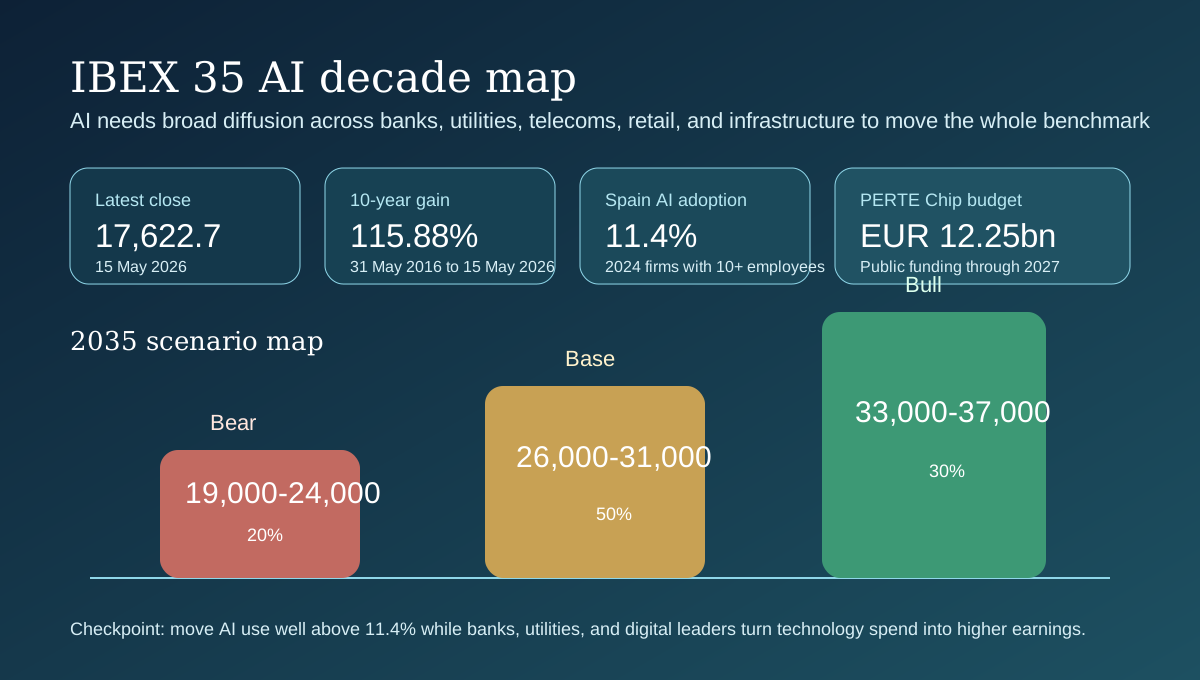
The ranges below are author estimates based on the current IBEX 35 level of 17,622.7, the index's 115.88% ten-year gain, BME's January 2026 valuation reference of 13x earnings and 4.1% dividend yield, the latest public sector weights, Spain's AI adoption data, and the institutional research cited above. They are not third-party price targets.
| Scenario | Probability | 2035 range | Trigger conditions | When to review |
|---|---|---|---|---|
| Bull | 30% | 33,000-37,000 | Spain's AI adoption rate moves well above the current 11.4%, public programmes such as PERTE Chip and RedIA produce listed earnings winners, and banks, utilities, and digital platforms convert AI into sustained margin or revenue gains | Review annually after ONTSI adoption updates, BME index reviews in June and December, and each full-year reporting season |
| Base | 50% | 26,000-31,000 | AI improves productivity in large incumbents, but the gains remain strongest in banks, utilities, travel tech, and retail while the broader economy adopts more slowly | Review each year and again at the end of the current PERTE Chip funding window in 2027 |
| Bear | 20% | 19,000-24,000 | Adoption stalls near current low-teen levels, regulation or compliance eats into the payoff, and AI benefits remain too narrow to offset normal cyclical pressure in banks and energy | Review early if corporate AI spending keeps rising through 2027-2028 while margins, free cash flow, and consensus earnings stop improving |
The practical conclusion is that AI should be read as a sector-rotation and productivity story first, and only then as a benchmark story. The IBEX 35 does have several possible beneficiaries, but the whole index is only meaningfully re-shaped if those gains spread beyond a narrow set of large incumbents.
The decade bull case is plausible because Spain combines relatively cheap equity valuations, heavy bank and utility weights that can monetize efficiency gains, and visible public support for digital infrastructure. It is not automatic because the current adoption rate is still low and because public institutional research still points to a modest Europe-wide baseline payoff.
References
Sources
- Yahoo Finance chart API for IBEX 35 10-year monthly history
- Yahoo Finance chart API for IBEX 35 latest daily price metadata
- BME IBEX 35 factsheet, data updated as of 19 December 2025
- BME Spain Investors Day market valuation note, 16 January 2026
- ONTSI: Indicadores de uso de inteligencia artificial en España 2024
- ONTSI PDF: Indicadores de uso de inteligencia artificial en España 2024
- ONTSI European comparison: companies using artificial intelligence
- Red.es RedIA call update, 9 October 2025
- Government of Spain approval of PERTE Chip, 24 May 2022
- Government of Spain announcement on EUR 100 million for AI digital sovereignty projects, 3 March 2026
- IMF Working Paper: AI and Productivity in Europe
- IMF speech on AI and countries' preparedness, 3 February 2026
- Banco de España macroeconomic projections, March 2026
- INE national accounts release for the first quarter of 2026
- INE CPI and HICP release for April 2026
- Eurostat flash estimate: euro area inflation in April 2026
- European Central Bank key interest rates page
- J.P. Morgan Asset Management: global ex-US equities outlook
- Santander Q1 2026 results
- BBVA Q1 2026 earnings release
- Iberdrola Q1 2026 results update
- Inditex Annual Report 2025 CEO statement