01. Historical Context
LVMH has disclosed AI infrastructure, but not AI monetization targets
LVMH's official digital careers materials describe group-wide digital, data, CRM, cybersecurity, omnichannel, IT, and AI capabilities, and its public AI job postings describe an AI Factory built to create and deploy high-impact AI solutions across the value chain. Those disclosures confirm AI is strategically relevant inside the group. They do not, however, provide a public revenue or EPS bridge for AI.
| Horizon | What matters most | What would strengthen the thesis | What would weaken the thesis |
|---|---|---|---|
| Next 12 months | Evidence of better clienteling and execution | AI tools improve conversion, inventory, or service quality | AI remains mostly organizational language |
| 2027-2030 | Whether AI deepens the luxury moat | AI strengthens personalization without hurting exclusivity | Benefits are generic and widely shared across competitors |
| Beyond 2030 | Whether AI changes long-run economics | Higher margins and better demand capture become measurable | AI spend becomes another cost layer without clear payoff |
The right way to read this is that AI can strengthen the investment case, but it should not replace the core luxury-demand thesis unless the company starts disclosing harder financial evidence.
02. Key Forces
Five ways AI could matter for LVMH without becoming a separate business line
First, AI can improve clienteling. For a luxury group, better product recommendations, CRM, and service customization can matter a lot because small changes in conversion and retention compound at high gross margins.
Second, AI can improve inventory, merchandising, and supply-chain decisions. That matters because luxury groups benefit from tighter stock discipline and fewer merchandising errors.
Third, AI can speed internal workflows. LVMH's AI Factory job description explicitly frames AI as a cross-value-chain capability, which suggests the effort is operationally broad rather than narrow.
Fourth, AI can strengthen the digital moat without directly boosting revenue. A better omnichannel experience and better data use can support brand desirability and conversion, even if management never breaks AI out financially.
Fifth, valuation discipline still dominates the stock. At about 20.5x 2026 earnings and with no public AI profit bridge, LVMH is still valued mainly on the luxury cycle, not on an AI premium.
| Factor | Current Assessment | Bias | Why it matters now |
|---|---|---|---|
| Disclosed AI infrastructure | Official materials describe AI Factory and group digital capabilities | Mild Bullish | Shows AI deployment is real inside the organization |
| Public AI KPI disclosure | No stand-alone AI revenue or EPS target disclosed | Neutral | Prevents a clean AI-only rerating case |
| Clienteling potential | AI can support personalization and omnichannel execution | Mild Bullish | Luxury margins reward better service and demand capture |
| Valuation | Stock still trades on luxury-cycle expectations | Neutral | AI is not yet the main reason investors own the shares |
| Brand and governance risk | Luxury positioning makes trust and execution critical | Neutral to Bearish | Poor AI deployment can hurt rather than help perceived exclusivity |
The practical point is that AI could make LVMH a better operator before it becomes a more obviously AI-linked stock.
03. Countercase
Why the AI story can still disappoint investors
The first limitation is evidence. LVMH has disclosed capability building, but not a quantified AI financial contribution. Without that bridge, AI cannot justify a major premium on its own.
The second limitation is that AI does not solve weak demand by itself. If Fashion & Leather Goods stays soft, better internal tooling will not fully offset slower luxury spending.
The third limitation is diffusion. Other luxury houses can also adopt similar tools, which means AI may improve the whole industry's efficiency without dramatically widening LVMH's competitive gap.
| Risk | Latest data point | Current Assessment | Bias |
|---|---|---|---|
| No quantified AI KPI | No public AI revenue or EPS target as of May 2026 | The biggest limitation today | Bearish |
| Demand still dominates | Q1 2026 organic growth only 1% | Luxury demand remains the main valuation driver | Neutral to Bearish |
| Competitive diffusion | AI tools are broadening across sectors | Can reduce differentiation if everyone catches up | Neutral |
That is why the AI thesis should be treated as an enhancer of the core case, not a substitute for it.
04. Institutional Lens
What the current research backdrop implies for AI-sensitive investors
The most important external lesson is that LVMH is still being valued on demand, not on AI hype. MarketScreener's targets and EPS path are built around the recovery in the luxury cycle, not around any public AI monetization metric.
That fits the macro backdrop as well. The IMF highlighted the risk that AI productivity gains disappoint globally, which is a reminder that capability building alone should not be turned into a valuation shortcut. For LVMH, AI matters if it improves execution and demand capture, not because the acronym is fashionable.
| Source | Updated | What it says | Why it matters here |
|---|---|---|---|
| LVMH digital materials | 2026 | AI and digital capabilities are being scaled across the group | Confirms AI adoption is real |
| LVMH AI job posting | April 1, 2026 | AI Factory aims to deploy high-impact solutions across the value chain | Shows AI is being operationalized, not just discussed |
| Public company disclosures | May 2026 status | No stand-alone AI revenue or EPS bridge | Limits the case for a separate AI premium |
| IMF WEO | April 14, 2026 | AI productivity disappointment is a downside risk | Reinforces the need for hard evidence |
The institutional reading is therefore disciplined: AI can improve LVMH's competitive quality, but the stock should still be underwritten mainly on luxury demand and earnings.
05. Scenarios
What AI means for the stock over time
| Scenario | Probability | Trigger | Target range | Review point |
|---|---|---|---|---|
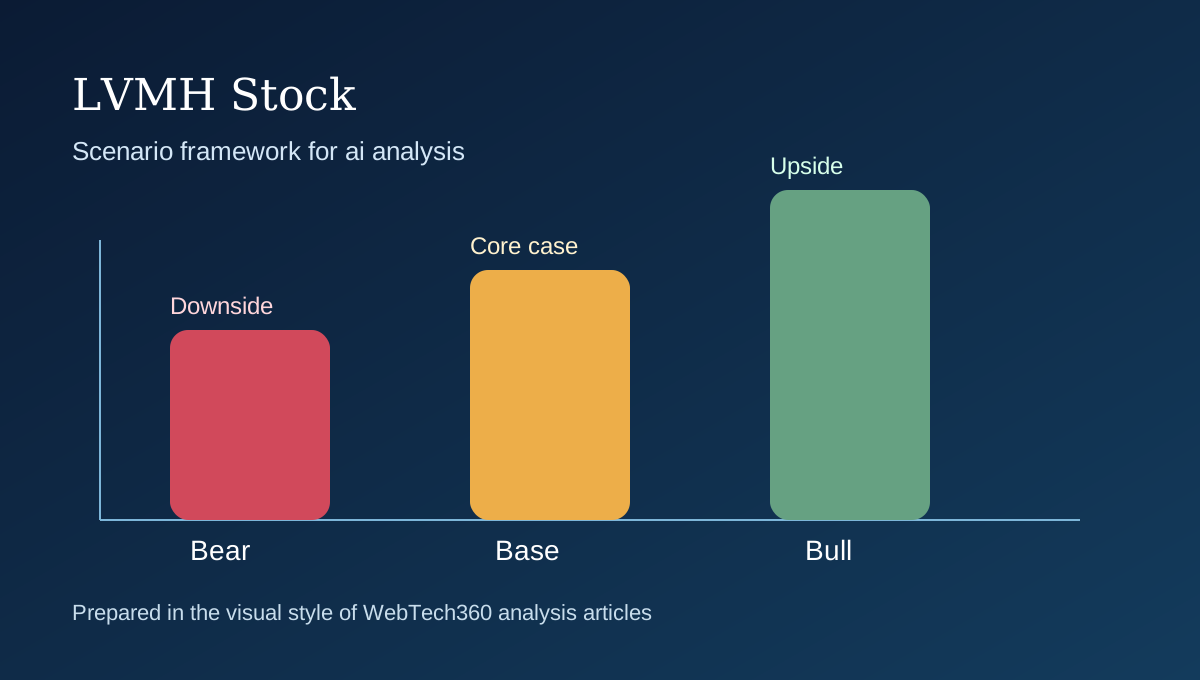
| Bull | 25% | AI materially improves clienteling, inventory precision, and service quality while the luxury cycle also recovers | EUR620 to EUR760 | Review after annual reports and any future disclosure of AI-linked KPIs |
| Base | 45% | AI remains a useful execution tool but the stock still trades mainly on core luxury demand | EUR520 to EUR640 | Reassess after FY2026 and FY2027 results |
| Bear | 30% | AI benefits remain hard to measure and the luxury cycle stays softer than expected | EUR360 to EUR470 | Review if there is still no measurable AI operating evidence over the next two annual cycles |
The base case remains that AI helps LVMH execute better, but the stock's long-run outcome will still be decided primarily by luxury demand and the health of the core division.
References
Sources
- Yahoo Finance 10-year chart data for MC.PA
- LVMH 2025 full-year results
- LVMH Q1 2026 revenue update
- LVMH digital careers and capability overview
- LVMH Head of AI Solutions job posting
- MarketScreener earnings estimates for LVMH
- IMF World Economic Outlook, April 2026
- Bain luxury market outlook after 2025 stabilization