01. Historical Context
AI matters only if it changes the cash-flow path
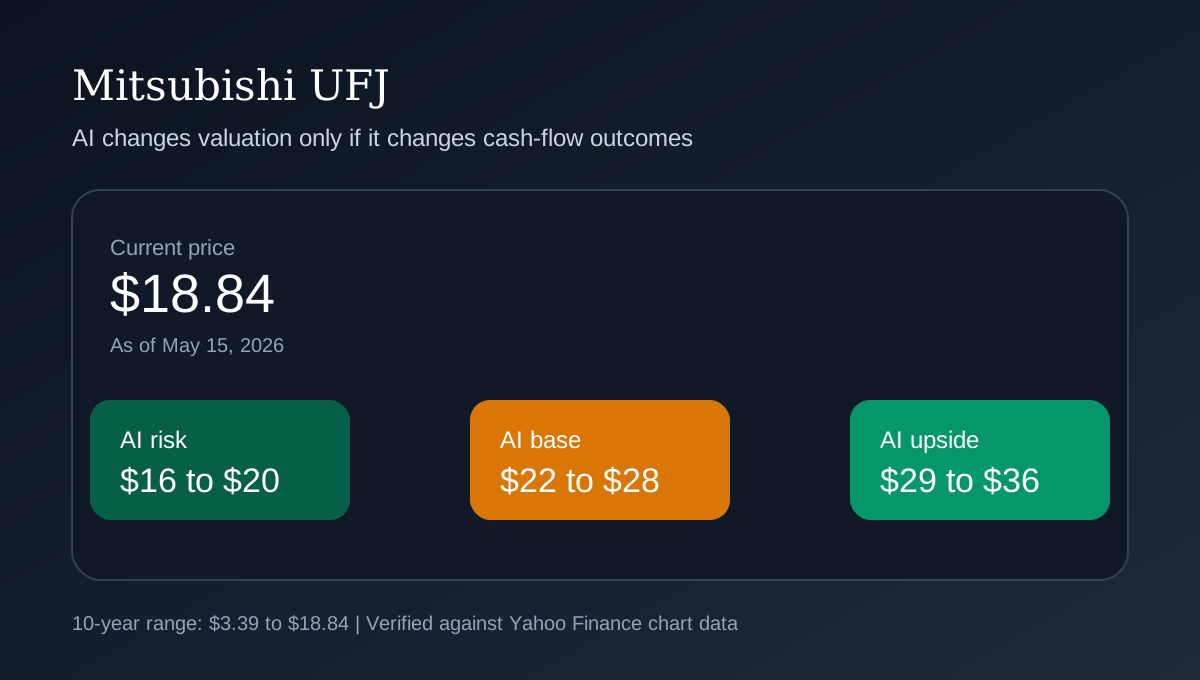
Mitsubishi UFJ trades at $18.84 as of May 15, 2026. Over the last 10 years the ADR ranged from $3.39 to $18.84, so the stock has already proven it can compound, but it is now much closer to the upper end of that long-cycle range than to the floor.
AI is a secondary, not primary, valuation driver for MUFG. The more realistic path is modest productivity gains in back office, compliance, and customer analytics rather than a sudden new revenue engine.
That is why the AI article uses the same valuation anchors as the standard stock articles: current price, current earnings, long-run trading history, and verified company disclosures.
| Horizon | What matters most | What would strengthen the thesis | What would weaken the thesis |
|---|---|---|---|
| 1-3 months | Price action versus $18.84 and the next guidance update | Revisions stabilize and the stock holds support | Price breaks support and revisions weaken |
| 6-18 months | Delivery against earnings guidance and margin resilience | Revenue and profit stay within management guidance bands | Guidance is cut or key segments miss |
| To 2030 | Capital allocation, valuation, and industry structure | Execution compounds and valuation stays disciplined | The thesis becomes too dependent on multiple expansion alone |
02. Key Forces
The five AI channels that can actually matter
The first AI channel is productivity. If AI lowers cost-to-serve, development time, defect rates, or back-office intensity, the impact can be real even without a headline AI product.
The second channel is product mix. AI can change what customers are willing to pay for, which matters more for valuation than vague claims about innovation.
The third channel is capital allocation. AI can help only if the company does not overspend relative to the eventual cash return.
The fourth channel is competitive structure. AI sometimes strengthens incumbents, but sometimes lowers barriers and compresses margins.
The fifth channel is macro spillover. IMF and BOJ work matters here because AI optimism can alter growth, capex, and rate expectations before it alters company earnings.
| Factor | Why it matters | Current assessment | Bias | What would change it |
|---|---|---|---|---|
| Valuation | Trailing P/E 15.1x to 17.2x across Yahoo Finance quote mirrors we verified in 2026; forward P/E about 12x on Yahoo Finance key statistics snapshots available in 2026 | Still investable, but less forgiving if execution slips | Neutral to bull | A cheaper entry or faster earnings growth would improve it |
| Earnings setup | TTM EPS $1.09; 1-year target estimate $17.47 | Upside exists, but the target needs earnings delivery to close the gap | Neutral | Upward estimate revisions would turn this more bullish |
| Macro | IMF sees Japan growth slowing to 0.8% in 2026, while the BOJ is still normalizing policy. | Japan is still growing, but the corridor is narrower than in 2024 | Neutral | A cleaner growth and inflation mix would help |
| 10-year trend | Range $3.39 to $18.84; total return about 359% | Long-run compounding is proven, so the debate is about entry and slope | Bull | A break below long-cycle support would weaken that read |
| Catalysts | Earnings, guidance, capital return, and policy | Plenty of review points remain on the calendar | Neutral | A positive guidance revision or a policy surprise would matter |
03. Countercase
Why the AI story can still disappoint
The simplest risk is that AI becomes a cost center rather than a monetization engine.
The second risk is that the market pays for AI optionality before the company can show measurable returns.
The third risk is that AI changes investor language faster than it changes the income statement, leaving the stock vulnerable to a narrative reset.
| Risk | Latest data point | Current assessment | Bias |
|---|---|---|---|
| Valuation reset | Trailing P/E 15.1x to 17.2x across Yahoo Finance quote mirrors we verified in 2026 | Not expensive enough to panic, but no longer gives a free pass | Neutral |
| Guidance risk | AI should help only if management can show measurable operating benefits. | The next 12 months matter because management has already set a clear bar | Bearish if missed |
| Macro slowdown | Macro optimism around AI does not remove normal business-cycle risk. | A softer Japan or global demand backdrop would pressure multiples and estimates | Neutral to bear |
| Narrative fatigue | Narrative premiums can reverse faster than real productivity gains appear. | If the story stops improving, the stock can de-rate even with okay results | Neutral |
04. Institutional Lens
Institutional lens on AI and valuation
The right institutional question is not whether AI sounds important. It is whether AI changes durable earnings power enough to alter the valuation range.
The macro backdrop is unusually important for MUFG. IMF staff said on April 3, 2026 that Japan growth should slow to 0.8% in 2026, while the BOJ has continued the process of withdrawing accommodation. For a diversified bank, that mix can still support net interest income, but it also raises the risk that slower activity eventually offsets margin gains.
For this reason the AI conclusion here is intentionally conservative: treat AI as an upside modifier unless the company starts reporting hard evidence that AI is changing margins, demand, or capital efficiency.
| Source | What it said | Why it matters here | Updated |
|---|---|---|---|
| Company filings | Reuters reported on May 15, 2026 that MUFG posted record annual net profit of yen 2.43 trillion for the year ended March 2026, up about 30% year over year, and set a new earnings target of yen 2.7 trillion for the year ending March 2027. Earlier, MUFG had revised its March 2025 profit target up to yen 1.86 trillion and its annual dividend to yen 64 per share. | This is the anchor for the operating case | May 15, 2026 |
| IMF Japan Article IV | The macro backdrop is unusually important for MUFG. IMF staff said on April 3, 2026 that Japan growth should slow to 0.8% in 2026, while the BOJ has continued the process of withdrawing accommodation. For a diversified bank, that mix can still support net interest income, but it also raises the risk that slower activity eventually offsets margin gains. | Defines the macro corridor that should frame valuation | April 3, 2026 |
| Bank of Japan | The BOJ continued policy normalization in 2026 instead of returning to emergency settings. | Critical for discount rates and bank or exporter sentiment in Japan | 2026 releases |
| Yahoo Finance | Live quote pages showed price $18.84, TTM EPS $1.09, and long-run price history. | Useful for valuation framing and long-cycle context | May 15, 2026 |
05. Scenarios
How AI changes the scenario map
These ranges do not assume that AI alone causes a rerating. They assume AI matters only if it improves the underlying operating story.
Review the thesis when the company starts giving concrete AI cost, revenue, or product metrics rather than narrative claims.
| Scenario | Probability | Trigger and target range | Review point |
|---|---|---|---|
| Bull case | 25% | AI improves productivity or mix and the market eventually capitalizes that into a higher earnings range; target range $29 to $36 | Reassess when management discloses measurable AI outcomes or major AI capex |
| Base case | 45% | AI helps operations modestly but does not justify a stand-alone rerating; target range $22 to $28 | Reassess when management discloses measurable AI outcomes or major AI capex |
| Bear case | 30% | AI spend runs ahead of returns or the narrative premium fades; target range $16 to $20 | Reassess when management discloses measurable AI outcomes or major AI capex |
References
Sources
- Yahoo Finance quote page for MUFG
- Yahoo Finance 10-year chart endpoint for MUFG
- MUFG shareholder return page, accessed May 2026
- MUFG revision of earnings target and dividend forecast, published April 30, 2025
- Reuters on MUFG FY2026 profit and FY2027 target, published May 15, 2026
- IMF Article IV for Japan, published April 3, 2026
- Bank of Japan statements on monetary policy, 2026 releases