01. Historical Context
Where AI already appears in the Nestle story
Nestle has already disclosed several AI programs, but the key point is what it has not disclosed. The company has highlighted AI-powered digital twins for marketing content, a digital core upgrade built to enable AI and automation at scale, and broad use of AI in supply chain, factories, and marketing. It has also said around 85% of procurement teams now use an AI-enabled tool on more than 40% of purchasing spend. What it has not done is publish a stand-alone AI revenue target or a quantified AI earnings bridge.
That makes the right framing straightforward. AI is part of the long-term operating toolkit, not yet a separable valuation pillar. Nestle's CFO said in the 2025 annual review that the company is using AI to better understand the lead indicators driving the profit and loss statement. That is useful, but it is not the same as proving a large new revenue pool.
| Area | Published evidence | Current assessment | Bias |
|---|---|---|---|
| Marketing content | AI-powered digital twins announced June 11, 2025 | Real and specific, with efficiency implications | Bullish |
| Digital core | SAP-based upgrade announced October 23, 2025 | Enables automation and better data use at scale | Bullish |
| Procurement | About 85% of teams use the tool on more than 40% of spend | Tangible workflow adoption rather than concept-stage AI | Bullish |
| Financial disclosure | No AI-specific revenue or margin target published | Limits how far valuation should move on narrative alone | Neutral to bearish |
02. Key Forces
Five ways AI could actually matter to shareholders
The most credible AI channel is efficiency. Nestle's digital twins program is designed to create localized marketing assets faster and more cheaply across many formats. The digital core upgrade is supposed to improve decision-making, accelerate product launches, and enable automation across the value chain. Those benefits can matter a lot over ten years even if they never show up as a separate line item.
The second channel is operating speed. Nestle's own disclosures point to AI being used in factories for energy, asset, performance, and food-safety optimization. Over a decade, that is more likely to improve gross margin stability and working-capital discipline than to invent an entirely new business.
| AI factor | Current data point | Current assessment | Bias |
|---|---|---|---|
| Content efficiency | Digital twins for Purina, Nescafe Dolce Gusto, and Nespresso | A real cost and speed lever for marketing execution | Bullish |
| Operations and factories | AI used across more than 300 factories according to Nestle's Frontier Firm AI disclosure | Likely to support efficiency more than revenue | Bullish |
| Procurement workflow | About 85% of teams use AI on more than 40% of spend | Shows meaningful adoption depth | Bullish |
| Disclosure quality | No AI-specific P&L target published | Prevents an aggressive AI rerating today | Neutral |
| Valuation impact | Current Nestle thesis still rests on margins, cash flow, and categories | AI should be treated as an enhancer, not the core case | Neutral |
03. Countercase
Why the AI thesis could disappoint
The main risk is over-attribution. A company can adopt AI broadly and still fail to create meaningful shareholder value if the gains are incremental, hard to measure, or reinvested immediately into other cost lines. Nestle's disclosures are promising, but they remain mostly operational in nature.
The second risk is that investors pay twice for the same benefit. If a margin recovery later comes from procurement, content, and factory efficiency, it would be wrong to call all of that "AI upside" if the savings were already embedded in the broader transformation plan and the CHF 3 billion cost-savings goal.
| Risk | Latest data point | Why it matters | Bias |
|---|---|---|---|
| No direct monetization disclosure | No public AI revenue target | Makes a stand-alone AI valuation premium difficult to defend | Bearish |
| Execution opacity | AI benefits are described qualitatively in most disclosures | Without milestones, investors may overestimate timing | Bearish |
| Savings overlap | CHF 3 billion savings plan already exists without being labelled as AI-only | Some AI upside may already be part of the base transformation case | Neutral |
| Core business still dominates | 2025 results still centered on sales, RIG, margin, and FCF | AI cannot outrun category execution in the near term | Neutral |
04. Institutional Lens
The realistic institutional lens on AI at Nestle
The best institutional read is not that Nestle becomes an AI stock. It is that Nestle becomes a slightly better operating stock because AI improves speed, asset reuse, and decision quality. The company's own disclosures support that interpretation more than any aggressive top-line AI story.
That matters for valuation. If AI lifts efficiency and the company's broader transformation also works, long-range upside improves. If investors try to assign a software-style AI premium to a consumer-staples business without hard P&L evidence, the stock becomes easier to overpay for.
| Source and date | What it said | Specific number | Why it matters |
|---|---|---|---|
| Digital twins announcement, June 11, 2025 | AI helps create localized product visuals faster and more cheaply | 250 marketing experts, 7 hubs, 45 studios | Shows scalable marketing workflow use |
| Digital core upgrade, October 23, 2025 | Upgrade enables AI and automation at scale | World's largest-ever SAP S/4HANA Cloud Private Edition upgrade | Supports the data foundation for enterprise-wide AI |
| Transformation page, crawled May 2026 | AI-enabled procurement adoption is already broad | About 85% of teams; over 40% of purchasing spend | A real adoption metric rather than a concept statement |
| Frontier Firm AI disclosure, November 19, 2025 | AI is used across more than 300 factories | Factory network adoption described as broad | Supports the productivity, not the hype, case |
05. Scenarios
What AI means for the long-term price range
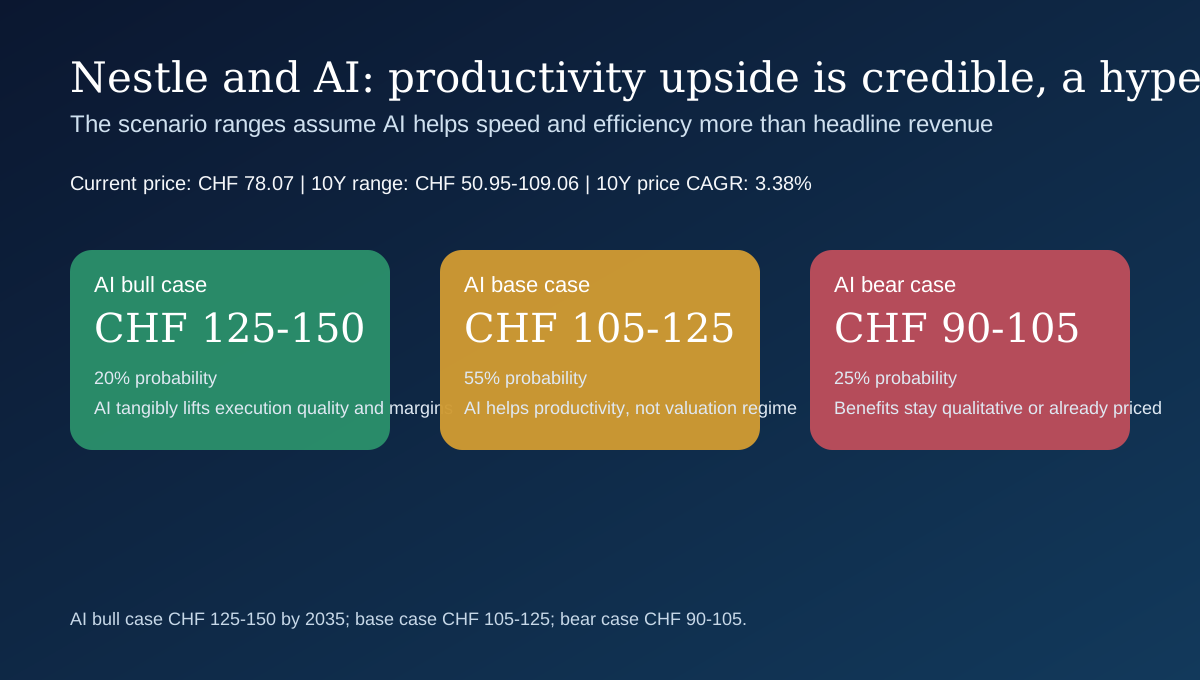
The AI scenario should be reviewed when Nestle begins to quantify more of the operational impact in margins, working capital, or speed-to-market. Until then, the sensible approach is to let AI widen the range modestly rather than to replace the core Nestle thesis.
The base case assumes AI helps, but does not justify a separate valuation regime. The bull case assumes AI meaningfully improves the quality and speed of the broader turnaround.
| Scenario | Probability | Trigger | Review date | Target range |
|---|---|---|---|---|
| Bull case | 20% | Nestle begins to show measurable AI-linked margin or speed benefits on top of the broader transformation | Annual results through 2027-2030 | CHF 125-150 by 2035 |
| Base case | 55% | AI helps productivity and execution, but the stock is still mainly valued as a staple compounder | Annual results through 2027-2030 | CHF 105-125 by 2035 |
| Bear case | 25% | AI remains diffuse, qualitative, or already absorbed into the standard savings program | Annual results through 2027-2030 | CHF 90-105 by 2035 |
References
Sources
- Yahoo Finance chart API for Nestle (NESN.SW) 10-year price history and latest market data
- Nestle three-month sales 2026 press release, published April 23, 2026
- Nestle full-year 2025 results and 2026 guidance, published February 19, 2026
- Nestle analysts and consensus page, including the latest company-compiled consensus references
- Nestle pre-full year 2025 company-compiled consensus PDF, published January 2026
- Nestle strategy page with 4%+ organic growth, 17%+ margin, and CHF 3 billion savings ambition
- StockAnalysis valuation page for Nestle ADR (NSRGY), used for forward P/E reference
- Nestle AI-powered digital twins announcement, published June 11, 2025
- Nestle digital core upgrade enabling AI and automation at scale, published October 23, 2025
- Nestle joins the Frontier Firm AI Initiative with Harvard D3 and Microsoft, published November 19, 2025
- Nestle annual report transformation page with procurement and AI adoption examples