01. Historical Context
How AI enters the valuation debate for Sanofi
The AI story for Sanofi is easier to respect than to hype. The company already describes itself as an R&D-driven, AI-powered biopharma company, and the current stock price of EUR 74.04 still does not reflect anything like an AI bubble.
The reason the theme matters is practical, not promotional. Sanofi, Formation Bio, and OpenAI announced an AI drug-development collaboration on May 21, 2024. Sanofi has since said AI has already delivered seven novel drug targets in one year, accelerated priority launches by about 12 months, and can shorten time to market by up to one year in manufacturing and supply.
That is enough to matter for a 10-year stock thesis. But investors should treat AI as an operating lever that may widen returns on R&D and launches, not as a stand-alone revenue line yet.
| Horizon | What matters now | Current datapoint | What would strengthen the thesis |
|---|---|---|---|
| 1-3 months | Execution versus guidance | Q1 2026 net sales were EUR 10.509 billion, up 13.6% at constant exchange rates, while business EPS was EUR 1.88, up 14.0% at CER. | Management keeps 2026 guidance and brand-level momentum remains intact. |
| 6-18 months | Valuation versus revisions | MarketScreener showed Sanofi on about 12.9x trailing 2025 earnings, 10.9x 2026 estimated earnings, and 10.1x 2027 estimated earnings. Consensus EPS on MarketScreener was EUR 6.852 for 2026 and EUR 7.372 for 2027, implying about 7.6% growth into 2027. | Consensus EPS moves higher while the multiple does not need to do all the work. |
| To 2035 | Structural compounding | 10-year price range EUR 44.62 to EUR 94.70; 10-year CAGR 4.1%. | The company sustains growth through launches, pipeline conversion, and disciplined capital allocation. |
02. Key Forces
Five ways AI could materially change the thesis
The first AI channel is R&D throughput. If target discovery, trial design, and portfolio allocation improve, Sanofi can increase the number of economically relevant assets per euro of R&D.
The second channel is launch efficiency. Sanofi explicitly says AI is helping accelerate priority launches by about 12 months, which can be worth a lot in peak-sales timing.
The third channel is manufacturing. Management says AI can reduce time to market by up to one year across the development lifecycle, including production.
The fourth channel is portfolio discipline. Agentic and decision-support tools matter because a company with a large pipeline can destroy or create value by how it allocates capital.
The fifth channel is competitive positioning. If AI productivity improves faster at Sanofi than at peers, the stock can eventually earn a better multiple than history would suggest.
| Factor | Current Assessment | Bias | Why it matters now |
|---|---|---|---|
| Drug development AI | OpenAI and Formation Bio partnership announced in May 2024 | Bullish | This is the clearest external sign that Sanofi is investing seriously in AI. |
| R&D output | Seven novel targets generated in one year | Bullish | That suggests AI is already influencing discovery work. |
| Launch timing | Priority launches accelerated by about 12 months | Bullish | Speed matters a lot in pharma economics. |
| Manufacturing productivity | Sanofi says AI can shorten time to market by up to one year | Bullish | Supply-chain speed can add real value. |
| Monetization visibility | No direct AI revenue disclosure | Neutral | The market still has to infer value through margins and pipeline success. |
03. Countercase
Why the AI story can still disappoint investors
The AI bear case is that the technology improves workflows but not enough to change the valuation framework. That is the most common outcome in large enterprises.
A second risk is measurement. Sanofi's current AI claims are mostly about speed, targets, and process quality. Those are useful, but they are harder to translate into near-term EPS than a new drug approval or a price increase.
A third risk is macro. The IMF's April 2026 WEO explicitly listed disappointment over AI-driven productivity as one downside risk to the global outlook. Investors should assume the same risk applies at company level.
| Risk | Latest datapoint | Current assessment | Bias |
|---|---|---|---|
| Direct monetization | Still indirect | Not yet a stand-alone valuation driver | Neutral |
| Execution risk | AI benefits must show up in launches and approvals | Real | Neutral |
| Productivity disappointment | IMF flagged it as a macro downside risk in April 2026 | Real | Neutral |
| Valuation | Stock still priced mainly on pharma fundamentals | Helpful | Bullish offset |
04. Institutional Lens
What the better AI evidence actually supports
There is enough real evidence to write an institutional-grade AI section on Sanofi without guessing. The company has an OpenAI and Formation Bio partnership, a stated goal of becoming AI-powered at scale, and published examples of faster launches and target generation.
The IMF contribution is the cautionary layer: April 2026 global forecasts still note that disappointment over AI productivity is a real downside risk. That is the right mindset for investors too.
So the institutional conclusion is straightforward. AI should improve Sanofi's probability of better long-term execution, but investors still need to see the payoff through approvals, launches, margins, and cash flow.
| Source | Latest update | What it says | Why it matters here |
|---|---|---|---|
| MarketScreener, May 7, 2026 | MarketScreener listed 24 analysts on May 7, 2026 with an Outperform consensus, average target EUR 97.10, low target EUR 82.00, and high target EUR 112.00. | Analysts still see upside because the stock is screening at a low-teens trailing P/E and about 11x forward earnings. | That institutional setup matters because Sanofi does not need an aggressive multiple to outperform if launches keep delivering. |
| IMF, April 2026 | Global growth 3.1% in 2026 and 3.2% in 2027. | The IMF said downside risks still dominate because of conflict, fragmentation, and disappointment over AI productivity. | A slower macro tape usually limits multiple expansion for defensive growth names as well as cyclical names. |
| FactSet, May 1, 2026 | Health Care was one of only two S&P 500 sectors reporting a year-over-year earnings decline; the S&P 500 forward P/E was 20.9x. | FactSet's message is that broad equity valuations are not cheap even as healthcare revisions remain mixed. | That raises the bar for stock-specific execution and makes relative valuation important. |
| J.P. Morgan Asset Management, 2026 | Public healthcare multiples sit at 30-year lows relative to the S&P 500 despite USD 318 billion of M&A across 2,500-plus transactions in 2025. | J.P. Morgan's sector view is that policy noise has compressed healthcare valuations relative to the market. | That helps explain why solid pharma execution can still re-rate if policy fears fade. |
05. Scenarios
What AI means for long-term investors
For a stock scenario, AI should be modeled as an amplifier of the existing pharma thesis. It can improve development speed and capital efficiency, but it is not likely to replace core product execution as the main driver.
The review dates are simple: watch annual R&D productivity signals, launch timing, and whether management starts disclosing a larger measurable impact on development timelines or cost structure.
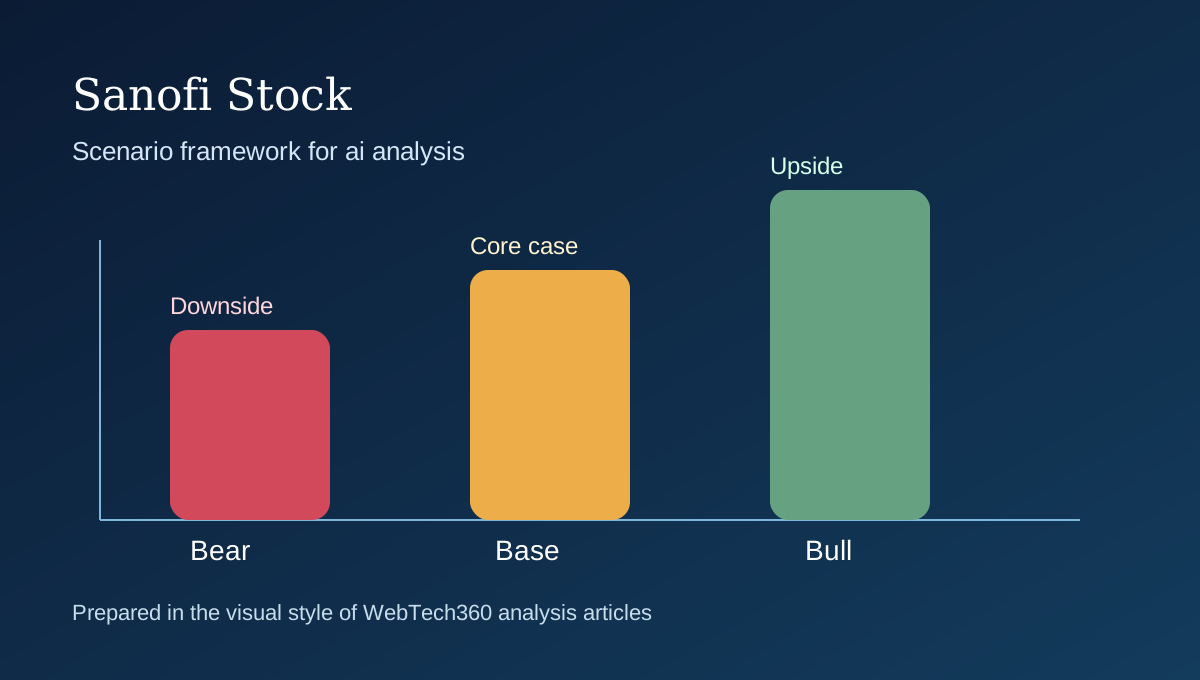
| Scenario | Probability | Target range | Trigger | When to review |
|---|---|---|---|---|
| AI upside | 30% | EUR 120 to EUR 150 by 2035 | AI noticeably improves target discovery, launch timing, and manufacturing speed, supporting a broader earnings base and a somewhat better multiple. | Review annually and after major R&D updates. |
| AI base case | 50% | EUR 105 to EUR 135 by 2035 | AI improves productivity, but the stock remains driven mainly by medicines and launches rather than by an AI premium. | Review after each annual report. |
| AI disappointment | 20% | EUR 80 to EUR 100 by 2035 | AI helps operations only marginally or the gains are offset by normal pharma execution risk. | Review if AI claims stop translating into product outcomes. |
References
Sources
- Yahoo Finance chart endpoint for Sanofi (SAN.PA), used for current price and 10-year range
- Sanofi press release: Q1 2026 double-digit sales and business EPS growth, published April 23, 2026
- Sanofi press release: FY 2025 strong sales and EPS growth, published January 29, 2026
- MarketScreener Sanofi financial forecasts and valuation ratios
- MarketScreener Sanofi analyst consensus and target prices
- IMF World Economic Outlook, April 2026
- FactSet S&P 500 Earnings Season Update, May 1, 2026
- J.P. Morgan Asset Management: Healthcare growth equity in 2026
- Sanofi, Formation Bio and OpenAI AI collaboration, published May 21, 2024
- Sanofi digital transformation and AI in R&D page
- Sanofi article on AI in biopharma production