01. Historical Context
Where AI already appears in SAP's disclosures
SAP is already far beyond generic AI branding. In the FY2025 results released January 29, 2026, Christian Klein said SAP Business AI was included in two thirds of Q4 cloud order entry. In Q1 2026, SAP followed with current cloud backlog growth of 25% at constant currencies and cloud revenue growth of 27% at constant currencies. That does not prove that AI caused all of the growth, but it does show AI is already part of the commercial engine.
The company then added strategic depth in May 2026. SAP announced the acquisition of Prior Labs and committed to invest more than EUR 1 billion over four years to build a globally leading frontier AI lab for structured data. On the same day it also announced an agreement to acquire Dremio to combine SAP and non-SAP data for agentic AI workloads in real time.
| Area | Published evidence | Current assessment | Bias |
|---|---|---|---|
| Commercial demand | Business AI in two thirds of Q4 2025 cloud order entry | Already embedded in selling motion | Bullish |
| Backlog and revenue | Q1 2026 backlog +25% cc; cloud revenue +27% cc | Shows AI is being sold inside a growing cloud platform | Bullish |
| Research platform | Prior Labs investment > EUR 1 billion over four years | A major strategic capital commitment | Bullish |
| Data layer | Dremio deal announced May 4, 2026 | Strengthens the data foundation needed for enterprise AI | Bullish |
02. Key Forces
Five ways AI could materially change the thesis
The first AI channel is better suite monetization. If AI makes SAP's cloud applications more useful inside finance, supply chain, HR, and procurement, the company does not need a separate AI product line to create value. It simply needs AI to lift retention, cross-sell, and deal size.
The second channel is data gravity. Prior Labs, Dremio, SAP Business Data Cloud, and the Autonomous Enterprise roadmap all point to SAP trying to become the orchestrator of structured enterprise data and AI agents. That is a more defensible position than simply exposing a chatbot on top of ERP screens.
| AI factor | Current data point | Current assessment | Bias |
|---|---|---|---|
| Commercial proof | Two thirds of Q4 cloud order entry included Business AI | Strongest disclosed proof point so far | Bullish |
| Platform economics | Q1 2026 current cloud backlog EUR 21.9 billion | A large backlog gives SAP room to monetize AI through the suite | Bullish |
| Research depth | Prior Labs investment > EUR 1 billion over four years | Shows SAP is investing for proprietary capability, not only partnering | Bullish |
| Data layer | Dremio acquisition announced May 4, 2026 | Important because enterprise AI usually fails at the data layer first | Bullish |
| Disclosure discipline | Most public AI evidence still routes through cloud and backlog metrics | Keeps the stock from becoming pure AI hype | Neutral |
03. Countercase
Why the AI thesis could still disappoint
The main risk is that AI improves the sales narrative more than the financial model. Enterprise customers can like AI roadmaps without materially accelerating purchasing behavior, and investors can overread anecdotal enthusiasm if it is not accompanied by stronger revenue quality or cash conversion.
The second risk is that the AI stack becomes expensive to build and integrate. Prior Labs, Dremio, and the Autonomous Enterprise roadmap are strategically coherent, but they also raise execution demands. If integration or monetization is slower than expected, the stock can remain capped even with good headlines.
| Risk | Latest data point | Why it matters | Bias |
|---|---|---|---|
| Narrative outruns numbers | Most public metrics are still cloud revenue, backlog, and FCF | AI still has to prove its marginal contribution | Bearish |
| Integration complexity | Multiple platform layers and acquisitions added in 2026 | Execution risk rises with strategic ambition | Bearish |
| Growth deceleration | Management still expects some backlog slowdown in 2026 | AI must be strong enough to offset normal maturing dynamics | Neutral |
| Valuation discipline | Current price still well below the cycle peak | The market is not yet giving SAP a full AI premium | Neutral |
04. Institutional Lens
The realistic institutional lens on AI at SAP
SAP is one of the easier companies to analyze through an AI lens because management has already tied AI to order entry, data architecture, and platform investment. That does not make the outcome guaranteed, but it does make the thesis more concrete than most AI-adjacent stocks.
The right conclusion is that AI should widen SAP's long-term range, not replace the base software thesis. The bull case needs AI to raise the quality and stickiness of SAP's recurring revenue model, not simply to generate press releases.
| Source and date | What it said | Specific number | Why it matters |
|---|---|---|---|
| SAP FY2025 results, January 29, 2026 | Business AI was already influencing demand | Included in two thirds of Q4 cloud order entry | Commercial proof of relevance |
| SAP Q1 2026 results, April 23, 2026 | Strong cloud and backlog growth continued | Backlog +25% cc; cloud revenue +27% cc | Suggests AI demand has not interrupted execution |
| Prior Labs announcement, May 4, 2026 | SAP committed serious capital to structured-data AI | More than EUR 1 billion over four years | Indicates long-term strategic intent |
| Dremio announcement, May 4, 2026 | SAP is strengthening the non-SAP data layer for agentic AI | Transaction terms undisclosed | Supports platform depth rather than shallow AI packaging |
05. Scenarios
What AI means for the long-term price range
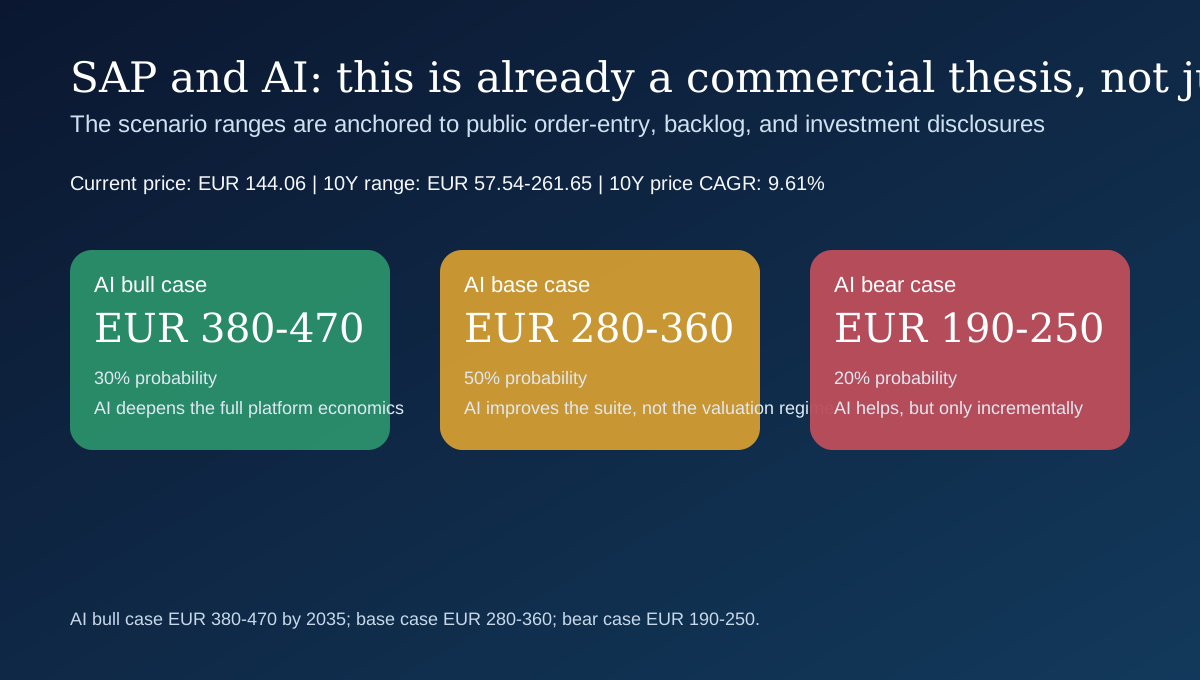
The AI scenario should be reviewed through the lens of backlog quality, cloud revenue, and free cash flow, not through product-launch noise alone. If AI keeps showing up inside those three metrics, long-run upside expands meaningfully.
The base case assumes AI helps SAP become a stronger platform company, but without assigning a limitless premium. The bull case assumes SAP wins a larger share of enterprise AI orchestration than the market currently discounts.
| Scenario | Probability | Trigger | Review date | Target range |
|---|---|---|---|---|
| Bull case | 30% | AI keeps lifting order entry, data-platform adoption, and cash-flow quality through the late 2020s | Annual results through 2027-2030 | EUR 380-470 by 2035 |
| Base case | 50% | AI improves the suite economics, but SAP is still valued mainly as a recurring enterprise software platform | Annual results through 2027-2030 | EUR 280-360 by 2035 |
| Bear case | 20% | AI remains strategically important but financially incremental, while valuation stays restrained | Annual results through 2027-2030 | EUR 190-250 by 2035 |
References
Sources
- Yahoo Finance chart API for SAP.DE 10-year price history and latest market data
- SAP Q1 2026 results, published April 23, 2026
- SAP Q4 and FY 2025 results, published January 29, 2026
- SAP Integrated Report 2025 five-year summary, including 2025 basic EPS
- SAP company-published consensus estimates, last update April 22, 2026
- SAP recent results page with 2026 outlook corridor and backlog commentary
- StockAnalysis valuation page for SAP, used for trailing and forward multiple cross-checks
- SAP acquisition of Prior Labs and more than EUR 1 billion AI lab investment, published May 4, 2026
- SAP agreement to acquire Dremio, published May 4, 2026
- SAP Sapphire 2026 Autonomous Enterprise announcement, published May 12, 2026