01. Historical Context
How AI enters the valuation debate for Siemens
The base case is straightforward: Siemens still has enough operating evidence to justify a constructive stance, but the return path depends on whether execution continues to outrun a tougher macro backdrop. Recent price action matters only because it now sits on top of specific, checkable numbers rather than on a vague story.
As of May 13, 2026, recent Yahoo Finance quote pages showed Siemens around EUR 266.35, with a 52-week range of EUR 198.00 to EUR 275.75. The longer context is important too. MarketScreener's ten-year range snapshot put the stock between EUR 58.77 to EUR 275.75, which is why the next move should be judged against long-cycle valuation discipline, not just the last quarter.
| Horizon | What matters most | What would strengthen the thesis | What would weaken the thesis |
|---|---|---|---|
| 1-3 months | Q2 FY2026 execution, backlog quality, and valuation discipline | Orders stay above revenue, the book-to-bill ratio holds above 1.1, and the stock consolidates near highs instead of failing at them | A margin miss in Mobility or Smart Infrastructure, or a fast de-rating after Germany and euro area inflation stay sticky |
| 6-18 months | Whether software, electrification, and AI-linked demand sustain high-quality earnings | Digital Industries keeps margin above 17%, Smart Infrastructure keeps record order intake translating into revenue, and EPS tracks the EUR 10.70-EUR 11.10 FY2026 guide | The software cycle fades, tariffs keep biting Mobility, or the market refuses to pay mid-20s earnings multiples |
| To 2030/2035 | Compounding of software, infrastructure, and industrial AI | Revenue growth stays near the 6%-8% FY2026 group corridor and AI monetization improves the mix | Execution stays good but multiples compress toward the high teens |
02. Key Forces
The operating evidence that makes AI relevant for Siemens
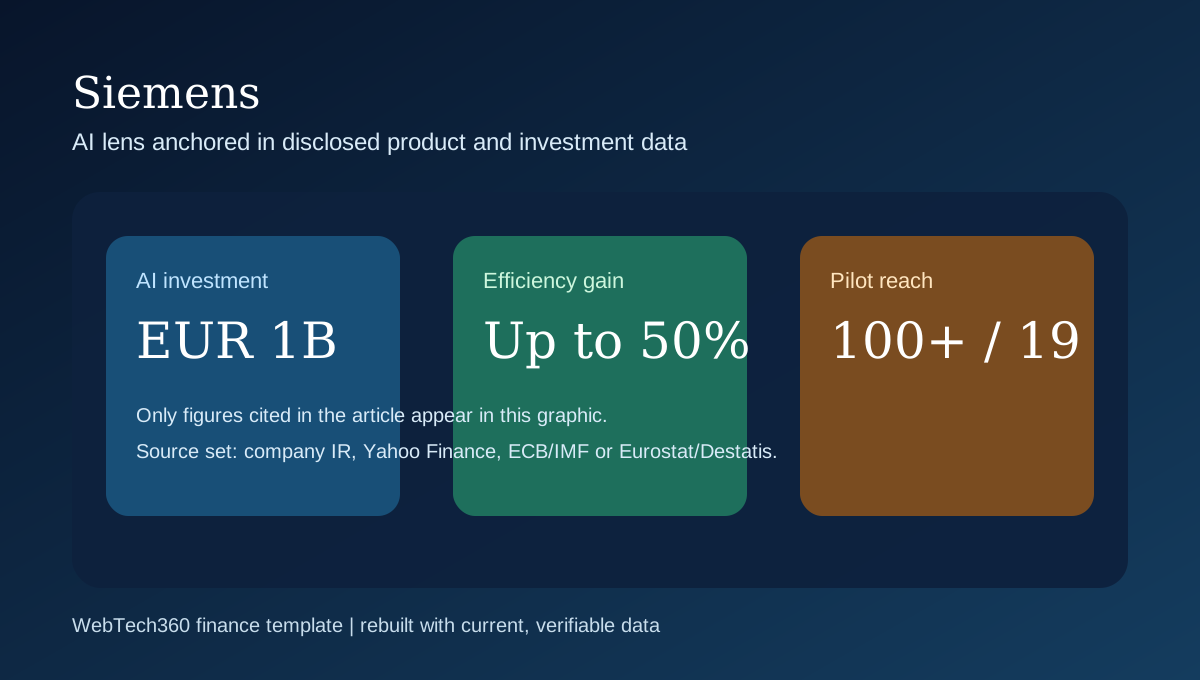
Siemens now has enough real AI disclosures to move the discussion beyond vague optimism. In April 2026, the company launched the Eigen Engineering Agent and said it could deliver up to 50% efficiency gains in automation engineering tasks. The rollout followed pilots with more than 100 customers in 19 countries and sits inside Siemens' stated EUR 1 billion industrial AI investment program.
That AI story matters because it is attached to businesses investors already value: industrial software, automation, electrification, and digital services. In Q2 FY2026, Siemens said its software ARR reached EUR 5.5 billion and its digital business grew 19% in the first half. If AI raises wallet share inside that installed base, the mix can improve without requiring heroic assumptions about entirely new markets.
The macro side matters too. At CES 2026, Siemens and NVIDIA said they were expanding work on an Industrial AI Operating System and AI-factory infrastructure. That connects Siemens to both factory productivity and data-center electrification, two of the few AI spending channels already visible in capex budgets.
| Factor | Current Assessment | Bias | What the latest data says |
|---|---|---|---|
| Industrial AI productization | Commercially launched | Bullish | Eigen Engineering Agent is now available and Siemens says it can deliver up to 50% efficiency gains. |
| Proof of customer demand | Early but real | Bullish | Pilot work covered 100+ customers across 19 countries before broad rollout. |
| Software monetization | Strong | Bullish | Software ARR reached EUR 5.5 billion and H1 FY2026 digital business growth was 19%. |
| Capital intensity | Manageable | Neutral | AI investment is explicit at EUR 1 billion, so investors can at least measure spend against outcomes. |
| Valuation sensitivity | Still high | Neutral to bearish | At around 26.5x trailing earnings, AI optimism still has to convert into durable profit growth. |
03. Countercase
Why the AI case can still disappoint
The risk is not that Siemens has no AI strategy. The risk is that investors pay for a software-style re-rating while the actual economics still look industrial. AI can improve workflows and still fail to justify a permanently higher multiple.
Another risk is implementation timing. Even a valid AI tool takes time to diffuse through customers, budgets, and engineering processes. If orders for the core businesses slow while AI monetization is still early, the stock can feel expensive before the AI thesis fully matures.
| Risk | Latest data point | Why it matters now |
|---|---|---|
| Monetization lag | ARR is real, but broad AI revenue attribution is still early. | The market can overestimate how fast productivity features become profit. |
| Valuation risk | Recent market snapshots still place Siemens near 26.5x trailing earnings. | A stock with a premium multiple has less patience for delayed payoff. |
| Tariffs and macro | Q2 FY2026 Mobility results were already hit by U.S. tariff effects. | AI progress does not insulate every business line from macro friction. |
| Integration risk | Altair and Dotmatics still raise capital employed and integration complexity. | AI upside arrives alongside execution risk, not instead of it. |
04. Institutional Lens
What current AI disclosures actually justify
The usable institutional lens here is company disclosure first, macro second. Siemens has already tied AI to specific products, customer pilots, and a fixed investment envelope. That is far more credible than generic statements about digital transformation.
The investment conclusion is that AI can raise Siemens' quality score, especially if it deepens software, services, and electrification economics. The conclusion is not that AI alone should justify a software-company multiple.
| Source | Updated | What it says | Type |
|---|---|---|---|
| Siemens AI release | April 20, 2026 | Eigen Engineering Agent launched; up to 50% efficiency gains; 100+ pilots in 19 countries; EUR 1 billion AI investment envelope. | |
| Siemens Q2 FY2026 | May 13, 2026 | Digital business +19% in H1 FY2026; software ARR EUR 5.5 billion; Q2 orders EUR 24.1 billion. | |
| CES 2026 | January 2026 | Siemens and NVIDIA expanded work on industrial AI and AI-factory infrastructure. | |
| Interpretation | Current | AI is already improving the quality of Siemens' growth story, but the stock still needs measurable cash-flow proof. |
05. Scenarios
How AI changes the 10-year scenario map
AI should be treated as an amplifier, not as the whole thesis. It can raise growth, margin, or terminal multiple assumptions, but only if it changes adoption and mix in businesses that already matter.
That makes it useful to write separate AI scenarios instead of quietly baking optimistic assumptions into every case.
| Scenario | Probability | Target range / outcome | Trigger | When to review |
|---|---|---|---|---|
| AI bull | 25% | Higher software mix and productivity gains | AI products scale inside the installed base, ARR keeps compounding, and industrial customers fund the capex. | Review after each full-year software and digital services update. |
| AI base | 55% | Efficiency gains but modest valuation effect | AI helps margins and customer retention without creating a stand-alone re-rating. | Revisit after fiscal 2027 and 2028 results. |
| AI bear | 20% | Spend outruns monetization | The tools work technically, but customers adopt slower than the stock market expected. | Reassess immediately after any slowdown in digital growth. |
References
Sources
- Yahoo Finance quote for Siemens (current price, 52-week range, target estimate)
- Yahoo Finance statistics snapshot for Siemens (valuation measures as of May 2026)
- Siemens Q2 FY2026 earnings release PDF
- Siemens Annual Report 2025
- Siemens industrial AI launch: Eigen Engineering Agent
- IMF World Economic Outlook, April 2026
- ECB staff macroeconomic projections for the euro area, March 2026
- Eurostat flash inflation for April 2026
- Destatis Germany CPI for April 2026
- MarketScreener Siemens quote page (10-year trading range snapshot)