01. Historical Context
Current market snapshot before the forecast
AI could matter more to Tencent than many investors assume because it can raise ad efficiency, improve game economics, deepen WeChat engagement, and create a real cloud and agent software layer on top of the existing ecosystem. Tencent announces 2026 first quarter results confirmed that 1Q2026 revenue rose 9% year over year and non-IFRS net profit rose 11%, while Tencent 2025 annual report shows the company entered the year from a FY2025 base of RMB751.8 billion in revenue and RMB259.6 billion in non-IFRS profit.
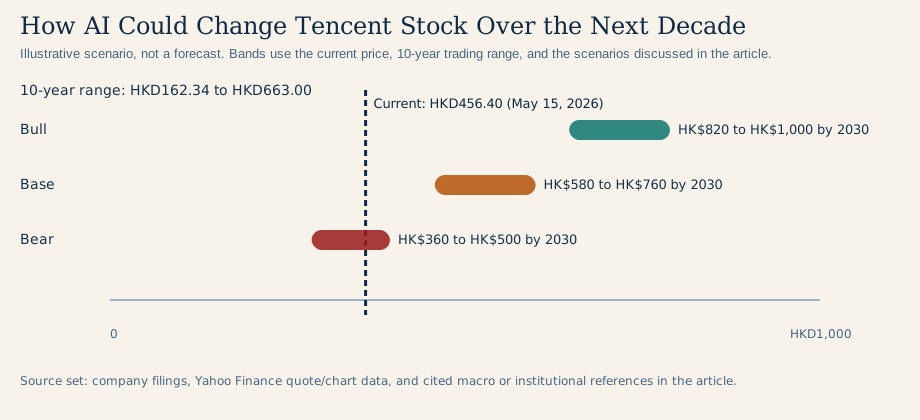
Tencent's recent close of HKD456.40 is below the 10-year high of HKD663.00 but far above the 10-year low of HKD162.34. That positioning tells you the market has already recognized recovery, yet still applies a discount versus global platform peers. Yahoo Finance quote page for Tencent Holdings (0700.HK)
| Metric | Current reading | Why it matters |
|---|---|---|
| Recent close | HK$456.40 on May 15, 2026 | Yahoo Finance 1-month daily chart |
| 10-year range | HK$162.34 to HK$663.00 | Yahoo Finance 10-year monthly chart |
| Forward valuation | About 13.5x forward P/E; 1-year target estimate HK$709.93 | Yahoo Finance quote page |
| Latest quarterly revenue | RMB196.5 billion in 1Q2026, up 9% year over year | Tencent 1Q2026 results |
| Latest AI/capex signal | 1Q2026 capex was RMB31.9 billion, up 16%; FY2025 AI product costs were RMB18 billion | Tencent 1Q2026 and FY2025 results |
Tencent still trades at a lower forward multiple than many U.S. platform peers despite better cash generation and a larger capital-return program, but the discount exists because geopolitical and regulatory risk have not vanished.
02. Key Forces
Main drivers shaping the next move
The first driver is the quality of Tencent's core cash flows. Tencent announces 2026 first quarter results showed 20% growth in Marketing Services and 20% growth in Business Services, while gaming stayed resilient. That mix matters because it gives Tencent room to spend on AI without blowing through liquidity.
The second driver is the AI build-out itself. Reuters-syndicated report on Tencent's annual results and AI investment plan explained that management intends to raise AI investment after saying export controls constrained parts of the prior year's spend. In other words, capex is rising because Tencent thinks the opportunity set is broad, not because the legacy business is deteriorating.
The third driver is the discount rate on China internet assets. IMF Executive Board concludes 2025 Article IV consultation with China and World Bank China Economic Update, December 2025 still imply a slower macro backdrop than the world's fastest-growth internet stories enjoy, so Tencent's rerating depends on both earnings and politics.
| Factor | Latest evidence | Current assessment | Bias |
|---|---|---|---|
| Gaming resilience | Domestic games revenue rose 6% and international games revenue rose 13% in 1Q2026. | The cash engine still looks healthy. | Bullish |
| Ad-tech and WeChat ecosystem | Marketing Services revenue rose 20% in 1Q2026 as AI recommendation tools improved pricing and performance. | This supports margin durability more than the market gave Tencent credit for two years ago. | Bullish |
| Cloud and business services | Business Services revenue rose 20% in 1Q2026 on stronger AI-related cloud demand. | This adds a second growth engine to games and ads. | Bullish |
| Geopolitical exposure | Reuters reported U.S. officials debated whether Tencent should keep some foreign gaming stakes. | The headline risk is real even if it has not yet hit fundamentals. | Neutral to Bearish |
| Valuation and capital return | Forward P/E was about 13.5x and Tencent repurchased 12.7 million shares for HK$7.6 billion in 1Q2026. | The valuation still leaves room for rerating if execution remains firm. | Bullish |
03. Countercase
What could invalidate the thesis
The first countercase is that AI spending becomes a bigger drag than the market expects. Tencent can afford the spend, but that does not mean investors will always reward it if monetization takes longer than planned.
The second risk is political. Tencent's overseas gaming stakes and broader China tech exposure remain easy headline targets, which means the stock can de-rate on regulation or national-security narratives even when operating results remain solid.
The third risk is cyclical breadth. Advertising and payments are real growth engines, but both still need a workable macro backdrop. If China's macro floor weakens further, Tencent's premium to slower-growth peers may not hold.
| Risk | Latest data or context | Why it matters now | When to review |
|---|---|---|---|
| AI spend rises faster than monetization | Tencent's FY2025 AI-product costs were RMB18 billion, and management signaled a substantial increase in 2026 investment. | Watch cloud margins, non-IFRS operating profit excluding new AI products, and capex cadence. | Each quarterly result through 2026 |
| Regulatory or cross-border gaming pressure | Reuters-linked reporting in March 2026 highlighted scrutiny around Tencent's overseas gaming stakes. | Watch any forced-asset-sale narrative or new operating restrictions. | Whenever new U.S. or Chinese policy headlines land |
| Consumer and ad demand soften | The ad business is growing fast, but it remains cyclical and depends on China's macro floor. | Watch marketing services growth against IMF and World Bank China forecasts. | Monthly macro data and each quarter |
| Valuation remains trapped | Despite a target estimate near HK$710, the stock still trades far below prior-cycle highs. | If investors keep demanding a China discount, earnings growth may not fully convert into price gains. | Reassess after August 2026 earnings |
04. Institutional Lens
What the latest institutional and primary-source evidence says
Institutional work is only useful when it changes the evidence set. For this group of articles, the most relevant inputs are the latest company filings, current quote and consensus pages, and official macro publications rather than generic market commentary. Tencent announces 2026 first quarter results and Yahoo Finance quote page for Tencent Holdings (0700.HK) are doing most of the heavy lifting.
That matters because each scenario range below is anchored to a recent trading price, the last 10 years of monthly price history, present valuation, and the direction of earnings or revenue revision signals. The methodology is intentionally simple: use the current price as the anchor, then widen or narrow the band depending on whether operating proof and macro conditions are improving or deteriorating.
In other words, these are probability-weighted ranges, not promises. The article becomes more bullish only if the measurable triggers continue to improve after the next review date.
| Source | Updated | What it says | Why investors should care |
|---|---|---|---|
| Tencent 1Q2026 results | May 13, 2026 | Revenue rose 9% to RMB196.5 billion, non-IFRS net profit rose 11% to RMB67.9 billion, and capex rose 16% to RMB31.9 billion. | This shows AI investment is being funded by a still-growing core platform. |
| Tencent 2025 annual report | April 2026 filing | FY2025 revenue was RMB751.8 billion and non-IFRS profit attributable to shareholders was RMB259.6 billion. | The annual base matters because it anchors long-duration scenarios in real earning power. |
| Yahoo Finance consensus | May 2026 quote snapshot | Forward P/E stood around 13.5x and the 1-year target estimate near HK$709.93. | That is a meaningful upside gap, but only if regulatory discount rates keep compressing. |
| Yahoo Finance analyst trends | Captured early 2026 | Consensus revenue growth for 2026 was about 9.9% with next-year normalized EPS growth around 12.5%. | That suggests the market expects growth, but not a bubble-like explosion. |
| Reuters on AI investment | March 18, 2026 | Reuters reported Tencent planned to step up AI investment in 2026 after saying chip curbs restrained parts of 2025 spending. | This explains why the market is watching capex discipline as closely as revenue growth. |
05. Scenarios
Scenario analysis and investor positioning
The probability table below reflects the current setup, not a permanent view. Rising odds represent the chance that the stock finishes the next review window above today's level by enough to validate the thesis; sideways odds cover consolidation or only modest change; falling odds cover a material de-rating or drawdown.
Current framework: probability of rising 44%, probability of moving sideways 30%, and probability of falling 26%. Investors should review the thesis when either consensus revisions, free cash flow, or the specific company catalyst path changes meaningfully.
| Scenario | Probability | Illustrative target range | Trigger conditions | When to revisit |
|---|---|---|---|---|
| Bull | 34% | HK$820 to HK$1,000 by 2030 | AI materially lifts ad yield, cloud services, and ecosystem productivity. | Reassess annually against AI spending and monetization |
| Base | 44% | HK$580 to HK$760 by 2030 | AI helps growth and margins, but valuation remains partly capped by China risk. | Reassess after annual reports |
| Bear | 22% | HK$360 to HK$500 by 2030 | AI remains strategically important but economically less powerful than bulls expect. | Reassess if capex rises while profit growth slows |
| Investor group | Suggested posture | Practical action | What to monitor next |
|---|---|---|---|
| Investor already in profit | Hold a core position but rebalance if the scenario table moves away from your original thesis. | Protect gains when probability skews worsen. | Revision breadth, valuation, and next catalyst |
| Investor currently at a loss | Separate a delayed thesis from a broken thesis. | Add only when measurable triggers improve. | Guidance, margin trend, and cash flow |
| Investor with no position | Waiting for a cleaner setup is valid. | Use scenario triggers rather than headlines as entry rules. | Price relative to current range and catalyst calendar |
| Trader | Focus on review dates and trigger conditions, not the long-range target. | Use stop-losses because scenario bands are wide. | Earnings reactions and macro data |
| Long-term investor | Use gradual position building or rebalancing rather than all-in decisions. | A wide base case is normal in long-horizon work. | Structural competitiveness and capital allocation |
| Investor seeking a hedge | Hedging is sensible when portfolio concentration is high. | Match hedge size to risk exposure rather than fear. | Volatility, correlation, and event timing |
The forecast ranges in this article are built from four anchors: the recent market price, the 10-year trading range, the current valuation regime, and the direction of revisions or cash-flow evidence. That framework is intentionally conservative because it tries to separate what is plausible from what is merely possible.
Disclaimer: This is a scenario-based research article, not personalized investment advice. Markets can move sharply on earnings, regulation, macro data, and liquidity. Use position sizing, stop-loss discipline where appropriate, and independent due diligence.
References
Sources
- Tencent announces 2026 first quarter results
- Tencent 2025 annual report
- Tencent announces 2025 annual and fourth quarter results
- Yahoo Finance quote page for Tencent Holdings (0700.HK)
- Yahoo Finance analyst estimates page for TCEHY
- IMF Executive Board concludes 2025 Article IV consultation with China
- World Bank China Economic Update, December 2025
- Reuters-syndicated report on Tencent's annual results and AI investment plan
- Tencent investor relations financial reports page
- Tencent media page linking recent result announcements