01. Historical Context
Unilever has disclosed AI adoption, but not AI monetization targets
Unilever's 2025 annual report said the company was building a business fit for the AI age and described AI-powered tools in areas such as marketing, content creation, and product development. The same report also discussed AI-enabled simulation work that can speed innovation. What it did not do was publish a stand-alone AI revenue, margin, or EPS target.
| Horizon | What matters most | What would strengthen the thesis | What would weaken the thesis |
|---|---|---|---|
| Next 12 months | Whether AI use shows up in productivity and speed | More evidence of savings, faster launches, or better mix | AI stays qualitative and difficult to tie to outcomes |
| 2027-2030 | Whether AI improves per-share economics | Higher margins or cash conversion with no major cost drag | AI becomes another cost and complexity layer |
| Beyond 2030 | Whether AI changes competitive position | Brand-building and R&D advantages become durable | The benefits diffuse across the industry with no moat effect |
The right conclusion is that AI is relevant to the stock, but only indirectly for now. Investors should treat it as a source of operating leverage until the company discloses harder financial proof.
02. Key Forces
Five ways AI could matter without becoming a separate revenue line
First, AI can compress innovation cycles. If simulation, testing, and content tools reduce launch times, Unilever can improve mix and working capital even without a new product category explicitly called AI.
Second, AI can support productivity. That matters because Unilever has already delivered EUR750 million of its EUR800 million savings target for the end of 2026. If AI helps sustain that culture of efficiency, it can contribute to margin durability even if management never breaks it out line by line.
Third, AI can sharpen marketing and personalization. For a scaled consumer group, even small improvements in media efficiency or product targeting can matter. But as of May 2026, those benefits remain qualitative in public disclosures.
Fourth, AI can help defend the innovation moat. A company with large datasets, many categories, and global marketing scale has more ways to deploy AI than a smaller rival. That matters strategically even when near-term financial disclosure is light.
Fifth, valuation discipline still matters. UL traded at 11.15x trailing earnings and 15.12x forward earnings on May 15, 2026. That tells investors the market is not pricing a large AI premium into the stock right now.
| Factor | Current Assessment | Bias | Why it matters now |
|---|---|---|---|
| Disclosed AI adoption | Annual report describes AI in innovation, marketing, and operating models | Mild Bullish | Shows AI is being deployed inside the business |
| Public AI KPI disclosure | No stand-alone AI revenue or EPS target disclosed | Neutral | Limits the case for an AI-only rerating |
| Productivity leverage | EUR750 million of the broader savings target already delivered | Mild Bullish | AI can help reinforce an existing efficiency program |
| Valuation | Forward PE around 15x, with little obvious AI premium | Neutral | Leaves room for upside if AI benefits become measurable |
| Execution and governance risk | AI use brings operational, compliance, and reputational complexity | Neutral to Bearish | The downside is real if capability scaling outruns control |
The AI bull case for Unilever is therefore best understood as a margin and speed story, not as a new revenue story that investors should value independently today.
03. Countercase
Why the AI story can still disappoint
The first limitation is disclosure. If management does not show where AI is changing costs, speed, or mix in a measurable way, investors are left with a narrative rather than an investment variable.
The second limitation is diffusion. AI tools can become table stakes across consumer staples. If everyone gets similar productivity benefits, the moat effect is weaker than the headline narrative implies.
The third limitation is macro. The IMF warned in its April 2026 update that a disappointment in AI-driven productivity gains is one of the downside risks to the global outlook. That is relevant here because a weaker economy plus unproven AI benefits would not help the stock's multiple.
| Risk | Latest data point | Current Assessment | Bias |
|---|---|---|---|
| No quantified KPI | No public AI revenue or EPS target as of May 2026 | The biggest limitation today | Bearish |
| Industry diffusion | Consumer AI tools are broadening across sectors | Potentially reduces differentiation | Neutral |
| Macro disappointment | IMF flagged AI productivity disappointment as a downside risk | Relevant for any AI-related premium | Neutral to Bearish |
That is why the prudent stance is to value AI as a support function unless Unilever starts reporting clearer financial evidence.
04. Institutional Lens
What the current research backdrop implies for AI-sensitive investors
The most important institutional input here is what has not been disclosed. Unilever's own reporting describes AI use cases, but the company has not published a specific AI P&L bridge. That means investors should not assume an AI premium that the company itself has not quantified.
The IMF's April 2026 macro update also matters because it explicitly highlighted the risk that AI-related productivity gains disappoint. For Unilever, that means the AI thesis should be treated as conditional. If AI helps speed up innovation and protect margins, it is supportive. If it remains mostly narrative, the stock should still be valued mainly on its traditional consumer-staples metrics.
| Source | Updated | What it says | Why it matters here |
|---|---|---|---|
| Unilever annual report | 2025 | AI is embedded in growth, innovation, and operating processes | Confirms AI adoption is real inside the business |
| Unilever disclosures | May 2026 status | No stand-alone AI revenue, margin, or EPS target | Prevents a fully separate AI valuation case |
| IMF WEO | April 14, 2026 | AI productivity disappointment is a downside risk | Shows why investors should demand evidence |
| StockAnalysis | May 15, 2026 | UL still trades on normal earnings multiples | Suggests the market has not applied a major AI premium |
The practical lesson is that AI can improve Unilever's long-run economics, but the stock should only receive a larger valuation benefit once those gains show up in disclosed numbers.
05. Scenarios
What AI means for the stock over time
| Scenario | Probability | Trigger | Target range | Review point |
|---|---|---|---|---|
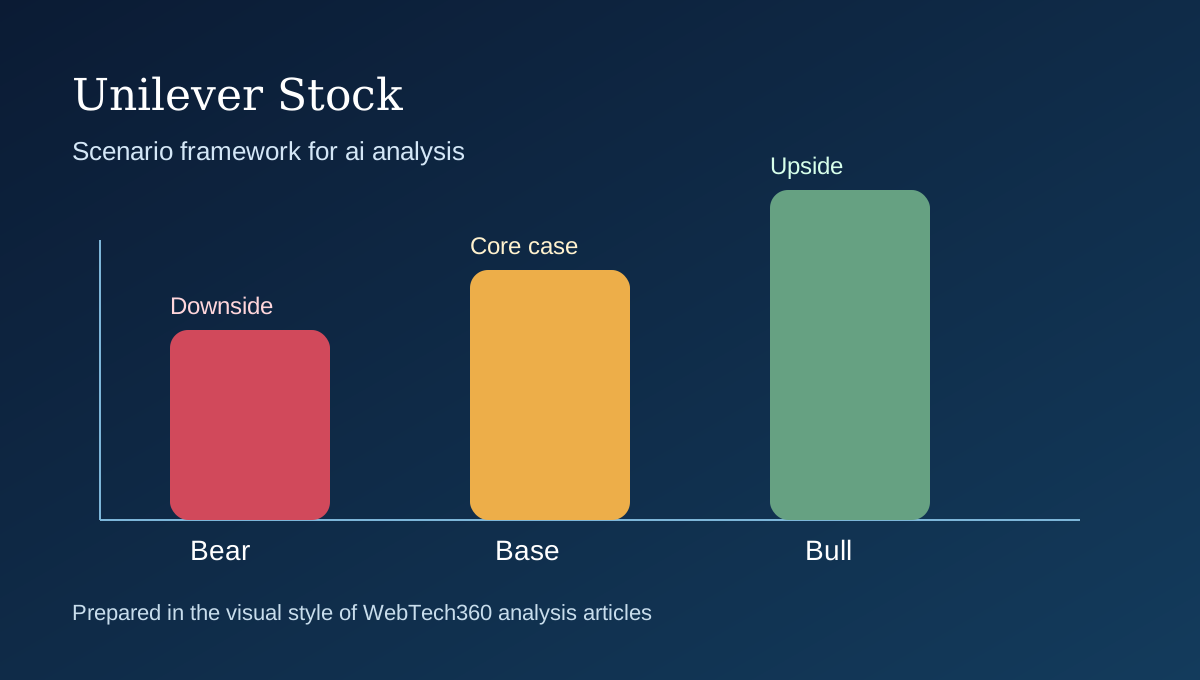
| Bull | 25% | Unilever begins to disclose measurable AI-linked efficiency or innovation gains and margins benefit without a major cost drag | $78 to $90 | Review after each annual report for harder AI-linked KPI disclosure |
| Base | 45% | AI remains an internal productivity tool that supports the existing staples thesis | $68 to $82 | Reassess after FY2026 and FY2027 reports |
| Bear | 30% | AI benefits remain vague while execution, governance, or macro risks absorb attention | $52 to $65 | Review if management still provides no measurable AI financial bridge by the next two annual cycles |
The base case remains that AI helps Unilever become a slightly better version of the company it already is. That is useful for the stock, but it is not yet a separate investment thesis.
References
Sources
- Yahoo Finance 10-year chart data for UL
- StockAnalysis valuation statistics for UL
- Unilever Annual Report and Accounts 2025
- Unilever Q1 2026 trading statement
- IMF World Economic Outlook, April 2026
- J.P. Morgan Asset Management 2026 investment outlook
- MarketScreener earnings estimates for Unilever's European line