01. Historical Context
How AI enters the valuation debate for Volkswagen
The base case is straightforward: Volkswagen still has enough operating evidence to justify a constructive stance, but the return path depends on whether execution continues to outrun a tougher macro backdrop. Recent price action matters only because it now sits on top of specific, checkable numbers rather than on a vague story.
As of May 6, 2026, recent Yahoo Finance quote pages showed Volkswagen around EUR 88.46, with a 52-week range of EUR 83.24 to EUR 108.90. The longer context is important too. MarketScreener's ten-year range snapshot put the stock between EUR 79.2 to EUR 250.0, which is why the next move should be judged against long-cycle valuation discipline, not just the last quarter.
| Horizon | What matters most | What would strengthen the thesis | What would weaken the thesis |
|---|---|---|---|
| 1-3 months | Whether Europe orders can offset China weakness and tariff noise | Europe order bank stays above year-end 2025, group margin improves from the 3.3% Q1 FY2026 starting point, and tariff assumptions do not worsen | China keeps falling faster than Europe can absorb and tariff effects widen beyond what guidance assumes |
| 6-18 months | Margin rebuild and software-defined-vehicle execution | The group moves back toward its 4.0%-5.5% operating margin guide while CARIAD losses narrow and Europe BEV demand stays constructive | Low-margin volumes persist and cash flow improvement proves temporary |
| To 2030/2035 | Capital discipline in a structurally difficult auto market | Cheap valuation converges with stronger execution, especially in Europe and software | The stock stays optically cheap because returns and China mix never normalize |
02. Key Forces
The AI and software channels that could matter for Volkswagen
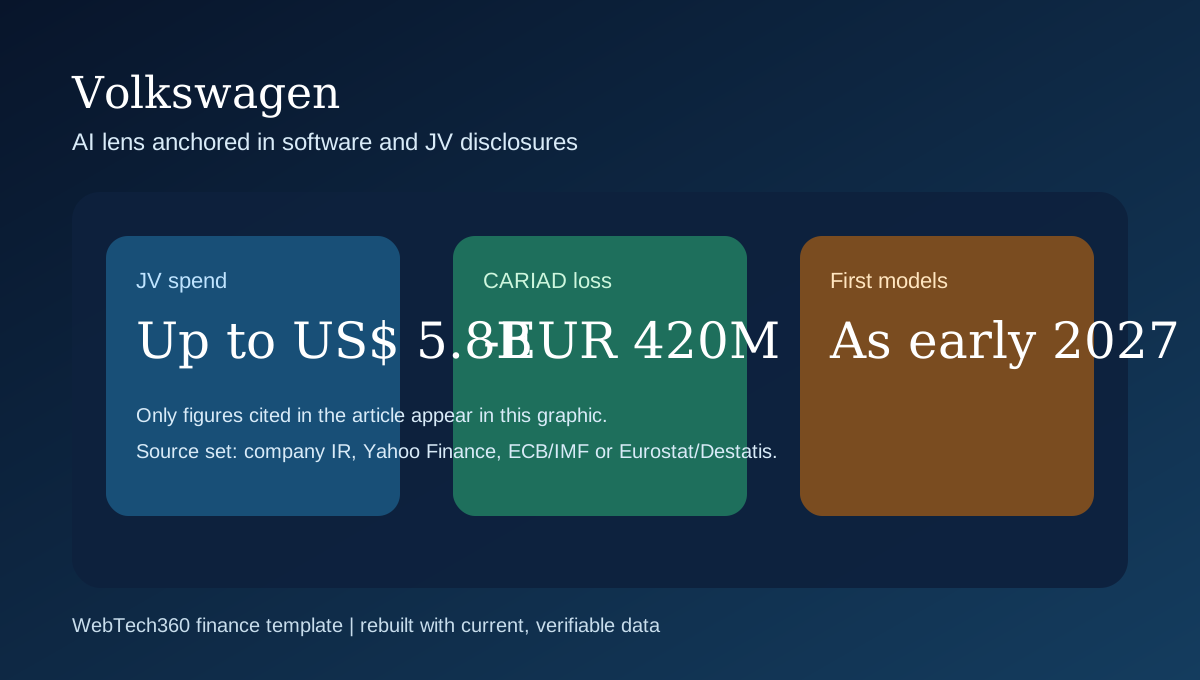
Volkswagen's AI angle is less about headline chatbots and more about software-defined vehicles, engineering productivity, and manufacturing. The most important disclosed program is the Rivian and Volkswagen Group Technologies joint venture. Volkswagen has said it plans to invest up to US$ 5.8 billion in Rivian and the joint venture by 2027, and the JV is meant to supply future zonal architecture and software for Volkswagen models as early as 2027.
There is also measurable progress inside the current software stack. In Q1 2026, CARIAD revenue rose to EUR 389 million and the operating loss narrowed to EUR 420 million from EUR 755 million a year earlier. That is not a finished turnaround, but it is a better number than a generic promise about software capability.
The strategic payoff would come if Volkswagen can use AI and software to lower complexity, improve cost per vehicle, and speed product cycles. Those benefits are plausible, but they still sit inside a structurally hard auto business. That is why AI can improve the stock's outlook without automatically changing the stock's valuation regime.
| Factor | Current Assessment | Bias | What the latest data says |
|---|---|---|---|
| Software platform progress | Real but incomplete | Neutral | CARIAD loss improved to -EUR 420 million from -EUR 755 million in Q1 2026. |
| JV scale | Large | Bullish | Volkswagen plans to invest up to US$ 5.8 billion in Rivian and the JV by 2027. |
| Launch timing | Near enough to matter | Bullish | Volkswagen said first group models using the JV technology can come as early as 2027. |
| Operational complexity | Still high | Bearish | Volkswagen is trying to improve software while also fixing margins, China share, and tariffs. |
| Valuation leverage | Potentially meaningful | Bullish | Because the stock trades near 6.6x trailing earnings, even modest proof of better software economics can matter. |
03. Countercase
Why the AI case can still disappoint
The risk is that investors overstate what AI can solve in a legacy auto group. Software improvements help, but they do not erase China competition, tariffs, cyclicality, or the capital intensity of vehicle manufacturing.
The second risk is that software becomes a cost center rather than a margin lever. Volkswagen can spend billions on architecture and still fail to persuade the market if those investments do not show up in margin, recall performance, or launch speed.
| Risk | Latest data point | Why it matters now |
|---|---|---|
| Unfinished turnaround | CARIAD still lost EUR 420 million in Q1 2026. | The software improvement is real, but it is not yet an economic moat. |
| Capital commitment | Up to US$ 5.8 billion is planned for Rivian and the JV by 2027. | That is a serious sum for a stock the market already prices cheaply. |
| Core auto pressures | Q1 2026 group margin was still only 3.3%, with China sales down 20%. | AI cannot fully offset weak auto economics if those remain unresolved. |
| Monetization risk | Future models are expected as early as 2027, not today. | The investment case can run ahead of the actual product cycle. |
04. Institutional Lens
What current AI disclosures justify for Volkswagen investors
The evidence supports a measured conclusion. AI and software can improve Volkswagen's earnings quality if they reduce complexity, improve launch economics, and make future vehicles more competitive. That would matter because the stock's starting multiple is already low.
But the current data does not justify treating Volkswagen like a pure software re-rating story. The auto business still dominates the economics, and the near-term scorecard remains margin, cash flow, China, and tariffs.
| Source | Updated | What it says | Type |
|---|---|---|---|
| Rivian and Volkswagen JV | 2025-2026 updates | State-of-the-art zonal architecture and software are being built for Volkswagen and Rivian; first Volkswagen models may arrive as early as 2027. | |
| Volkswagen Q1 2026 | April 30, 2026 | CARIAD revenue rose to EUR 389 million and the operating loss improved to -EUR 420 million. | |
| Qualcomm LOI | January 8, 2026 | Volkswagen added another disclosed building block for next-generation in-car experiences inside the software-defined-vehicle stack. | |
| Interpretation | Current | AI is a potential earnings-quality improvement story for Volkswagen, not yet a stand-alone valuation story. |
05. Scenarios
How AI changes the 10-year scenario map
For Volkswagen, AI does not replace the auto thesis. It changes the slope of the thesis if software can improve cost, quality, and product speed enough to lift margins.
That is why the AI scenarios should be read as modifiers on top of the core execution case.
| Scenario | Probability | Target range / outcome | Trigger | When to review |
|---|---|---|---|---|
| AI bull | 20% | Software-defined vehicles lift returns | The JV stack launches on time, software losses narrow, and future models command better pricing or lower cost. | Review at 2027 launch milestones. |
| AI base | 55% | Software helps but does not transform valuation | Execution improves, but AI remains one of several moving pieces inside the auto turnaround. | Revisit after each annual results cycle. |
| AI bear | 25% | Spend remains ahead of payoff | The software stack improves technically but does not change group margins enough for investors to care. | Reassess if software losses widen again. |
References
Sources
- Yahoo Finance quote for Volkswagen (current price, 52-week range, target estimate)
- Yahoo Finance statistics snapshot for Volkswagen (valuation measures as of May 2026)
- Volkswagen Group Q1 2026 results
- Volkswagen Group Annual Report & Full Year Results 2025
- Volkswagen Group deliveries in 2025
- Volkswagen Group and Rivian progress update
- Qualcomm and Volkswagen software-defined vehicle announcement
- IMF World Economic Outlook, April 2026
- ECB staff macroeconomic projections for the euro area, March 2026
- Eurostat flash inflation for April 2026
- Destatis Germany CPI for April 2026
- MarketScreener Volkswagen quote page (10-year trading range snapshot)