01. Current Data
The market data shaping the current natural gas outlook
A serious energy article should start with the market that actually exists, not the market implied by stale narratives. Right now, that means grounding the discussion in official balances, storage or inventory trajectories, the latest benchmark pricing, and the macro conditions that can accelerate or interrupt the trend. Those anchors are more useful than generic talk about sentiment because energy markets are ultimately balanced by molecules and barrels, not by slogans.
For this rewrite, I prioritized primary or near-primary sources: EIA, IEA, the World Bank, the IMF, and the latest U.S. inflation releases. That matters because an energy article becomes genuinely actionable only when the reader can see exactly which figures are driving the conclusion. In this case, the anchor points are $3.50/MMBtu, 2,205 Bcf storage, and the still-relevant inflation backdrop of April 2026 U.S. CPI rose 3.8% year over year, April 2026 core CPI rose 2.8%, and March 2026 core PCE rose 3.2%.
| Period | Data point | Why it matters |
|---|---|---|
| May 1, 2026 | Working gas storage 2,205 Bcf | Official storage cushion is above both last year and the 5-year average |
| 2026f | EIA Henry Hub annual average $3.50/MMBtu | Base U.S. benchmark for the current cycle |
| 2027f | EIA Henry Hub annual average $3.18/MMBtu | Official easing scenario despite stronger export capacity |
| 1Q26 | U.S. marketed gas production 120.2 Bcf/d | Production is still rising |
| 2026f | U.S. LNG exports 17.0 Bcf/d | Export demand remains a powerful structural sink |
Those figures establish the regime before any opinion enters the room. The core discipline is simple: if the balance data and price action are reinforcing each other, the thesis deserves more respect. If they are diverging, caution should rise. That principle matters more in energy than in many asset classes because spot moves can be extreme while the underlying balance can still normalize quickly.
02. Institutional Lens
What the latest institutional data actually say
The institutional lens for natural gas is strongest when you separate the domestic U.S. benchmark from the global LNG shock, then reconnect them through exports and power demand. EIA's May 12, 2026 STEO says the Henry Hub spot price averages $3.50/MMBtu in 2026 and $3.18/MMBtu in 2027. Those are not panic numbers. But they sit alongside stronger export capacity and a still-growing power load, which makes the market tighter than the annual average alone suggests.
The production side explains why natural gas cannot be analyzed with one-dimensional bullishness. EIA says U.S. marketed natural gas production averaged 120.2 Bcf/d in 1Q26, up 4% from 1Q25, and now forecasts 121.8 Bcf/d in 2026 and 126.8 Bcf/d in 2027. It also expects U.S. LNG exports to reach 17.0 Bcf/d in 2026 and 18.2 Bcf/d in 2027. That pairing matters: supply is growing, but so is the structural outlet for supply.
The storage picture gives the near-term reality check. In its Weekly Natural Gas Storage Report released May 7, 2026, EIA said working gas in storage was 2,205 Bcf as of May 1. That was 75 Bcf above last year and 139 Bcf above the five-year average. A market with that much gas in storage is not structurally broken. But it can still rally if weather, exports, or power demand tighten the next balancing season.
The IEA's Q2 2026 Gas Market Report explains why global context still matters. It says the effective closure of the strait has removed nearly 20% of global LNG supply from normal flows and altered the medium-term outlook after damage to liquefaction infrastructure in the Middle East. That keeps international LNG prices elevated and supports export economics from the United States. So the correct institutional reading is not simply that gas is abundant. It is that domestic abundance now lives inside a much more connected and geopolitically fragile LNG system.
| Factor | Why it matters | Current Assessment | Bias | Current evidence |
|---|---|---|---|---|
| Storage cushion | High storage tempers near-term panic but does not erase winter risk | Mixed | 0 | EIA storage stood at 2,205 Bcf, 139 Bcf above the five-year average |
| Production trend | Rising output limits how durable a spike can be | Bearish | - | EIA sees U.S. marketed production rising to 121.8 Bcf/d in 2026 and 126.8 Bcf/d in 2027 |
| LNG pull | Exports tighten domestic balances faster than old Henry Hub models assumed | Bullish | + | EIA sees U.S. LNG exports at 17.0 Bcf/d in 2026 and 18.2 Bcf/d in 2027 |
| Global disruption | International LNG stress can leak into U.S. pricing through spreads and exports | Bullish | + | IEA says nearly 20% of global LNG supply was affected by the strait closure |
| Power demand | Electricity demand growth supports gas burn even in a softer economy | Constructive | + | EIA sees U.S. electricity demand rising 1.3% in 2026 and 3.1% in 2027 |
The scoring table matters because it forces the article to stop hiding behind broad adjectives like bullish or bearish. Readers should be able to see the current tilt factor by factor. Right now, the evidence is not one-dimensional. Some signals support higher prices, some argue for caution, and some mainly show that time horizon matters more than conviction alone.
03. Countercase
The risks that could weaken the current thesis
The first bear case for natural gas is straightforward: storage is comfortable and production is still growing. EIA's latest weekly report shows 2,205 Bcf in storage, which is above both last year and the five-year average. At the same time, EIA expects marketed production to rise from 121.8 Bcf/d in 2026 to 126.8 Bcf/d in 2027. If those two conditions hold together, rallies can struggle to stay extended.
The second risk is that export optimism becomes over-owned. The LNG story is real, but markets often price the headline before the full physical effect arrives. If domestic production keeps growing, if outages are resolved faster than expected, or if global LNG tightness eases, then Henry Hub can disappoint relative to the enthusiasm around international gas scarcity.
The third risk is macro and inflation sensitivity. Higher-for-longer real rates, reflected in April 2026 CPI at 3.8% and March 2026 core PCE at 3.2%, can matter even for a commodity with a strong physical story. If industrial activity slows, storage refills comfortably, and weather does not tighten balances, then the next gas selloff can be more about absence of stress than about actual oversupply.
That is why the countercase has to be tied to current data and review dates rather than to textbook abstractions. An energy market can stay tense for longer than many models expect, but it can also normalize faster than many headlines imply. The useful question is not whether a risk sounds plausible. It is what number would confirm it and how quickly that number updates.
04. Forecast Framework
AI changes the medium-term demand conversation, but through energy-system channels
The AI angle should not be treated as a magic substitute for physical analysis. Its real value is in showing how power demand, industrial buildout, logistics, and energy efficiency can subtly change the medium-term balance. That is useful, but it does not replace the classic energy-market questions.
For investors who are already profitable, that often argues for a more surgical approach than all-in conviction. Scaling out into the top of the bull band can make sense when prices have outrun the newest physical confirmation. For investors who are currently losing, the harder but more useful question is whether the original thesis still matches the updated balance data. If the balance is deteriorating, averaging down can simply magnify the wrong exposure. If the balance is tightening again, selective patience can be reasonable.
For readers without a position, the real distinction is between chasing a move and paying for a validated trend. If the market is confirming the thesis with fresh draws, tighter storage, or resilient demand, waiting indefinitely for a perfect pullback can be costly. If the market is already euphoric while the physical data are only mixed, patience is usually the better trade. In other words, the right action depends on entry point and evidence, not on a slogan about buying dips or fearing rallies.
Another discipline that improves long-horizon results is separating structural conviction from tactical sizing. Energy markets overshoot fair value in both directions because they are shock-sensitive and policy-sensitive at the same time. Position sizing, review dates, and trigger levels therefore matter as much as the thesis itself. They are the bridge between a good article and a defensible portfolio decision.
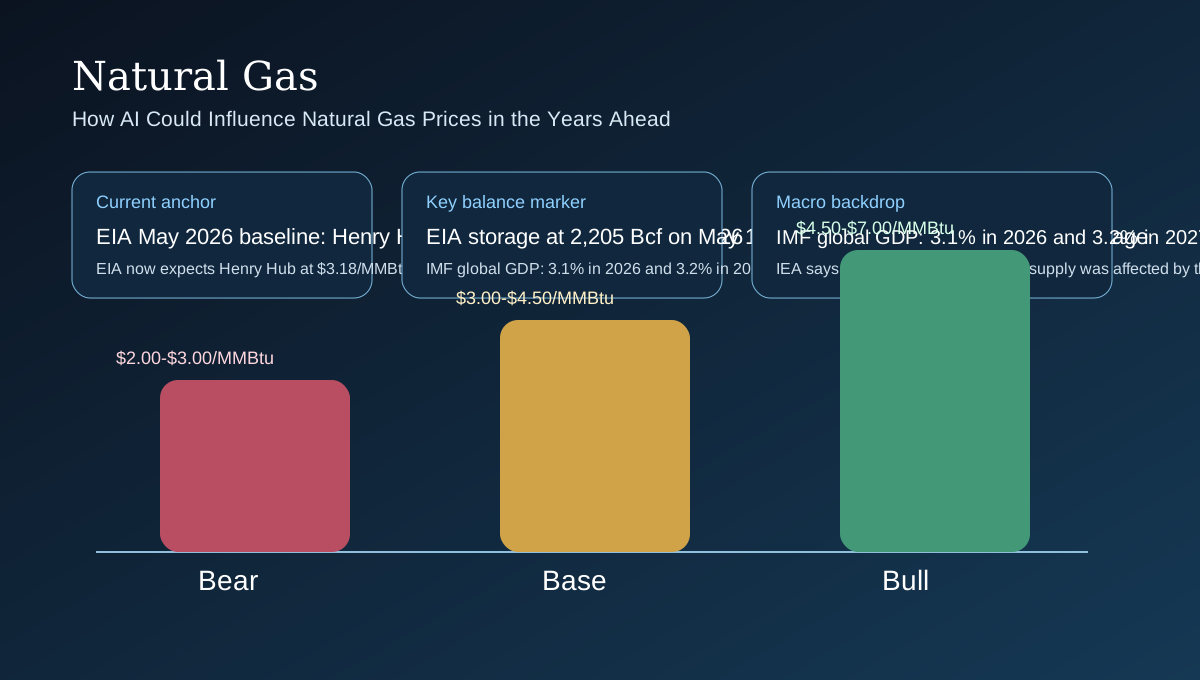
The scenario ranges in this article are meant to help different readers act differently. A trader may care most about weekly storage, inventory, and prompt-structure changes. A long-only allocator may care more about whether the base case is improving or deteriorating every six months. A business operator with fuel or gas exposure may care most about whether today's market still justifies hedging. The same research should be useful to all three audiences.
A final rule is to avoid treating volatility as proof that the thesis is wrong. In energy markets, volatility is often how the thesis expresses itself. The more important question is whether volatility is occurring alongside improving evidence or deteriorating evidence. If the underlying balance is strengthening, volatility can be an opportunity. If the evidence is weakening, the same volatility can be a warning. That distinction is what keeps scenario analysis grounded in process instead of emotion.
AI matters more directly to natural gas than to oil because power demand is the transmission mechanism. EIA's May 2026 STEO says U.S. electricity demand rises 1.3% in 2026 to almost 4,250 billion kilowatthours and then grows another 3.1% in 2027. If commercial and data-centre demand keep expanding faster than expected, natural gas generation can stay more relevant for longer even as renewables keep gaining share.
The bullish AI case for gas is simple: new load arrives before enough new transmission, storage, and dispatchable low-carbon capacity are ready. In that setting, gas-fired generation becomes the bridge technology that keeps the power system functioning. The bearish case is also simple: if efficiency gains, load management, and rapid renewable buildout offset much of the new demand, the AI premium in gas may arrive later and more unevenly than bulls expect.
The global LNG angle matters too. Higher international LNG prices widen the spread between domestic U.S. gas and overseas markets, supporting export economics and making Henry Hub less isolated than it once was. That does not mean every AI headline should move gas prices. It means the demand stack is broadening, and AI can be one more layer in that stack.
05. Scenarios
Actionable scenarios with probabilities, triggers, and review points
Scenario analysis becomes useful only when it includes explicit probabilities, measurable triggers, and a review schedule. Otherwise it is just polished ambiguity. The map below is designed to be monitored over time rather than admired once.
| Scenario | Probability | Range / implication | Trigger | When to review |
|---|---|---|---|---|
| AI load meaningfully tightens gas | 35% | Power demand keeps a structural bid under gas | Trigger: stronger electricity demand and dispatchable generation needs | Review after each EIA power-demand revision |
| AI is supportive but not decisive | 45% | Gas benefits, but production growth keeps the market balanced | Trigger: load rises while associated gas also rises | Review semiannually |
| AI effect is delayed | 20% | Efficiency and renewables absorb more of the new load than expected | Trigger: gas burn lags despite rising data-centre headlines | Review if power-sector gas share keeps slipping |
The purpose of this table is not to create false precision. It is to force discipline. If a trigger is hit, the probability mix should change. If it is not hit, conviction should remain limited. That approach is especially important in energy because spot moves can be dramatic while the deeper balance evolves more gradually.
06. Sources
Primary and institutional sources used in this article
- EIA Short-Term Energy Outlook, May 12 2026
- IEA Gas Market Report, Q2 2026
- EIA Weekly Natural Gas Storage Report, released May 7 2026
- World Bank Commodity Markets Outlook, April 2026
- IMF World Economic Outlook, April 2026
- BLS CPI April 2026
- BEA Personal Income and Outlays, March 2026
- EIA Natural Gas Monthly