01. Historical Context
AI influences silver indirectly through hardware, power, and electronics demand
For silver, AI is not an earnings story. It is a fabrication and infrastructure story. The February 10, 2026 Silver Institute outlook said data centers, AI-related technologies, and the automotive sector should support silver consumption across industrial end-uses. The April 15, 2026 World Silver Survey release went further and said 2025 industrial demand still benefited from structural growth in AI infrastructure, power-grid investment, and automotive demand. But those supports were not strong enough to stop total industrial demand from falling 3% to 657.4 Moz in 2025.
| Horizon | What matters most | Current assessment | What would strengthen the thesis | What would weaken the thesis |
|---|---|---|---|---|
| 1-2 years | Whether AI-linked demand offsets PV weakness | Not yet proven | Industrial demand stops falling despite PV substitution | AI demand remains too small to change the aggregate |
| 2027-2030 | Scale of data-center, electronics, and power-grid demand | Incrementally constructive | Those categories become a larger share of fabrication | PV thrift and substitution continue to dominate |
| To 2030 and beyond | Whether AI changes silver's long-run demand floor | Plausible but still conditional | Multi-year deficits persist while AI-linked end-uses broaden | Supply and substitution catch up faster than new uses grow |
The clean conclusion is that AI matters for silver, but the current evidence supports a “helps at the margin” interpretation rather than an “AI alone explains the rally” interpretation.
02. Key Forces
Five ways AI could materially change silver demand
The first channel is data-center and electronics buildout. Silver is used in electronics, connectors, and high-conductivity applications. The Silver Institute explicitly tied AI infrastructure to ongoing support for industrial demand in both its February and April 2026 updates, even though the total industrial figure remained under pressure.
Second, AI expands the power-and-grid angle. AI workloads raise power demand, and power systems require silver-bearing electrical components. The Silver Institute's April 15, 2026 release cited healthy power-grid investment as one of the structural supports that offset part of the weakness in solar-related demand.
Third, AI does not cancel substitution risk. The World Bank said in April 2026 that silver remains a key input for semiconductors and renewable energy, but it also warned that substitution in photovoltaic technologies is likely to temper industrial demand growth. That is the key limitation of the AI-for-silver bull case: new demand is rising, but not in a vacuum.
Fourth, AI still interacts with macro conditions. IMF growth projections of 3.1% in 2026 and 3.2% in 2027 are enough to keep industrial demand alive, but sticky inflation can offset that support. April 2026 CPI at 3.8% and March 2026 PCE at 3.5% mean real-rate pressure is still a live counterweight to any AI-linked demand boost.
Fifth, AI can improve the floor before it improves the ceiling. A higher baseline level of electronics and infrastructure demand can help silver avoid reverting to old regime prices, even if it does not justify a dramatic rerating on its own.
| Factor | Why it matters | Current assessment | Bias | Bullish read | Bearish read |
|---|---|---|---|---|---|
| AI-related fabrication demand | Creates new industrial offtake | Supportive but not dominant | Neutral to bullish | AI hardware demand grows faster than substitution | Too small to move total demand |
| Power-grid investment | Supports silver-intensive electrical uses | Constructive | Bullish | Grid capex remains elevated for years | Capex cycle fades quickly |
| PV substitution | Reduces silver intensity in solar demand | Current headwind | Bearish | Substitution slows | Substitution accelerates further |
| Macro inflation | Affects the valuation of non-yielding metals | Still restrictive with CPI at 3.8% and PCE at 3.5% | Bearish | Inflation cools and real rates ease | Rates stay higher for longer |
| Physical balance | Shows whether net demand pressure is real | Still supportive with a 46.3 Moz 2026 deficit forecast | Bullish | Deficits persist despite substitution | Market rebalances faster than expected |
The most important point is that AI should be analyzed on a net basis. If AI-linked uses add demand but substitution removes more demand elsewhere, the AI narrative stays interesting without becoming decisive.
03. Countercase
Why the AI story can still disappoint silver bulls
The first reason is already in the data. The Silver Institute said 2025 industrial demand fell to 657.4 Moz and expects 2026 industrial fabrication to decline to around 650 Moz. If AI were already a dominant driver, that aggregate would look better than it does.
The second reason is that PV substitution is real and measurable. The Silver Institute and World Bank both point to thrifting and substitution in photovoltaic technologies as a constraint on silver demand growth. That makes it dangerous to tell an AI bull story without also acknowledging the offsetting effect.
Third, silver's price still depends on macro policy. April 2026 CPI at 3.8% and March 2026 PCE at 3.5% mean inflation remains high enough to keep real-rate pressure relevant. Even a true AI demand tailwind can be overwhelmed in the short run if monetary conditions stay restrictive.
| Investor type | Main risk | Suggested posture | What to monitor next |
|---|---|---|---|
| Already profitable | Overpaying for a narrative before the data confirm it | Keep size tied to observed demand, not AI enthusiasm | Annual industrial-demand updates and macro data |
| Currently losing | Using AI as a justification to ignore weak aggregate demand | Wait for net demand to improve | Whether industrial demand stops falling |
| No position | Assuming AI makes silver a one-way trade | Build only if the AI effect starts showing up in the totals | Physical deficit trend and industrial composition |
The bearish AI countercase is not that AI is irrelevant. It is that AI may remain too small, too slow, or too offset by substitution to justify a stand-alone silver rerating.
04. Institutional Lens
What the credible institutional sources actually say
The Silver Institute is the most useful direct source here. On February 10, 2026 it said data centers, AI-related technologies, and autos should support silver usage, while also forecasting 2026 industrial fabrication down to around 650 Moz because of PV weakness. On April 15, 2026 it reported that 2025 industrial demand still fell 3% to 657.4 Moz even though AI infrastructure, power-grid investment, and automotive demand were all supportive. That is strong evidence that AI is helping, but not yet dominating.
The World Bank's April 2026 commodity outlook adds that silver remains important for semiconductors and renewable energy, but it again warns that PV substitution is tempering industrial demand growth. IMF macro projections matter because AI-related demand is not isolated from the broader economy. If global growth holds up and inflation cools, AI's incremental demand contribution becomes more valuable. If inflation stays sticky, macro pressure can offset it.
| Source | Latest update | What it says | Why it matters here |
|---|---|---|---|
| Silver Institute | February 10, 2026 | AI-related technologies support use, but 2026 industrial demand is still forecast lower | Shows AI is supportive but not sufficient |
| Silver Institute | April 15, 2026 | 2025 industrial demand fell to 657.4 Moz despite AI and grid support | Net demand matters more than the headline narrative |
| World Bank | April 2026 | Silver is relevant to semiconductors, but PV substitution tempers growth | Confirms the two-sided industrial story |
| IMF | April 14, 2026 | Global growth 3.1% in 2026 and 3.2% in 2027 | AI-linked demand needs a stable macro corridor to matter fully |
The institutional takeaway is measured: AI improves silver's strategic relevance, but the market still needs proof that the benefit is large enough to change aggregate demand materially.
05. Scenarios
What AI means for different silver scenarios
| Scenario | Probability | Trigger conditions | Target range | Next review point |
|---|---|---|---|---|
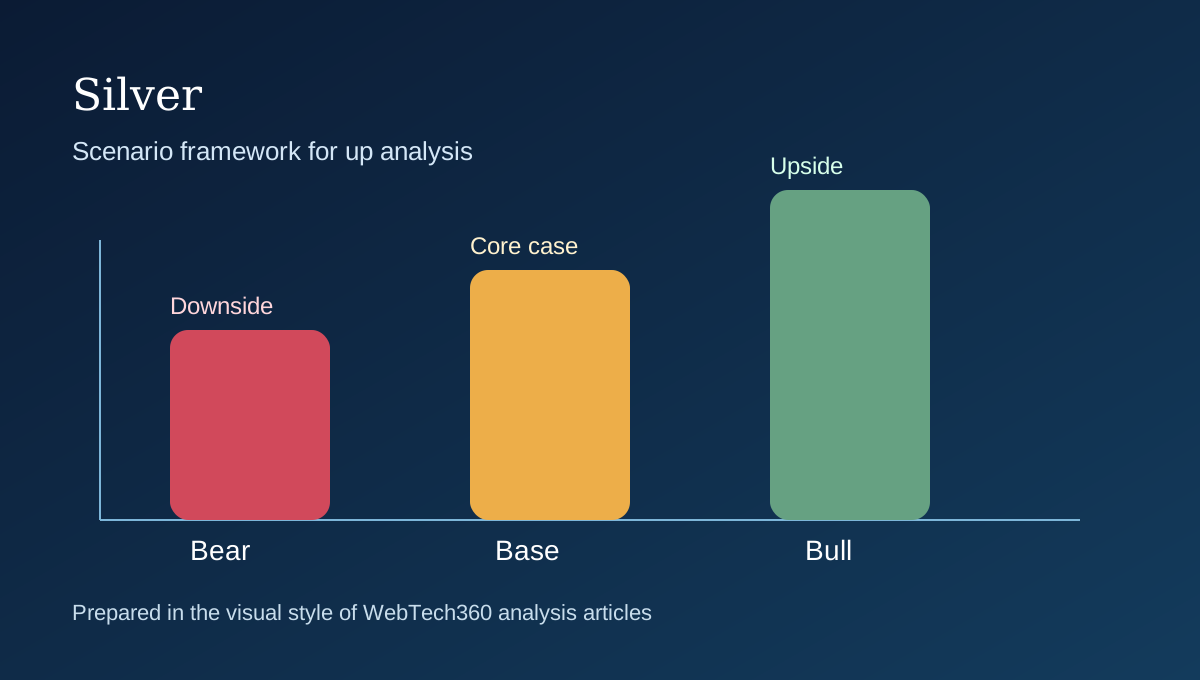
| AI strengthens the bull case | 25% | Industrial demand stabilizes or rises despite PV substitution, deficits persist, and macro inflation cools | $90-$120 by 2030 | Review after each annual Silver Institute survey and major macro update |
| AI remains an incremental support | 50% | AI, grid, and electronics demand help the floor but do not dominate aggregate demand | $75-$100 by 2030 | Review quarterly and after industrial-demand revisions |
| AI impact is overstated | 25% | PV substitution and macro headwinds keep overwhelming AI-related gains | $55-$75 by 2030 | Review immediately if industrial demand keeps slipping while inflation stays sticky |
The base case is that AI helps preserve silver's higher regime rather than single-handedly launching the next one.
References
Sources
- Yahoo Finance quote page for Silver futures (SI=F)
- Silver Institute 2026 market outlook, February 10, 2026
- Silver Institute, World Silver Survey 2026 release, April 15, 2026
- World Bank Commodity Markets Outlook, April 2026
- IMF World Economic Outlook, April 2026
- U.S. Bureau of Labor Statistics CPI release for April 2026, published May 12, 2026
- U.S. BEA Personal Consumption Expenditures Price Index