01. Historical Context
AI matters for AEX because the index is concentrated, global, and already near record levels
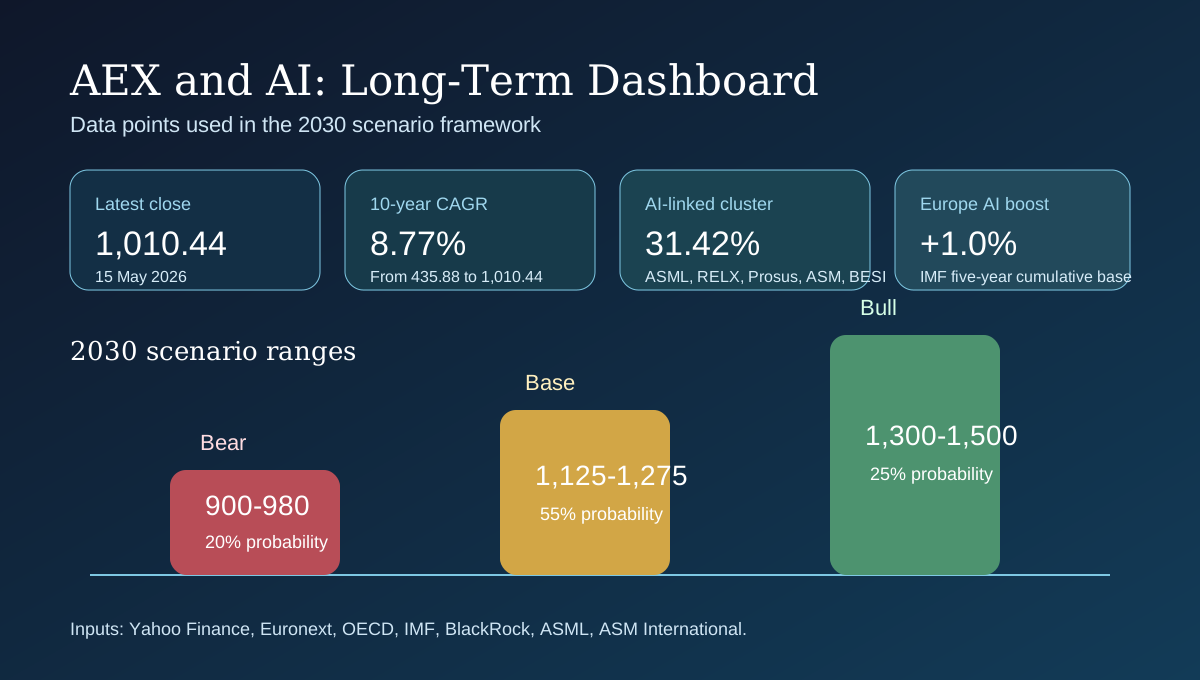
The AEX closed at 1,010.44 on 15 May 2026, versus 435.88 ten years earlier, a gain of 131.82% and a 10-year CAGR of 8.77% based on Yahoo Finance chart data. The monthly peak in the same 10-year window was 1,027.02 in January 2026, and the 52-week high in Yahoo metadata was 1,036.02. In other words, the market is not pricing the AEX as a distressed benchmark waiting for a story; it is pricing it as a mature, globally exposed index already close to its highs.
| Horizon | What matters most | What would strengthen the thesis | What would weaken the thesis |
|---|---|---|---|
| 1-3 months | Inflation, ECB stance, and semiconductor demand commentary | Euro area inflation cools from April's 3.0% and AI-linked earnings stay firm | Energy shock persists and management commentary turns cautious |
| 6-18 months | Whether AI capex converts into sales, margins, and revisions | Positive EPS revisions in Europe and continued equipment demand | Capex outruns monetization and valuation support fades |
| To 2030 | Whether AI lifts AEX cash flows beyond a narrow tech cluster | Broad productivity gains and wider sector participation | Benefits stay concentrated while regulation and rates cap multiples |
The composition matters. Euronext's 31 March 2026 factsheet shows that the top ten names make up 75.42% of the AEX, while the separate composition sheet shows Shell at 16.02%, ASML at 14.69%, Unilever at 12.41%, ING at 7.54%, and RELX at 6.11%. AI is therefore relevant to the AEX largely because a handful of very large businesses can move the entire index.
That concentration cuts both ways. It gives the AEX a direct line to semiconductor and information-services spending, but it also means AI is not yet a broad-based Dutch market story. The AI case is strongest if it spreads from semiconductor equipment and information services into consumer, industrial, financial, and healthcare earnings rather than remaining a narrow capex cycle.
02. Key Forces
Five ways AI could materially change the long-term AEX thesis
First, AI already has a direct earnings channel inside the AEX. ASML reported Q1 2026 net sales of EUR 8.8 billion and net income of EUR 2.8 billion, and said the semiconductor industry's growth outlook was continuing to solidify because of AI-related infrastructure investment. ASM International reported Q1 2026 revenue of EUR 862.5 million and an adjusted operating margin of 33.1%, saying AI-led demand accelerated further in the quarter. Those are not abstract AI narratives; they are current revenue and margin datapoints inside the index.
Second, the AEX has a meaningful but concentrated AI-linked weight. Using the 31 March 2026 Euronext composition, ASML, RELX, Prosus, ASM International, and BESI together account for 31.42% of the index. That is large enough for AI capex, AI software, digital content, and semiconductor packaging trends to matter at the index level, but still too concentrated to assume AI automatically lifts the whole benchmark.
Third, AI may improve the macro backdrop, but the upside is likely moderate in Europe unless adoption broadens. OECD wrote in April 2026 that AI could lift annual labour-productivity growth in G7 economies by 0.5 to 1.0 percentage point over the next 10 years in a central scenario. IMF's 4 April 2025 paper on Europe estimated productivity gains of around 1% cumulatively over five years for Europe as a whole, while warning that regulation could cut those gains by more than 30% if AI exposure were materially reduced in regulated tasks and sectors.
Fourth, adoption is moving from pilot to real usage. OECD reported on 28 January 2026 that 20.2% of firms used AI in 2025, up from 14.2% in 2024 and 8.7% in 2023. That matters for the AEX because a sustained AI thesis requires real diffusion into business processes, not just data-center spending at the start of the chain.
Fifth, AI can support valuation only if it eventually improves cash flow. One investable AEX proxy, the iShares AEX UCITS ETF, showed a P/E ratio of 18.31 and an earnings-per-share figure of 5.55 as of 14 May 2026 on BlackRock's product page. At that valuation, AI can justify upside if earnings compound, but it does not leave much room for a prolonged period in which spending rises faster than monetization.
| Factor | Why it matters | Current assessment | Bias |
|---|---|---|---|
| AI-linked index weight | Determines how much AI can move aggregate earnings | Meaningful at 31.42%, but still concentrated in a few names | Neutral to bullish |
| Semiconductor capex cycle | ASML, ASM and BESI are key transmission channels | Still supportive based on Q1 2026 company commentary | Bullish |
| Macro backdrop | Rates and growth determine how much valuation support survives | Mixed: euro area GDP grew only 0.1% qoq in Q1 2026 while unemployment stayed low at 6.2% | Neutral |
| Inflation and ECB | AI upside is worth less if discount rates stay elevated | Bearish near term after euro area inflation rose to 3.0% in April 2026 and the ECB held rates | Bearish |
| Valuation discipline | Sets the hurdle for AI to create returns, not just excitement | P/E at 18.31 is workable, but not cheap for a slow-growth macro region | Neutral |
The practical conclusion is that AI can reshape the AEX through earnings composition first and broad productivity later. The direct channel is already visible in semicap and information-services names. The broader channel still needs evidence.
03. Countercase
Why the AI case could still disappoint
The first risk is macro timing. Euro area GDP rose only 0.1% quarter on quarter in Q1 2026, according to Eurostat's flash estimate, while euro area inflation accelerated to 3.0% in April 2026 from 2.6% in March. On 30 April 2026 the ECB kept the deposit facility rate at 2.00% and explicitly warned that higher energy prices were intensifying upside inflation risks and downside growth risks. If that combination persists, AI enthusiasm may fail to offset the drag from higher real discount rates.
The second risk is concentration. The top ten AEX constituents account for 75.42% of the index. If AI demand remains mainly a semiconductor-equipment and platform story, the AEX may still benefit, but the upside can narrow quickly if one or two leaders de-rate or guide more cautiously.
The third risk is regulation and implementation drag. IMF's 2025 Europe paper estimated that regulation around safety, occupation-level requirements, and data privacy could cut Europe's productivity gains from AI by more than 30% in some scenarios. That does not kill the AI thesis, but it weakens the idea that Europe captures AI gains as quickly as the US narrative implies.
| Risk | Latest data point | Why it matters | Current assessment |
|---|---|---|---|
| Sticky inflation | Euro area CPI 3.0% in April 2026; Netherlands flash inflation 2.8% | Raises the chance that valuation support stays capped | Bearish |
| Soft growth | Euro area GDP +0.1% qoq in Q1 2026; Dutch GDP +0.1% qoq | Limits broad earnings participation outside direct AI winners | Neutral to bearish |
| Concentration risk | Top ten AEX weight 75.42% | Index-level outcome can hinge on a few names | Bearish |
| Valuation risk | iShares AEX ETF P/E 18.31 as of 14 May 2026 | Requires real earnings delivery, not only capex excitement | Neutral |
The countercase is not that AI is irrelevant. The countercase is that AI helps revenues and productivity more slowly than the market hopes, while inflation and regulation keep multiples from expanding enough to hide that delay.
04. Institutional Lens
What serious institutions actually say about AI and Europe
OECD's April 2026 report, Foundations for Growth and Competitiveness 2026, said AI could add 0.5 to 1.0 percentage point to annual labour-productivity growth across G7 economies over the next decade in a central scenario. That is a meaningful number, but it is not a claim that AI automatically produces a broad market rerating.
IMF's 4 April 2025 working paper, AI and Productivity in Europe, estimated medium-term productivity gains for Europe as a whole at around 1% cumulatively over five years, and found that regulation could cut those gains by more than 30% in some scenarios. That is the right way to think about the AEX: AI likely helps, but the medium-term macro boost in Europe may be modest unless adoption diffuses more broadly.
Goldman Sachs Research has remained more constructive on the long-run global productivity potential, writing that generative AI could raise global GDP by 7% and lift productivity growth by 1.5 percentage points over a 10-year period. That is a long-run global estimate, not an AEX forecast, but it explains why investors keep paying for the semicap side of the Dutch market.
| Institution | What it said | Date | Why it matters here |
|---|---|---|---|
| OECD | AI could add 0.5-1.0 percentage point to annual labour-productivity growth in G7 economies over 10 years | April 2026 | Supports a real macro upside case, but not a near-term blanket rerating |
| IMF | Europe-wide AI productivity gains around 1% cumulatively over five years; regulation could cut gains by more than 30% | 4 April 2025 | Shows Europe may monetize AI more slowly than US bulls assume |
| Goldman Sachs Research | Generative AI could raise global GDP by 7% and productivity growth by 1.5 percentage points over a decade | 2023 article, still cited by Goldman in later AI work | Explains why AI infrastructure and semicap exposure continue to command a premium |
| OECD | Firm AI use rose to 20.2% in 2025 from 14.2% in 2024 and 8.7% in 2023 | 28 January 2026 | Confirms diffusion is real, though still incomplete |
The message from credible institutions is consistent: AI has enough scale to matter for productivity and earnings, but the measurable benefits arrive unevenly, and Europe still faces more execution and regulatory friction than the most bullish narratives admit.
05. Scenarios
2030 scenarios with explicit probabilities and review triggers
The ranges below are author estimates, not sell-side price targets. They are anchored to the latest AEX level of 1,010.44, the 10-year CAGR of 8.77%, the current valuation snapshot from BlackRock's AEX ETF page, and the current euro-area macro data from Eurostat and the ECB.
| Scenario | Probability | Range | Trigger conditions | When to review |
|---|---|---|---|---|
| Bear | 20% | 900-980 | Euro area growth remains stuck near 0-1%, inflation stays too firm for meaningful easing, and AI gains remain narrow to semicap while broader sectors fail to re-rate | Reassess after each ECB quarterly projection and after 2026 and 2027 AEX earnings seasons |
| Base | 55% | 1,125-1,275 | ASML, ASM, BESI and digital-service leaders continue to grow, while AI gradually lifts productivity but does not transform the whole index at once | Reassess after each April and October euro area inflation update and after ASML annual guidance cycles |
| Bull | 25% | 1,300-1,500 | AI demand broadens beyond semicap, euro area inflation normalizes closer to target, and wider AEX sectors participate in earnings upgrades | Reassess if Europe EPS revisions broaden materially and if AEX breaks sustainably above its 2026 highs |
The base case range intentionally sits below what a simple extension of the last 10-year CAGR would imply. That is deliberate. It reflects the view that AI remains a positive structural force for the AEX, but Europe still faces a tougher macro and regulatory path than the most optimistic global AI narratives suggest.
For investors, the practical implication is simple: treat AI as a real structural support for the AEX, but demand proof that the gains are widening beyond a few flagship names. If that evidence appears, the bull case strengthens materially. If it does not, the index can still perform, but mostly through concentration rather than broad-based rerating.
References
Sources
- Yahoo Finance chart API for AEX 10-year monthly history
- Yahoo Finance chart API for AEX latest daily price metadata
- Euronext AEX Index factsheet, 31 March 2026
- Euronext AEX Index composition, 31 March 2026
- BlackRock iShares AEX UCITS ETF overview and key facts
- ASML Q1 2026 financial results
- ASM International Q1 2026 results
- OECD Foundations for Growth and Competitiveness 2026
- OECD announcement on AI adoption by firms and individuals, 28 January 2026
- IMF Working Paper: AI and Productivity in Europe, 4 April 2025
- Goldman Sachs Research on generative AI and global GDP
- Eurostat flash estimate: euro area GDP in Q1 2026
- Eurostat flash estimate: euro area inflation in April 2026
- Statistics Netherlands flash inflation estimate for April 2026
- ECB monetary policy decision, 30 April 2026