01. Historical Context
AI matters for CAC 40 because the index has real industrial infrastructure exposure, but also clear sector limits
The CAC 40 is not a pure AI index. Euronext's 31 March 2026 composition shows big weights in TotalEnergies, LVMH, Air Liquide, Sanofi, Airbus, Safran, BNP Paribas, and AXA. That means AI can reshape the benchmark only if it improves real profits in industrial automation, electrification, semiconductors, software, logistics, and enterprise productivity faster than slower-moving sectors dilute the effect.
| Horizon | What matters most | What would strengthen the thesis | What would weaken the thesis |
|---|---|---|---|
| 1-3 years | Orders, bookings, capex, and adoption evidence | Schneider, Air Liquide, STMicro, and Capgemini keep reporting AI-linked demand and monetization | AI talk rises faster than margins, bookings, or backlog |
| To 2030 | Diffusion across firms and power infrastructure | French SME and ETI adoption moves materially toward the 80% target and power supply remains supportive | Adoption stalls, regulation bites, or grid constraints slow deployment |
| To 2035 | Whether productivity gains broaden beyond enablers | AI raises index-level earnings growth above the long-run baseline | Benefits remain concentrated in a narrow set of suppliers while the rest of the index lags |
The starting point matters. The CAC 40 factsheet shows price-to-book of 3.24, price-to-sales of 2.55, price-to-cash-flow of 14.58, dividend yield of 2.96%, and historical price return since 31 December 1987 of 5.52% annualized. The public factsheet does not publish a CAC 40 P/E, so the cleanest long-run reference point is that historical return baseline. For AI to truly reshape the index, it needs to raise sustainable earnings growth above something close to that long-run pace.
The visible composition already includes several AI-adjacent channels. Schneider Electric is 7.57% of the index, Air Liquide 5.90%, Legrand 1.98%, Thales 1.34%, and STMicroelectronics 1.05% in the public composition snapshot. That visible slice alone represents at least 17.84% of the benchmark before counting other indirect beneficiaries. But the same index also has large exposures to energy, luxury, health care, and financials, so AI is a major driver only if it diffuses into those broader cash-flow streams too.
02. Key Forces
Five ways AI could materially change the decade-long thesis
First, French public policy is explicitly trying to accelerate diffusion. The government's Osez l'IA plan says AI is expected to deliver a 20% productivity gain per company, yet only 13% of French SMEs and ETIs have taken concrete steps so far. The plan's 2030 targets are ambitious: 100% of large groups using AI, 80% of SMEs and ETIs, and 50% of very small businesses, backed by a network of 300 AI ambassadors. If those targets are even partially achieved, the CAC 40 would operate in a much more AI-enabled domestic business environment by the end of the decade.
Second, France's energy profile is a real strategic advantage for AI infrastructure. The Ministry of the Economy's PPE 3 energy plan states that France in 2026 has electricity that is 95% decarbonized and among the most competitive in Europe. That matters because AI demand is not only a software story. It is also a power, cooling, grid, and equipment story. A country that can support compute growth with abundant lower-carbon power gives its listed industrial enablers a better operating backdrop.
Third, some CAC 40 constituents are already seeing the AI build-out in their numbers. Schneider Electric reported Q1 2026 revenue of EUR 9.767 billion, up 11.2% organically, with data centers the main growth driver. Air Liquide said Q1 sales were nearly EUR 6.8 billion, investment decisions reached EUR 1.5 billion, and backlog a record EUR 5.5 billion, including electronics projects for next-generation AI chips. STMicroelectronics said it expected data-center revenue nicely above USD 500 million in 2026 and well above USD 1 billion in 2027. Capgemini reported Q1 bookings of EUR 6.054 billion, with generative and agentic AI representing more than 11% of group bookings.
Fourth, the macro productivity upside is real, but modest unless diffusion broadens. IMF research on 31 European countries estimates medium-term productivity gains for Europe as a whole at around 1% cumulatively over five years in the base case. The same IMF research says national and EU regulations around occupation-level requirements, AI safety, and data privacy could cut Europe's productivity gains by more than 30% if AI exposure were 50% lower in affected tasks, occupations, and sectors. That is a useful discipline: the upside exists, but it is conditional.
Fifth, the global upside is still large if policy and adoption align. In February 2026, IMF Managing Director Kristalina Georgieva said IMF estimates show AI could fuel a boost to global productivity of up to 0.8 percentage points per year with the right measures in place. That upper-end upside is what the market is trying to price in. But for the CAC 40 to capture it, the index needs wide adoption, not just a handful of data-center beneficiaries.
| Factor | Why it matters | Current assessment | Bias |
|---|---|---|---|
| Policy diffusion | Broad adoption determines whether AI reaches the whole economy | France targets 80% SME/ETI usage by 2030, but the starting point is only 13% | Neutral to bullish |
| Power and infrastructure | AI needs electricity, cooling, automation, and grid upgrades | France says its electricity mix is 95% decarbonized in 2026 and competitive in Europe | Bullish |
| Listed enablers | Selected components can translate AI capex into earnings | Schneider, Air Liquide, STMicro, and Capgemini all report AI-linked demand signals | Bullish |
| Economy-wide productivity | Determines whether AI changes the index, not just a few stocks | IMF base work points to only around 1% cumulative gain over 5 years for Europe | Neutral |
| Index mix and valuation | Large non-AI sectors dilute any blanket rerating | Top ten weights are 59.64%, with energy, luxury, health care, and banks still very large | Neutral to bearish |
The most realistic AI bull case for the CAC 40 is therefore not a pure technology narrative. It is a blended story in which infrastructure beneficiaries deliver first, enterprise adoption follows, and productivity eventually spreads into a broader share of index earnings.
03. Countercase
Why the AI story can still disappoint long-term investors
The first risk is weak diffusion. The French government is targeting 80% AI adoption among SMEs and ETIs by 2030, but the current starting point is only 13%. That gap is large. If adoption remains concentrated in big corporates and specialist vendors, the CAC 40 will still have winners, but the benchmark-wide payoff will be smaller than headline enthusiasm suggests.
The second risk is regulation. IMF research says national and EU rules around AI safety, data privacy, and occupation-level requirements could reduce Europe's productivity gains by more than 30% in a lower-exposure scenario. That does not mean regulation is bad. It does mean the market should be careful about assuming US-style AI monetization speeds in a more regulated European operating environment.
The third risk is that AI can raise system risk even as it raises productivity. In May 2026, the IMF warned that extreme cyber-incident losses could trigger funding strains, raise solvency concerns, and disrupt broader markets as AI-enabled cyberattacks become more powerful. For an index with heavy exposure to banks, insurers, telecoms, and critical industrial systems, that risk is relevant.
The fourth risk is simple sector math. The CAC 40 is still dominated by large weights in energy, luxury, health care, and finance. LVMH's Q1 2026 organic growth was only 1%, with Fashion and Leather Goods down 2% organically. France's GDP was flat in Q1 2026 and unemployment rose to 8.1%. AI can help productivity, but it does not erase cyclical demand pressure or domestic macro weakness.
| Risk | Latest data point | Why it matters | Current assessment |
|---|---|---|---|
| Adoption gap | 13% of French SMEs and ETIs engaged today versus 80% target by 2030 | Shows how much execution remains before AI is economy-wide | Bearish |
| Regulatory drag | IMF says Europe-wide productivity gains could be cut by more than 30% in a lower-exposure regulatory scenario | Limits the speed of monetization and diffusion | Bearish |
| Cyber and resilience | IMF warns extreme AI-enabled cyber losses could trigger funding strains and broader market disruption | Creates a financial-stability channel, not just an operational nuisance | Bearish |
| Index composition | Top ten weights total 59.64%; TotalEnergies is 9.52%, LVMH 6.63%, STMicro 1.05% | AI winners may not be large enough to rerate the whole benchmark quickly | Neutral to bearish |
| Macro backdrop | France GDP 0.0% qoq in Q1 2026, unemployment 8.1%, euro area CPI 3.0% | Weak demand or sticky inflation can delay AI payoff into reported earnings | Bearish |
The long-term AI thesis only becomes robust when these risks stay manageable and the corporate proof points keep broadening. Without that diffusion, AI helps a slice of the index rather than reshaping the benchmark.
04. Institutional Lens
What serious public and institutional research actually says
The best long-term AI work is more restrained than market hype. IMF Working Paper 2025/067 modeled 31 European countries and found that Europe's medium-term productivity gains from AI adoption are likely to be around 1% cumulatively over five years in the baseline case. That is positive, but modest. It supports a structural uplift story, not an immediate index-wide boom.
French public policy is far more ambitious than the IMF baseline. The Osez l'IA plan says AI is a competitiveness lever with an expected 20% productivity gain per company and aims to push French SME and ETI adoption to 80% by 2030, with 300 ambassadors supporting the rollout. The gap between those policy ambitions and the IMF's more modest Europe-wide baseline is exactly where the investment debate sits: the upside is real, but execution will determine how much of it the CAC 40 captures.
Market research adds one more discipline. J.P. Morgan Asset Management said on its 2026 outlook page available in May 2026 that diversification helps hedge portfolios against the risk of retrenchment in AI sentiment and that returns are likely to become more earnings-driven than multiple-driven. That is the right way to read the CAC 40 as well. AI can lift the ceiling, but the ceiling only matters if cash flows follow.
| Source | What it said | Date | Read-through for CAC 40 |
|---|---|---|---|
| IMF Working Paper 2025/067 | AI adoption in 31 European countries implies around 1% cumulative productivity gain over 5 years; regulation could reduce gains by over 30% | 4 April 2025 | Baseline upside exists, but it is modest unless diffusion and regulation improve |
| IMF Managing Director speech | AI could lift global productivity by up to 0.8 percentage points per year with the right measures in place | 3 February 2026 | Shows the upside range if adoption and preparedness are strong |
| French Economy Ministry / Osez l'IA | Expected productivity gain of 20% per company; 13% of SMEs and ETIs engaged; targets of 80% SME/ETI adoption, 50% TPE adoption, and 100% large-group adoption by 2030 | 1 July 2025 launch; 14 May 2026 France 2030 follow-up | French policy is pushing hard for diffusion, but the starting point is low |
| French PPE 3 energy plan | France has electricity that is 95% decarbonized in 2026 and among the most competitive in Europe | 2026 government energy plan | Supports the physical infrastructure side of AI deployment |
| J.P. Morgan Asset Management | Diversification hedges retrenchment in AI sentiment and future returns should be increasingly earnings-driven | 2026 outlook page available in May 2026 | AI enthusiasm alone is not enough; investors need profit conversion |
The institutional conclusion is clear: AI can reshape the CAC 40, but the benchmark needs diffusion, infrastructure, and execution to turn potential into a durable index-level earnings tailwind.
05. Scenarios
Actionable long-term scenarios through 2035
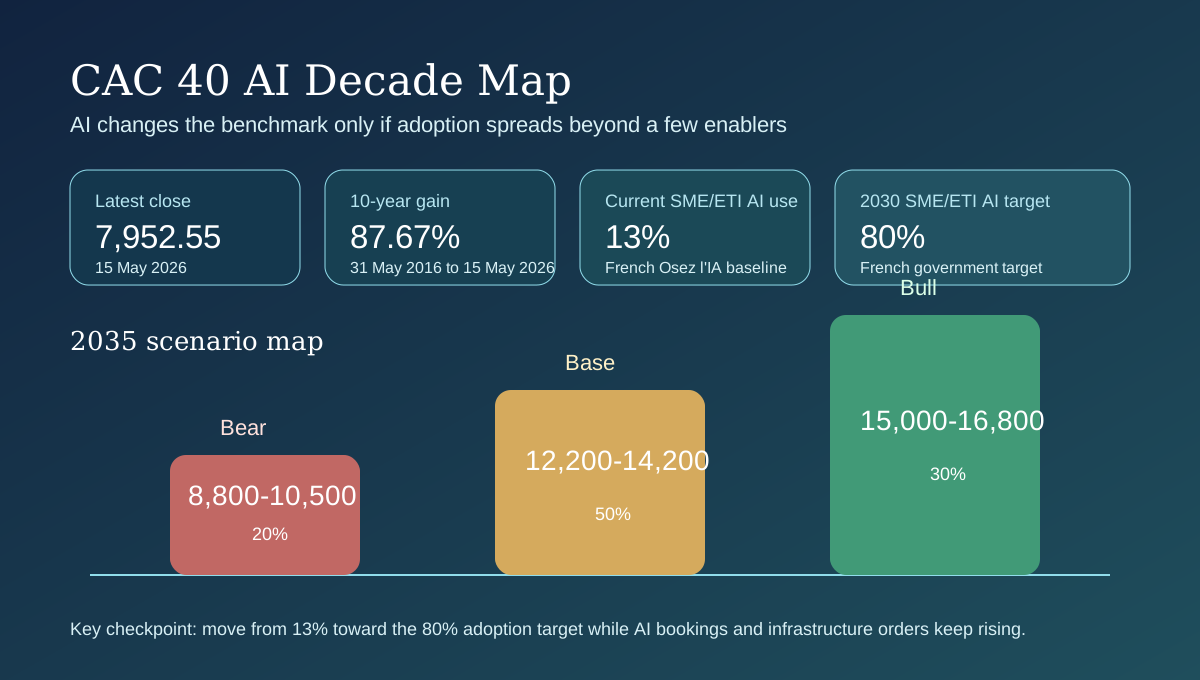
The ranges below are author estimates based on the current CAC 40 level of 7,952.55, the index's 87.67% ten-year gain, Euronext's 5.52% long-run annualized price return since 1987, the current sector mix, the French AI policy targets, and the institutional research cited above. They are not third-party price targets.
| Scenario | Probability | 2035 range | Trigger conditions | When to review |
|---|---|---|---|---|
| Bull | 30% | 15,000-16,800 | French SME and ETI AI adoption tracks materially toward the 80% target by 2030, AI-enabling constituents keep compounding earnings, and Europe captures more than the IMF baseline productivity gain | Review annually after major CAC 40 full-year results and after government AI adoption updates |
| Base | 50% | 12,200-14,200 | AI benefits remain strongest in industrial and software leaders, adoption improves but with delays, and the index compounds near or modestly above its historical trend | Review each year and again at the 2030 policy milestone |
| Bear | 20% | 8,800-10,500 | Adoption remains far below targets, regulation and cyber risk slow monetization, and AI capex outpaces realized margin or productivity gains for several years | Review early if AI-linked capex keeps rising while corporate margin commentary stops improving |
The practical takeaway is that AI should be treated as a dispersion story first and a benchmark story second. The CAC 40 does have real winners in electrification, semiconductors, industrial gases, and enterprise technology. But for the whole index to be meaningfully re-shaped by AI, those gains have to spread well beyond the current enablers.
The decade bull case is therefore plausible, but it is not automatic. It needs adoption to move from 13% toward the government's targets, and it needs corporate evidence to keep turning AI demand into revenue, backlog, margin, and free cash flow.
References
Sources
- Yahoo Finance chart API for CAC 40 10-year monthly history
- Yahoo Finance chart API for CAC 40 latest daily price metadata
- Euronext CAC 40 factsheet, 31 March 2026
- Euronext CAC 40 composition, 31 March 2026
- French government Osez l'IA plan
- French Economy Ministry overview of the national AI strategy
- France 2030 AI call for sovereign SME and ETI solutions
- French PPE 3 energy plan
- IMF Working Paper: AI and Productivity in Europe
- IMF speech on AI and productivity preparedness, 3 February 2026
- IMF blog: How Europe Can Capture the AI Growth Dividend
- IMF blog on AI-enabled cyber risk and financial stability
- Schneider Electric Q1 2026 revenues
- Air Liquide Q1 2026 activity update
- STMicroelectronics Q1 2026 financial results
- Capgemini Q1 2026 revenues
- LVMH Q1 2026 revenue release
- Insee GDP flash estimate for Q1 2026
- Insee unemployment release for Q1 2026
- Eurostat flash estimate: euro area inflation in April 2026
- J.P. Morgan Asset Management: global ex-US equities outlook