01. Historical Context
AI matters for the DAX because the benchmark already owns several real beneficiaries
The DAX is not an AI pure-play index, but it is no longer AI-agnostic either. STOXX's DAX page lists Siemens, Allianz, SAP, Siemens Energy, Airbus, Deutsche Telekom, Munich Re, Infineon, Rheinmetall and Deutsche Bank among the top ten components. The direct AI and infrastructure leverage is concentrated mainly in SAP, Siemens, Siemens Energy and Infineon. That concentration is important: AI can reshape the index materially even if only a few heavyweights outperform, but it will not transform the whole benchmark overnight.
| Horizon | What AI must improve | Current evidence | What would strengthen the thesis | What would weaken the thesis |
|---|---|---|---|---|
| 1-2 years | Visible revenue and backlog growth in AI-linked leaders | SAP cloud backlog is up 20%, Siemens digital business is up 19%, and Infineon says AI data-center demand is very high | More DAX constituents begin quantifying AI-enabled revenue or margin gains | AI enthusiasm stays confined to a few companies without index-wide spillover |
| 2028-2030 | Productivity diffusion across Germany's industrial base | EU AI infrastructure is expanding, but most public evidence is still company-specific | Industrial AI, grid investment and software adoption start lifting aggregate earnings breadth | AI remains a capex cycle with narrow profit capture |
| 2031-2035 | Durable earnings and valuation support at index level | The DAX already has strong digital and electrification champions, but also many non-AI-heavy sectors | AI improves competitiveness across factories, logistics, power systems and services | AI becomes a cost of staying relevant rather than a differentiated return driver |
The long-run price record gives a useful anchor. Yahoo Finance data show the DAX rising from 9,680.09 on 31 May 2016 to 23,950.57 on 15 May 2026, a 147.42% gain, or 9.53% annualized. If the index repeated that annualized return for another nine years, it would reach roughly 54,000 by 2035. That is a demanding bull case, not a default forecast. For that path to become realistic, AI would need to expand the DAX's earnings power beyond today's software, chip and grid-infrastructure winners.
Valuation also argues for discipline. Goldman Sachs Research said on 15 January 2026 that Europe traded at 15x 2026 earnings, around the 70th to 71st percentile of its own history. Simply Wall St's German market page, updated 16 May 2026 using S&P Global Market Intelligence data, showed an aggregate market P/E of 17.2x and expected earnings growth of 17% annually. That is not cheap enough for investors to pay twice for the same AI story.
02. Key Forces
Five ways AI could materially change the index over the next decade
The first channel is enterprise software monetization through SAP. In its Q1 2026 results released on 23 April 2026, SAP said current cloud backlog reached EUR 21.9 billion, up 20% reported and 25% at constant currencies, while cloud revenue rose 19% reported and 27% at constant currencies. CEO Christian Klein explicitly tied that performance to momentum in Business AI. Because SAP is one of the largest DAX weights, that kind of growth matters at index level even before it spreads elsewhere.
The second channel is industrial AI and automation through Siemens. Siemens said on 13 May 2026 that its digital business grew 19% in the first half of fiscal 2026, its order backlog reached a record EUR 124 billion, and AI is a clear growth driver for its hardware, software and services business. That matters because industrial AI is one of the most plausible ways for Germany's broader manufacturing base to raise productivity rather than simply talk about it.
The third channel is the semiconductor and power stack through Infineon. Infineon's 2025 annual report says revenue from power supply solutions for AI data centers nearly tripled in fiscal 2025 to over EUR 700 million and that its 2026 revenue forecast for that business was raised from about EUR 1 billion to around EUR 1.5 billion. In its Q2 FY2026 release on 6 May 2026, the company added that the AI boom is strengthening further and that its power supply solutions for AI data centers are in very high demand. That is one of the cleanest public examples of AI already converting into real DAX earnings.
The fourth channel is the power and grid buildout that AI requires. Siemens Energy said on 12 May 2026 that orders hit a record EUR 17.7 billion, order backlog reached EUR 154 billion, and Grid Technologies was strong enough to help lift the company's 2026 revenue growth guidance to 14% to 16%, with free cash flow pre tax now seen around EUR 8 billion. AI does not only need software and chips; it also needs transmission, grid equipment and reliable power infrastructure. The DAX owns that part of the stack too.
The fifth channel is policy support and ecosystem depth. The European Commission said on 9 April 2026 that 19 AI Factories and 13 AI Factory antennas were already operational, and that the call for AI Gigafactories drew 76 responses across 60 sites in 16 member states. The same update said Apply AI calls worth up to EUR 1 billion had opened across strategic sectors. That does not guarantee DAX profits, but it does improve the odds that Europe remains a meaningful AI adoption region rather than just a consumer of non-European infrastructure.
| Factor | Latest evidence | Current assessment | Bias |
|---|---|---|---|
| Software monetization | SAP current cloud backlog EUR 21.9 billion, up 20%; cloud revenue up 19% | AI already appears in a large DAX winner's financial results | Bullish |
| Industrial AI adoption | Siemens digital business +19% in H1 FY2026; AI called a clear growth driver | Strong evidence that industrial AI is moving from concept to revenue support | Bullish |
| AI infrastructure semis | Infineon AI data-center power revenue over EUR 700 million in FY2025 and forecast around EUR 1.5 billion in FY2026 | One of the clearest direct AI earnings beneficiaries in the index | Bullish |
| Power and grids | Siemens Energy order backlog EUR 154 billion; 2026 free cash flow pre tax now seen around EUR 8 billion | Grid buildout gives the DAX a second-order AI infrastructure lever | Bullish |
| Diffusion beyond leaders | Top DAX weights still include insurers, banks, telecoms and aerospace names with less direct AI monetization | AI benefits are real, but still concentrated rather than broad-based | Neutral |
The most important distinction is between AI as a stock-picker theme and AI as an index-wide productivity regime. The DAX already has credible exposure to the first. The second is the real decade-long question.
03. Countercase
Why the AI story can still disappoint investors
The biggest risk is concentration. STOXX's DAX page shows that the benchmark's top tier still contains many companies whose earnings are driven more by finance, insurance, autos, chemicals, defense or telecom than by direct AI monetization. If SAP, Siemens and Infineon outperform but the rest of the index lags, AI can create winners without dramatically changing the index multiple.
A second risk is that capex arrives faster than productivity. Goldman Sachs Research wrote in December 2025 that AI companies may invest more than USD 500 billion in 2026 and warned that the timing of any slowdown in capex growth poses a risk to valuations. That warning matters for the DAX because some beneficiaries, especially in power and semiconductor infrastructure, are already being rewarded for future demand that still has to translate into durable earnings.
Third, macro conditions can delay the payoff. Destatis said Germany's CPI rose 2.9% in April 2026 and Eurostat estimated euro area inflation at 3.0%, both pushed up by energy. The IMF's April 2026 World Economic Outlook explicitly lists disappointment around AI-driven productivity as a downside risk for growth and markets. If energy costs or weak demand absorb the gains, the AI story may improve company capabilities without immediately improving aggregate equity returns.
| Risk | Latest evidence | Why it matters | Current bias |
|---|---|---|---|
| Narrow leadership | Public AI monetization evidence is strongest in SAP, Siemens, Infineon and Siemens Energy | A few leaders can outperform without lifting the whole benchmark | Neutral |
| Capex outruns profits | Goldman flags AI capex above USD 500 billion in 2026 and sees valuation risk if growth slows | Infrastructure winners can de-rate if markets decide demand is already fully priced | Neutral to bearish |
| Macro drag | Germany CPI 2.9% and euro area inflation 3.0% in April 2026 | Energy shocks and higher real rates can delay productivity payoffs | Bearish |
| Policy diffusion risk | EU AI support is real, but adoption still needs to spread from leaders into the wider economy | Policy frameworks help, yet they do not guarantee index-level earnings breadth | Neutral |
| Valuation hurdle | Europe trades near 15x 2026 earnings and the German aggregate market P/E is 17.2x | Investors still need cash-flow proof before granting a durable AI premium | Neutral |
The bearish AI case is therefore not that the technology is fake. It is that the financial benefit may remain too concentrated, too delayed, or too expensive to produce a broad index rerating.
04. Institutional Lens
What the best public evidence says about DAX 40 and AI
The institutional view is constructive on European AI, but it is notably more practical than the typical market narrative. Public evidence points to four real pillars: software monetization, industrial AI deployment, AI power semiconductors, and the power-grid buildout that underpins compute expansion. That is enough to matter for the DAX, but not enough to make every constituent an AI stock.
| Source | What it said | Updated | Why it matters here |
|---|---|---|---|
| SAP Q1 2026 results | Current cloud backlog EUR 21.9 billion, up 20%; cloud revenue up 19%; management tied performance to Business AI momentum | 23 April 2026 | Shows that one of the DAX's biggest weights is already monetizing AI-linked software demand |
| Siemens Q2 2026 release | Digital business up 19% in H1 FY2026; order backlog at a record EUR 124 billion; AI described as a clear growth driver | 13 May 2026 | Supports the industrial AI productivity thesis inside Germany's manufacturing base |
| Infineon Annual Report 2025 | AI data-center power revenue nearly tripled to over EUR 700 million in FY2025; FY2026 revenue forecast raised from about EUR 1 billion to around EUR 1.5 billion | Published in 2026 FY2025 reporting cycle | Provides rare, concrete AI revenue numbers from a DAX semiconductor leader |
| Infineon Q2 FY2026 release | The AI boom is strengthening further and power solutions for AI data centers are in very high demand | 6 May 2026 | Confirms that the demand trend continued into 2026 |
| Siemens Energy Q2 FY2026 release | Orders EUR 17.7 billion, order backlog EUR 154 billion, 2026 revenue growth guidance lifted to 14% to 16% | 12 May 2026 | Shows the DAX also owns part of the electricity and grid stack needed for AI |
| European Commission AI Continent update | 19 AI Factories and 13 antennas operational; 76 gigafactory expressions of interest across 60 sites in 16 member states; Apply AI calls worth up to EUR 1 billion | 9 April 2026 | Improves the odds that Europe remains relevant in AI adoption and infrastructure |
| Goldman Sachs Research | Europe may have an edge in developing AI applications; European unicorns have more than tripled to 413 since 2016 | 17 March 2026 | Supports the view that Europe's opportunity is stronger in applied AI than in foundational models |
| IMF World Economic Outlook | Disappointment around AI-driven productivity is a downside risk for growth and markets | 14 April 2026 | Reminds investors that AI optimism can reverse if macro payoff lags |
The practical takeaway is that AI already matters for DAX sector leadership. The open question is when that leadership becomes broad enough to reshape index-level earnings and valuation for an extended period.
05. Scenarios
What AI could mean for the DAX over the next decade
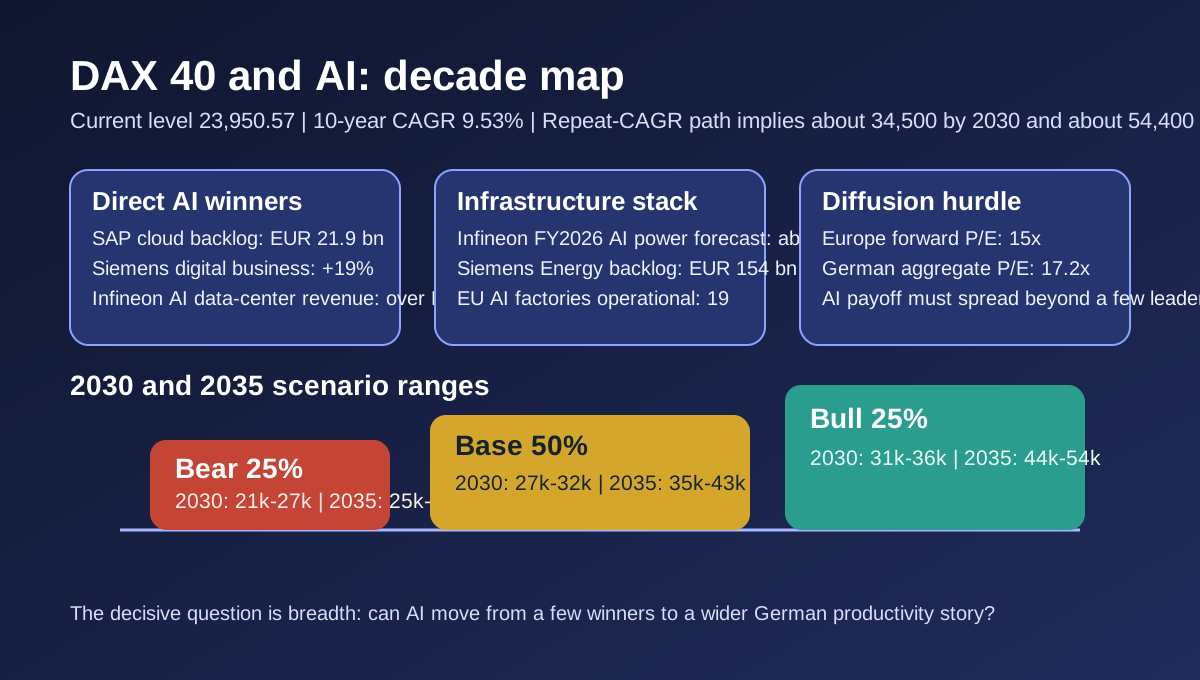
One useful anchor is the last decade's return profile. Repeating the DAX's 9.53% annualized gain from the current 23,950.57 level would imply roughly 34,500 by 2030 and about 54,400 by 2035. That is a useful ceiling for the most optimistic case, not a neutral assumption. A disciplined base case should assume slower compounding unless AI benefits diffuse far beyond today's leaders.
| Scenario | Probability | Trigger | 2030 range | 2035 range | When to re-check |
|---|---|---|---|---|---|
| Bull | 25% | AI-driven profit growth broadens from SAP, Siemens, Infineon and grid names into a wider set of industrial and service companies | 31,000-36,000 | 44,000-54,000 | Re-check after each full-year reporting cycle and after major EU and German AI infrastructure updates |
| Base | 50% | AI remains a real but concentrated earnings tailwind, while the rest of the index benefits only gradually through productivity and capex spillovers | 27,000-32,000 | 35,000-43,000 | Re-check annually against earnings breadth, adoption evidence and macro conditions |
| Bear | 25% | AI capex remains high but profit capture stays narrow, while energy costs and weak growth absorb much of the productivity upside | 21,000-27,000 | 25,000-34,000 | Re-check whenever revision breadth weakens materially or AI spending outpaces visible returns |
The most realistic conclusion is that AI can reshape DAX leadership before it reshapes the full index multiple. That still matters. A benchmark with exposure to enterprise software, industrial automation, power semiconductors and grid equipment has more genuine AI leverage than many traditional country indices.
But the next decade will still be decided by breadth. If AI stays concentrated in a few champions, the DAX becomes a better stock-picking market. If the productivity gains spread across Germany's wider industrial economy, the index itself can compound on a meaningfully higher path.
References
Sources
- Yahoo Finance chart API for DAX 40 10-year monthly history
- Yahoo Finance chart API for DAX 40 latest daily prices
- STOXX DAX index page for methodology and top components
- Simply Wall St German market valuation page using S&P Global Market Intelligence data, updated 16 May 2026
- SAP Q1 2026 results, published 23 April 2026
- Siemens Q2 2026 release, published 13 May 2026
- Infineon Annual Report 2025
- Infineon Q2 FY2026 release, published 6 May 2026
- Siemens Energy Q2 FY2026 release, published 12 May 2026
- European Commission update on the AI Continent Action Plan, 9 April 2026
- Goldman Sachs Research on Europe's AI application layer, 17 March 2026
- Goldman Sachs Research on AI capex, 18 December 2025
- Goldman Sachs Research: European stocks outlook, 15 January 2026
- IMF World Economic Outlook, April 2026
- Destatis CPI release for April 2026
- Eurostat flash estimate for euro area inflation in April 2026