01. Historical Context
AI matters for this index because the benchmark already owns real enablers
The EURO STOXX 50 is not an abstract AI proxy, but it is also not AI-empty. Yahoo Finance chart data show the index at 5,827.76 on 15 May 2026, 5.06% below its January 2026 monthly peak of 6,138.41 and 6.00% below its 52-week high of 6,199.78. Over the past decade it rose from 2,864.74 on 31 May 2016 to 5,827.76, a gain of 103.43%. That long-run move means the next decade's return will depend less on discovering AI and more on whether AI can extend earnings growth from an already mature base.
| Horizon | What matters most | What would strengthen the thesis | What would weaken the thesis |
|---|---|---|---|
| 1-3 months | Q2 reporting, ECB tone, and whether AI-linked leaders keep guiding up | ASML, SAP, Siemens, Schneider, and Infineon keep linking demand to AI, while euro area inflation moves back toward 2.5% | Large-cap AI winners hold up but the rest of the index sees weaker revisions and the ECB stays cautious because inflation is near 3.0% |
| 6-18 months | Adoption breadth and whether AI spend turns into operating leverage | AI use broadens from pilot use to moderate or significant use across more euro area firms, and earnings revisions stay positive | Capex rises faster than productivity, or AI benefit remains concentrated in a few index members |
| To 2030 | Productivity diffusion, grid buildout, and valuation discipline | Enterprise software, semicap, industrial automation, and grid capex all convert into durable EPS growth without a major de-rating | Regulation, energy bottlenecks, and low-intensity adoption keep macro productivity gains modest |
The latest public STOXX factsheet, dated 31 March 2026, showed France at 33.4% of the index, Germany at 29.5%, and the Netherlands at 14.6%. The same factsheet put sector weights at 16.6% banks, 16.0% technology, 16.0% industrial goods and services, 8.4% energy, 6.9% insurance, and 5.9% healthcare. It also showed 17.2x trailing P/E, 14.7x projected P/E, 2.0 price-to-book, 2.6% dividend yield, 1.6 price-to-sales, and 21.2 price-to-cash-flow.
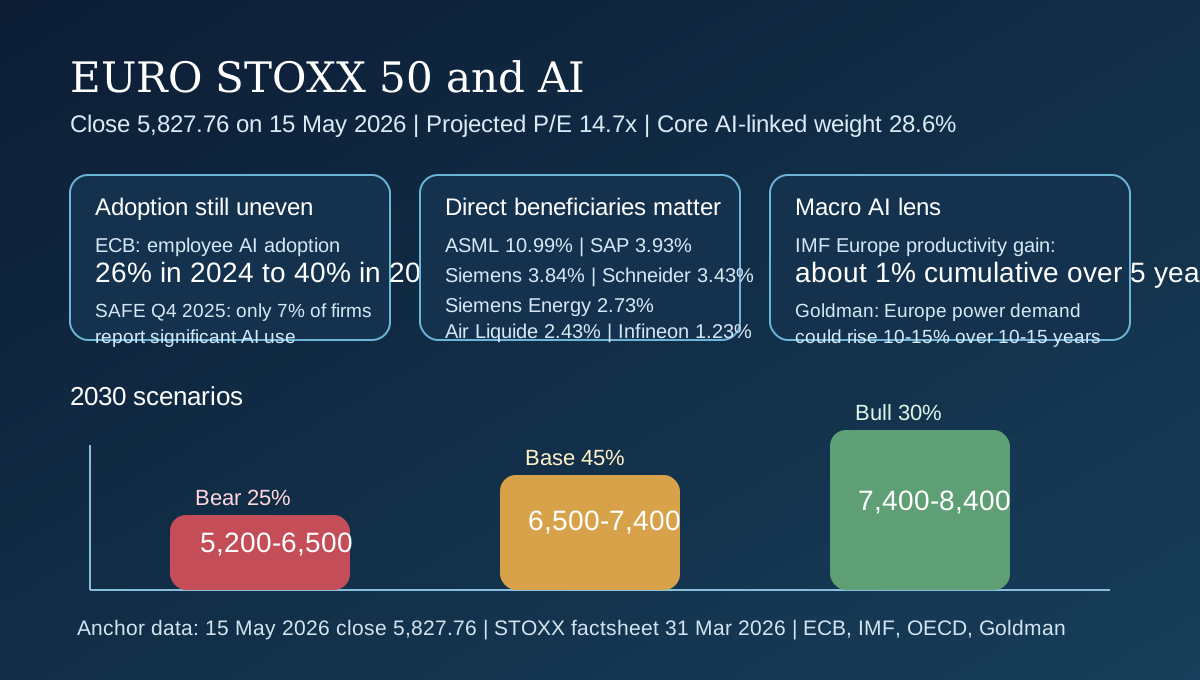
The composition data matter because AI exposure is real but uneven. As of the latest public components page, ASML carried a 10.99% weight, SAP 3.93%, Siemens 3.84%, Schneider Electric 3.43%, Siemens Energy 2.73%, Air Liquide 2.43%, and Infineon 1.23%. Together those seven names represented 28.58% of the index. That is enough to move the benchmark if AI spending and productivity keep feeding through, but not enough to guarantee that every sector benefits equally.
02. Key Forces
Five ways AI could materially change the long-run index path
First, the index already owns a large block of direct AI enablers. ASML reported Q1 2026 net sales of EUR 8.8 billion and lifted its 2026 sales outlook to EUR 36-40 billion, saying semiconductor growth continues to be driven by AI-related infrastructure investment. SAP reported on 23 April 2026 that current cloud backlog reached EUR 21.9 billion and cloud revenue rose 27% at constant currencies, with management explicitly pointing to Business AI momentum. This is why the AI story for the EURO STOXX 50 starts with existing constituents rather than with speculative future entrants.
Second, enterprise and industrial adoption is spreading, but the intensity is still mixed. In a 23 March 2026 speech, the ECB said employee AI adoption in its Consumer Expectations Survey rose from 26% in 2024 to 40% in 2025. The ECB also said two-thirds of the 5,000 firms in SAFE reported that employees use AI. But SAFE's fourth-quarter 2025 results showed the split was still uneven: 27% of euro area firms do not use AI, 33% use it very infrequently, 31% use it moderately, and only 7% use it significantly. That is constructive for the long run, but it is not yet the kind of broad adoption profile that justifies a market-wide rerating today.
Third, the macro productivity upside for Europe is positive but not automatically large. The IMF working paper AI and Productivity in Europe, published 4 April 2025, estimated that medium-term productivity gains for Europe as a whole are likely to be around 1% cumulatively over five years. The authors also found that national and EU regulation could reduce those gains by more than 30% if AI exposure were 50% lower in regulated tasks, occupations, and sectors. That makes AI a real growth lever, but also a reminder that diffusion and policy design matter as much as technical capability.
Fourth, AI changes the power and infrastructure complex, which matters for this index because industrial and grid names are large enough to benefit. Goldman Sachs published on 4 February 2025 that AI and traditional data centers could lift Europe's power demand by 10-15% over the coming 10-15 years and that the European data-center pipeline amounts to about 170 GW, roughly one-third of the region's power consumption. That is directly relevant to Siemens Energy, Schneider Electric, Siemens, Air Liquide, and utilities such as Iberdrola and Enel, but it also creates a capex and bottleneck risk if grid buildout lags demand.
Fifth, Europe's AI opportunity may be stronger in the application layer than in foundation-model ownership. Goldman Sachs wrote on 17 March 2026 that European companies may have an edge in developing AI applications, and cited Atomico data showing that the number of European unicorns has more than tripled to 413 since 2016, with almost three dozen new unicorns created in 2025 and early 2026. That is supportive for the region's software and services ecosystem, but most of that growth still has to show up in public-market earnings before it becomes an index-level re-rating story.
| Factor | Why it matters | Current assessment | Bias |
|---|---|---|---|
| Index composition | Large direct beneficiaries can move the benchmark even before broad adoption arrives | Seven core AI-linked enablers account for 28.58% of index weight | Bullish |
| Adoption breadth | Broad productivity gains need more than pilot use | SAFE shows 27% no AI use, 33% very infrequent use, 31% moderate use, and 7% significant use | Neutral |
| Macro productivity | This decides whether AI becomes a market-wide rather than stock-specific driver | IMF sees roughly 1% cumulative productivity gain over five years for Europe as a whole | Neutral |
| Power and industrial buildout | AI needs grids, cooling, gases, and automation hardware | Goldman estimates a 10-15% boost to European power demand over 10-15 years and a 170 GW data-center pipeline | Bullish |
| Valuation discipline | Even a good AI theme can disappoint if the starting multiple is already full | STOXX published 17.2x trailing P/E and 14.7x projected P/E on 31 March 2026 | Neutral |
The practical read-through is that AI is already material to the benchmark, but mainly through identified winners and enabling infrastructure. The broader index still needs firmer evidence that AI is lifting margins, demand, and productivity outside those obvious beneficiaries.
03. Countercase
Why the AI story could still under-deliver for index investors
The first risk is that adoption stays shallow for longer than the market expects. SAFE's fourth-quarter 2025 survey is encouraging on usage, but only 7% of firms reported significant AI use. If that mix does not improve, AI may keep helping a handful of technology and industrial leaders while leaving most of the index with higher spending and only modest productivity gains.
The second risk is policy and regulatory friction. The IMF's April 2025 Europe productivity paper explicitly found that regulation around occupation-level requirements, safety, and data privacy could reduce productivity gains by more than 30% in a lower-exposure scenario. That does not argue against regulation, but it does argue against assuming that every euro of AI capex turns into a full euro of economic benefit for listed equities.
Third, the valuation starting point is not distressed. STOXX's 31 March 2026 factsheet showed 17.2x trailing P/E and 14.7x projected P/E. Those are workable numbers if AI keeps driving earnings, but they are not the kind of multiples that leave the index immune to disappointment. If the market decides AI is boosting capex more than profits, the re-pricing can come through the multiple even if the long-run technology story remains intact.
| Risk | Latest data point | Why it matters | Current assessment |
|---|---|---|---|
| Low-intensity adoption | SAFE Q4 2025: 27% no AI use, 33% very infrequent, 31% moderate, 7% significant | Broad index productivity gains need higher-intensity use than the current mix shows | Neutral to bearish |
| Regulatory drag | IMF estimated regulation could cut Europe's AI productivity gains by more than 30% in a lower-exposure scenario | Europe can still benefit from AI, but the payoff may be slower than equity markets prefer | Bearish |
| Energy and grid bottlenecks | Goldman sees a 170 GW European data-center pipeline and a 10-15% power-demand uplift over 10-15 years | Insufficient grid buildout would delay monetization and raise costs for users | Neutral |
| Valuation | STOXX published 17.2x trailing P/E and 14.7x projected P/E on 31 March 2026 | The index still needs earnings proof; it is not priced like a no-growth market | Neutral |
| Weak starting productivity base | OECD said euro area labor productivity fell 0.9% in 2023 and AI's impact is not yet evident in productivity statistics | A weak macro starting point raises the burden on company-level execution | Neutral to bearish |
The AI bull case for the EURO STOXX 50 therefore remains conditional. It gets stronger if adoption deepens, infrastructure keeps being built, and leading constituents keep translating AI demand into visible earnings. It weakens if the benchmark ends up with concentrated winners and a long tail of firms that spend without comparable payoff.
04. Institutional Lens
What the institutional research actually says
The most useful institutional work is not saying that AI automatically re-rates Europe. It is saying that Europe has identifiable AI winners, a real adoption wave, and a potentially meaningful infrastructure cycle, but that the macro payoff is highly sensitive to diffusion speed, regulation, and power availability.
| Source | What it said | Date | Read-through for EURO STOXX 50 |
|---|---|---|---|
| ECB speech by Philip R. Lane | Employee AI adoption rose from 26% in 2024 to 40% in 2025; two-thirds of SAFE firms reported employee AI use; slow adoption would raise TFP by about 0.2 percentage points per year | 23 March 2026 | Adoption is real, but index-wide productivity gains still depend on faster diffusion and reorganization |
| IMF Working Paper, AI and Productivity in Europe | Europe-wide productivity gains are likely to be around 1% cumulatively over five years; regulation could reduce gains by more than 30% in a lower-exposure scenario | 4 April 2025 | Supports a measured macro AI case rather than an automatic market-wide boom |
| Goldman Sachs Research | AI and traditional data centers could lift Europe's power demand by 10-15% over 10-15 years; European data-center pipeline is about 170 GW | 4 February 2025 | Constructive for grid, automation, power-equipment, and industrial-gas constituents |
| Goldman Sachs | Europe may have an edge in the AI application layer; European unicorns have more than tripled to 413 since 2016 and nearly three dozen were created in 2025 and early 2026 | 17 March 2026 | Good for the region's software ecosystem, but public-index monetization still needs proof |
| OECD AI page | 20.2% of firms reported AI use in 2025, up from 14.2% in 2024 and 8.7% in 2023 | OECD page accessed in May 2026 | Adoption is accelerating, but it is not yet close to universal across the corporate base |
The common message is disciplined, not euphoric. AI is already important to Europe's public markets, but the cleanest investment case is still in companies with direct pricing power, hard-to-replicate technology, or infrastructure bottlenecks that become more valuable as adoption rises.
05. Scenarios
Actionable AI scenarios through 2030
The ranges below are author estimates, not third-party index targets. They are built from the current index level, the latest public projected P/E of 14.7x, the 10-year price history, current constituent weights, and the institutional work cited above.
| Scenario | Probability | 2030 range | Trigger conditions | When to review |
|---|---|---|---|---|
| Bull | 30% | 7,400-8,400 | AI-linked leaders keep compounding, firm-level AI use shifts from low-intensity to moderate/significant use, and Europe expands power and grid capacity without a major policy shock | Review after each full-year reporting season and after major ECB or EU AI-policy updates |
| Base | 45% | 6,500-7,400 | AI remains a real but concentrated earnings driver, macro productivity improves only gradually, and valuation stays near the mid-teens on forward earnings | Review every six months using STOXX valuation updates, SAFE adoption data, and key constituent guidance |
| Bear | 25% | 5,200-6,500 | AI adoption remains shallow, regulation and energy constraints delay payoff, and the market de-rates the benchmark because capex outruns monetization | Review immediately if AI leaders stop guiding to demand growth or if Europe-wide revisions turn decisively negative |
The most likely path is still positive, but not spectacular. The index already has enough AI exposure to benefit if semicap, enterprise software, industrial automation, power equipment, and related infrastructure keep executing. What it does not yet have is enough evidence to justify treating the entire benchmark as a simple AI beta trade.
The cleanest long-run signal will be whether AI spreads from a handful of clear winners into broader euro area productivity data and broader index earnings. Until then, AI should be treated as a differentiated source of leadership inside the EURO STOXX 50, not as a guarantee that every constituent deserves a higher multiple.
References
Sources
- Yahoo Finance chart API for EURO STOXX 50 10-year monthly history
- Yahoo Finance chart API for EURO STOXX 50 latest daily price metadata
- STOXX EURO STOXX 50 factsheet page, current factsheet data dated 31 March 2026
- STOXX EURO STOXX 50 components page
- ECB speech: AI and the euro area economy, 23 March 2026
- ECB SAFE survey for the fourth quarter of 2025
- IMF Working Paper: AI and Productivity in Europe, 4 April 2025
- OECD artificial intelligence topic page
- OECD Compendium of Productivity Indicators 2025
- Goldman Sachs: AI to drive 165% increase in data center power demand by 2030, 4 February 2025
- Goldman Sachs: Europe Has an Edge in Developing Applications for AI, 17 March 2026
- ASML Q1 2026 financial results
- SAP Q1 2026 results
- Schneider Electric quarterly financial results page with Q1 2026 revenue release
- Air Liquide Q1 2026 activity update
- Siemens press release, 13 May 2026
- Infineon Q2 FY2026 release, 6 May 2026