01. Historical Context
AI matters for FTSE 100 because the index has real exposure to finance, energy, health care, defence, and industrial infrastructure, but only limited direct platform economics
The FTSE 100 is not a pure AI benchmark. BlackRock's March 2026 FTSE 100 factsheet showed the top ten holdings were AstraZeneca, HSBC, Shell, Rolls-Royce, BP, British American Tobacco, Unilever, GSK, Rio Tinto, and BAE Systems, together accounting for 49.84% of the index. That mix matters. It means AI can lift the index through productivity, automation, risk management, engineering, and data-centre-related infrastructure, but only if those gains spread into sectors that still dominate the benchmark's cash flows.
| Horizon | What matters most | What would strengthen the thesis | What would weaken the thesis |
|---|---|---|---|
| 1-3 years | Evidence of adoption and monetization | Large-cap banks, industrials, and service groups report measurable AI-led cost, revenue, or risk gains | AI remains mostly a pilot expense while margins do not improve |
| To 2030 | National infrastructure and business diffusion | UK business AI use rises materially from today's 16%, data-centre buildout continues, and skills programmes broaden usage | Adoption stalls, cyber risk rises, or the 80% of firms with no current plans remain largely inactive |
| To 2035 | Whether productivity gains become benchmark-wide | AI raises index-level earnings growth above the FTSE 100's recent 4.6% annualized price-growth baseline | Benefits remain concentrated in a few suppliers while the rest of the index only sees higher costs |
The historical starting point is important. Yahoo Finance chart data show the FTSE 100 rising from 6,504.30 on 31 May 2016 to 10,195.37 on 15 May 2026, a price gain of 56.75%, or about 4.6% annualized before dividends. LSEG's January 2026 note also matters as a sentiment marker: the benchmark recorded its first five-figure close at 10,004.57 on 5 January 2026, reminding investors that the index already entered this AI debate from a position of visible strength rather than deep distress.
The current valuation backdrop is neither euphoric nor cheap enough to grant AI a free rerating. BlackRock's iShares product page showed the FTSE 100 on a 16.67x P/E ratio, 2.31x price-to-book, and a 2.88% 12-month trailing dividend distribution yield as of 14 May 2026. Because BlackRock defines that P/E as current price divided by current forecast-year earnings, the market is already leaning on forward profit delivery. AI only reshapes the benchmark if it improves those profits, not if it merely decorates management presentations.
02. Key Forces
Five ways AI could materially change the decade-long thesis
First, UK business adoption is still early, which leaves genuine room for upside if diffusion improves. The Department for Science, Innovation and Technology's AI Adoption Research, published 28 January 2026, found that only 16% of businesses currently use at least one AI technology, 5% plan to adopt it, and 80% neither use nor plan to use it yet. Large firms are ahead at 36% adoption, mid-sized firms at 23%, and micro firms at 14%. For the FTSE 100, that creates a straightforward setup: the upside is not in proving AI exists, but in proving it moves from pilots into broad operating practice.
Second, the UK government is trying to build the physical and institutional base for that diffusion. In its 29 January 2026 progress report, the government said it had completed 38 of the Action Plan's 50 actions, designated 5 AI Growth Zones, and said those zones were already unlocking GBP 28.2 billion of investment and more than 15,000 jobs. The same report said the government had committed GBP 2 billion to expand UK compute capacity twentyfold by 2030 and backed the Sovereign AI Unit with up to GBP 500 million. That does not guarantee higher FTSE 100 earnings, but it does improve the probability that the benchmark's industrial, utility, defence, and service exposures benefit from domestic AI infrastructure spending.
Third, financial services are the clearest immediate read-through because the FTSE 100 is heavily exposed to banks and insurers. HM Treasury said on 20 January 2026 that around three-quarters of UK financial firms already use AI and that independent analysis suggests AI could add tens of billions of pounds to the financial and professional services sector by 2030. That matters directly for HSBC and indirectly for the broader UK large-cap financial complex: the nearest-term AI benefits for the FTSE 100 are more likely to come through underwriting, fraud detection, customer service, productivity, and compliance than through software-platform economics.
Fourth, the global AI capex wave is large enough to matter even for an old-economy-heavy index. Goldman Sachs Global Institute wrote on 1 May 2026 that its baseline model implied roughly USD 765 billion of annual AI capex in 2026, growing to USD 1.6 trillion in 2031, or about USD 7.6 trillion cumulatively between 2026 and 2031 across compute, data centres, and power. For the FTSE 100, that is relevant through energy, mining, engineering, defence electronics, and capital-goods demand. The index may not own many AI platforms, but it does own several businesses that sit near the physical economy AI requires.
Fifth, the macro productivity upside is real but modest unless regulation and diffusion cooperate. IMF Working Paper 2025/067 estimated that AI could lift Europe's productivity by about 1.1% cumulatively over five years in its preferred medium-term scenario, while national and EU regulations around AI safety, data privacy, and occupation-level requirements could reduce those gains by more than 30% in a lower-exposure scenario. That is the right discipline for FTSE 100 investors: AI can help, but the benchmark still needs a broad, measured improvement in productivity rather than a single grand narrative.
| Factor | Why it matters | Current assessment | Bias |
|---|---|---|---|
| Business adoption | Broad use determines whether AI reaches economy-wide earnings | Only 16% of UK firms currently use AI and 80% still have no active plans | Neutral to bearish |
| Policy and compute | AI needs power, data, planning support, and public-private coordination | Government says 38 of 50 actions are complete, with 5 AI Growth Zones and GBP 28.2bn unlocked | Bullish |
| Financial sector readiness | Banks and insurers are major FTSE 100 earnings pools | HM Treasury says around three-quarters of UK financial firms already use AI | Bullish |
| Index mix | Sector weights decide how much AI can move benchmark earnings | Top ten holdings are 49.84% and remain dominated by pharma, banks, oil, staples, mining, and defence | Neutral to bearish |
| Productivity conversion | Long-term rerating needs real efficiency gains | IMF's preferred Europe-wide gain is only about 1.1% over 5 years, with clear regulatory downside | Neutral |
The most realistic AI bull case for the FTSE 100 is therefore not a pure technology story. It is a blended story in which finance adopts first, infrastructure spending stays high, industrial productivity broadens, and the benchmark's large non-tech sectors find ways to convert AI into better margins and more resilient cash flow.
03. Countercase
Why the AI story can still disappoint long-term investors
The first risk is weak diffusion. The government's own research says only 16% of UK businesses are using AI today, while 80% neither use it nor plan to adopt it yet. That gap is large enough that a credible AI story for the FTSE 100 can still fail simply because adoption remains too narrow for too long.
The second risk is that regulation and trust slow the payoff. IMF research says Europe's medium-term AI productivity gains could be reduced by more than 30% if AI exposure is lower in the tasks and sectors touched by regulation. For a benchmark with heavy exposure to regulated sectors such as banking, health care, tobacco, and utilities, that is not a theoretical issue.
The third risk is cyber and resilience. The National Cyber Security Centre warned on 15 April 2026 that AI will make it easier, faster, and cheaper to discover and exploit weaknesses, increasing the pressure on organisations to patch systems quickly and raising the cost of poor security hygiene. For a large-cap index packed with critical infrastructure, banks, pharma companies, and consumer brands, AI can raise operating leverage and operating risk at the same time.
The fourth risk is sector math. The FTSE 100 still gets a large share of its earnings from companies whose main drivers are oil prices, rates, health-care demand, mining cycles, defence budgets, and consumer staples. AI can improve those businesses at the margin, but it does not automatically replace their existing macro exposure. That is why the benchmark's AI upside is likely to be slower and more conditional than that of a software-heavy index.
| Risk | Latest data point | Why it matters | Current assessment |
|---|---|---|---|
| Adoption gap | 16% of UK businesses use AI, 5% plan to adopt it, 80% have no current plans | Shows how much execution remains before AI becomes economy-wide | Bearish |
| Regulatory drag | IMF says Europe-wide productivity gains could be cut by more than 30% in a lower-exposure scenario | Limits the speed of monetization and diffusion | Bearish |
| Cyber risk | NCSC says AI will make it easier, faster, and cheaper to discover and exploit weaknesses | Raises compliance, patching, and resilience costs across large organisations | Bearish |
| Sector concentration | Top ten holdings total 49.84%, led by AstraZeneca, HSBC, Shell, Rolls-Royce, and BP | AI winners may not be large enough to rerate the whole benchmark quickly | Neutral to bearish |
| Valuation hurdle | P/E 16.67x, P/B 2.31x, trailing yield 2.88% as of 14 May 2026 | The index is not cheap enough to absorb repeated AI disappointment without a reset | Neutral |
The long-term AI thesis only becomes robust when these risks stay manageable and the proof points broaden beyond a few early adopters. Without that diffusion, AI helps selected FTSE 100 constituents rather than reshaping the benchmark.
04. Institutional Lens
What serious public and institutional research actually says
The most credible public research is notably more restrained than the market narrative. IMF Working Paper 2025/067 estimated that AI adoption would lift Europe's productivity by about 1.1% cumulatively over five years in its preferred medium-term scenario and that regulation could shave more than 30% from that gain. That is positive, but it supports a structural uplift story, not an immediate benchmark-wide boom.
UK public policy is more ambitious than the IMF baseline. In its 29 January 2026 progress report, the government said it had met 38 of 50 Action Plan commitments, delivered more than 1 million AI upskilling courses toward a goal of 10 million workers by 2030, designated 5 AI Growth Zones, and committed GBP 2 billion to expand compute capacity twentyfold by 2030. On 19 February 2026, UK Research and Innovation added that it had committed a record GBP 1.6 billion directly targeted at the AI sector over 2026 to 2030. Those numbers show real state support, but they still need private-sector execution to become benchmark earnings.
Goldman Sachs adds a final layer of realism. On 1 May 2026, Goldman Sachs Global Institute said its baseline model implied about USD 765 billion of annual AI capex in 2026 and USD 1.6 trillion by 2031. That scale explains why infrastructure beneficiaries can still perform even if application monetization takes time. For the FTSE 100, the institutional message is clear: AI can reshape the benchmark, but only through diffusion, infrastructure, and measurable profit conversion.
| Source | What it said | Date | Read-through for FTSE 100 |
|---|---|---|---|
| IMF Working Paper 2025/067 | Europe's medium-term AI productivity gain is about 1.1% over 5 years in the preferred scenario; regulation can reduce gains by more than 30% | 4 April 2025 | Baseline upside exists, but it is modest and conditional |
| UK government Action Plan update | 38 of 50 actions completed; 5 AI Growth Zones; more than 1 million courses delivered toward 10 million workers by 2030; GBP 2bn to expand compute twentyfold | 29 January 2026 | Policy support is real, but still early relative to the scale of adoption required |
| HM Treasury financial-services AI update | Around three-quarters of UK financial firms already use AI; independent analysis suggests tens of billions of pounds could be added to the sector by 2030 | 20 January 2026 | Finance is the cleanest immediate AI transmission channel into FTSE 100 earnings |
| UK Research and Innovation | GBP 1.6bn of direct AI funding over 2026 to 2030 | 19 February 2026 | Supports domestic research, compute, and commercialization capacity |
| Goldman Sachs Global Institute | Baseline AI capex model implies about USD 765bn in 2026, USD 1.6tn in 2031, and USD 7.6tn cumulatively from 2026 to 2031 | 1 May 2026 | Physical AI infrastructure demand is large enough to benefit parts of the FTSE supply chain |
The institutional conclusion is straightforward: the FTSE 100 can benefit from AI, but the benchmark remains a second-order AI market rather than a direct platform market. Productivity, infrastructure, and sector diffusion will matter more than theme exposure alone.
05. Scenarios
Actionable long-term scenarios through 2035
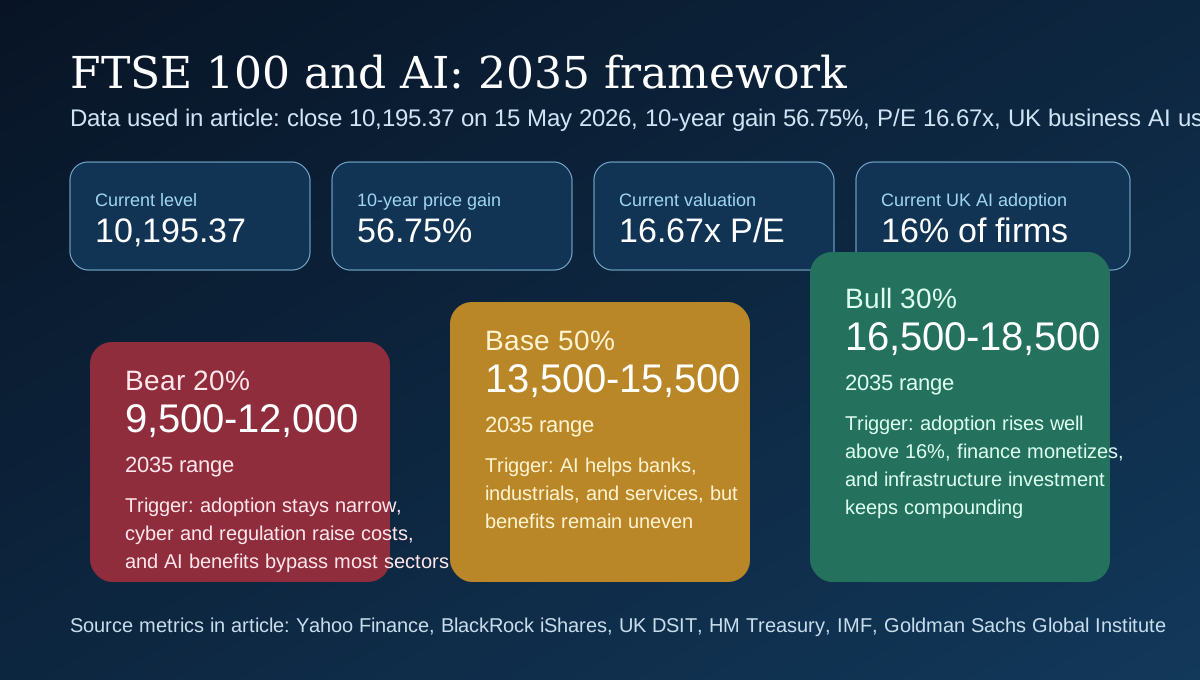
The ranges below are author estimates based on the current FTSE 100 level of 10,195.37, the index's 56.75% ten-year price gain, its roughly 4.6% annualized price-growth baseline over that period, the current sector mix, the UK government's AI policy push, and the institutional research cited above. They are not third-party price targets.
| Scenario | Probability | 2035 range | Trigger conditions | When to review |
|---|---|---|---|---|
| Bull | 30% | 16,500-18,500 | UK business AI use rises materially above 16%, the share of firms with no plans falls sharply, financial-services AI translates into visible productivity gains, and infrastructure spending continues beyond the current GBP 28.2bn first-wave Growth Zone commitment | Review annually after DSIT adoption updates, UK Budget announcements, and major FTSE 100 full-year results |
| Base | 50% | 13,500-15,500 | AI improves productivity in banks, industrials, and selected service groups, but benefits stay uneven and the benchmark compounds near its long-run price trend | Review each year and again at the government's 2030 skills and compute milestones |
| Bear | 20% | 9,500-12,000 | Adoption remains narrow, cyber and regulatory costs rise, and AI capex benefits bypass most of the benchmark while valuation support erodes | Review early if adoption surveys stay stuck near current levels and margin evidence fails to broaden by the next few annual reporting cycles |
The practical takeaway is that AI should be treated as a dispersion story first and a benchmark story second. The FTSE 100 has real beneficiaries in finance, defence, engineering, energy, and selected industrial infrastructure. But for the whole index to be meaningfully reshaped by AI, those gains have to spread well beyond the current early adopters.
The decade bull case is plausible, but it is not automatic. It needs adoption to move materially above today's 16%, infrastructure policy to keep translating into private investment, and large-cap earnings to show that AI is lifting revenue quality, efficiency, or capital returns rather than simply raising spending.
References
Sources
- Yahoo Finance chart API for FTSE 100 10-year monthly history
- Yahoo Finance chart API for FTSE 100 latest daily price metadata
- LSEG FTSE Russell insight: FTSE 100 hits five figures, 8 January 2026
- iShares Core FTSE 100 UCITS ETF product page with current portfolio characteristics
- iShares Core FTSE 100 UCITS ETF factsheet, March 2026
- UK Department for Science, Innovation and Technology: AI Adoption Research, 28 January 2026
- UK government: AI Opportunities Action Plan, one-year progress update, 29 January 2026
- HM Treasury: AI Champions appointed to help City safely seize AI opportunities, 20 January 2026
- UK government and UKRI AI strategy announcement, 19 February 2026
- IMF Working Paper 2025/067: AI and Productivity in Europe
- IMF blog: How Europe Can Capture the AI Growth Dividend
- Goldman Sachs Global Institute: Tracking Trillions, 1 May 2026
- UK National Cyber Security Centre: Retaining defensive advantage in the age of frontier AI cyber capabilities, 15 April 2026