01. Historical Context
AI matters for the FTSE MIB because the index has real banks, power, industrial, and chip exposure, but it is still far from being a pure AI benchmark
BlackRock's iShares FTSE MIB UCITS ETF, a liquid tracker of the benchmark, showed 40 holdings on 14 May 2026. Financials accounted for 46.97% of the portfolio, utilities 16.02%, industrials 9.78%, consumer discretionary 9.60%, energy 8.25%, and information technology just 4.92%. That sector mix defines the AI debate. If AI creates value in Italy, the payoff is more likely to come through bank productivity, grid investment, fibre and cable demand, industrial automation, and defence electronics than through a conventional software rerating.
| Horizon | What matters most | What would strengthen the thesis | What would weaken the thesis |
|---|---|---|---|
| 1-3 years | Adoption evidence, capex discipline, and company-level monetization | Italian enterprise AI use keeps rising from 16.4%, while STMicro, Prysmian, banks, and digital infrastructure names convert AI demand into earnings | AI talk rises faster than margins, fee income, backlog, or productivity |
| To 2030 | Diffusion across firms, public infrastructure, and compute capacity | Italy closes the gap with the EU's 20.0% enterprise AI usage rate and public-private compute infrastructure scales | Adoption remains concentrated, skills shortages persist, or regulation slows rollout |
| To 2035 | Whether AI raises index-level cash-flow growth above the non-AI baseline | AI boosts bank efficiency, grid spending, digital infrastructure, and industrial earnings broadly enough to lift the whole benchmark | Benefits remain too narrow to offset the index's heavy concentration in non-tech sectors |
The starting point is not cheap enough to ignore execution. The same iShares tracker showed a holdings P/E of 15.31, a price-to-book ratio of 2.05, and a 12-month trailing dividend distribution yield of 3.44 on 14 May 2026. Publicly available tracker data do not provide a clean benchmark forward P/E for the FTSE MIB, so the most defensible current valuation anchor is this trailing holdings multiple, not a made-up forward number.
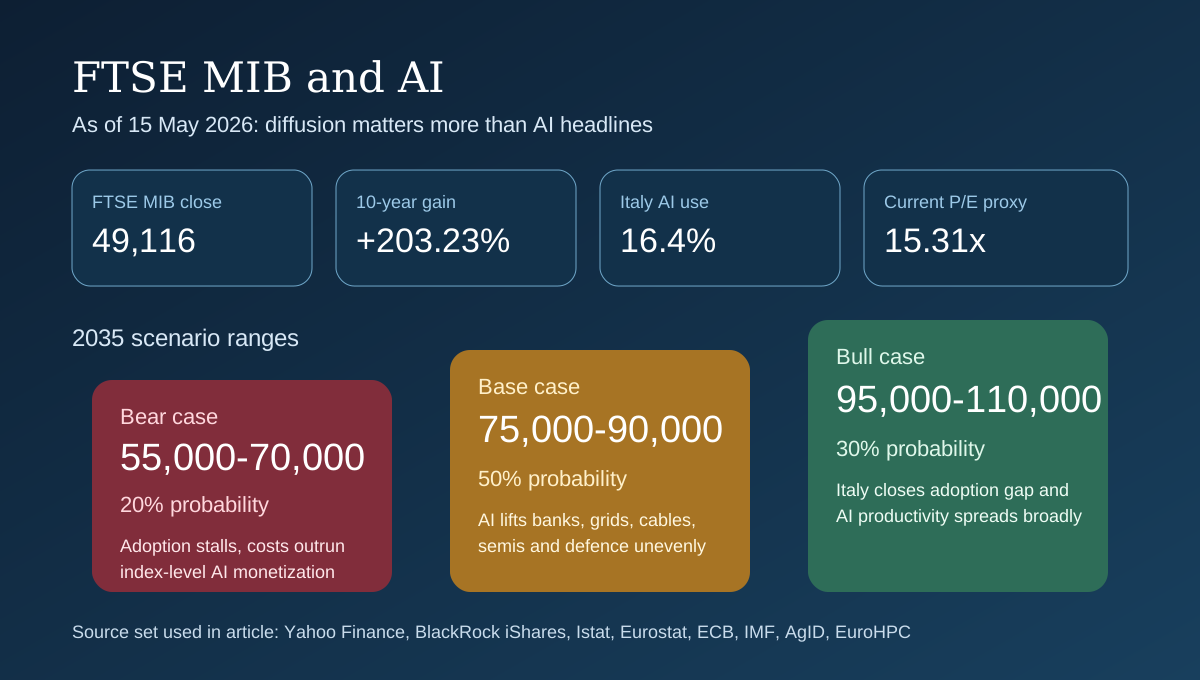
The index also enters the AI decade from a position of strength. Yahoo Finance data show the FTSE MIB at 49,116.47 on 15 May 2026 versus 16,198.00 on 31 May 2016, a 203.23% price gain, equal to roughly 11.73% annualized over ten years. That gives the benchmark a strong long-run trend, but it also means any new AI tailwind should be judged against an already powerful baseline rather than treated as the sole reason for future returns.
Concentration tells the same story. UniCredit was 14.97% of the tracker, Intesa Sanpaolo 12.43%, Enel 10.47%, Prysmian 6.22%, Eni 6.17%, Generali 5.27%, STMicroelectronics 4.92%, Ferrari 4.75%, and Leonardo 2.79%. The top ten holdings made up 70.72% of the benchmark. AI can reshape the FTSE MIB, but only if it changes economics inside those dominant weights or if enough adjacent winners become large enough to matter at index level.
02. Key Forces
Five ways AI could materially change the decade-long thesis
First, adoption in Italy is finally moving from marginal to visible. Istat said on 15 December 2025 that 16.4% of Italian firms with at least 10 employees used at least one AI technology in 2025, up from 8.2% in 2024 and 5.0% in 2023. Large enterprises reached 53.1%, while SMEs still lagged at 15.7%. That is important for the FTSE MIB because an index heavy in banks, utilities, and industrials needs broad enterprise adoption more than it needs a handful of consumer-facing AI stories.
Second, the ECB's March 2026 work on the euro area economy shows how large the spread is between a fast and a slow diffusion path. The ECB said employee AI usage in the euro area rose from 26% in 2024 to 40% in 2025, and that firms planned to allocate an average 9% of total investment to AI in 2026. The same analysis said faster diffusion could add around 0.3-0.4 percentage points a year to TFP growth over the coming decade, while slow adoption would imply only around 0.2 percentage points. That is the most relevant macro-style AI range for a non-US benchmark like the FTSE MIB.
Third, Italian public infrastructure is becoming more AI-specific. AgID's updated Italian Strategy for Artificial Intelligence 2024-2026 groups policy actions around research, public administration, enterprises, and training. AgID also notes that Italy's AI law, dated 23 September 2025, created a national legal framework for the technology. On 22 April 2026, EuroHPC signed the procurement contract for a new AI-optimised supercomputer for the IT4LIA AI Factory in Bologna. This does not guarantee listed-equity upside, but it does improve the country's long-run compute and ecosystem base.
Fourth, some FTSE MIB constituents are already seeing AI-adjacent demand in reported numbers. STMicroelectronics said in its Q1 2026 results that it expected datacenter revenue to be nicely above USD 500 million in 2026 and well above USD 1 billion in 2027. Prysmian said on 8 May 2026 that Digital Solutions adjusted EBITDA rose to EUR 88 million from EUR 42 million a year earlier, while global demand for fibre and optic cables was surging, starting from data centers. Those are not theoretical AI talking points. They are monetization signals inside real FTSE MIB weights.
Fifth, the banks can turn AI into index-level efficiency even if Italy never becomes a classic AI stock market. UniCredit's May 2025 Google Cloud agreement covers a 10-year partnership across 13 markets focused on AI, data, and virtualized infrastructure. Intesa Sanpaolo said in its Q1 2026 results released on 8 May 2026 that technology and AI-enabled process streamlining should help deliver around EUR 570 million of run-rate cost savings by 2030. In a benchmark where financials account for almost 47%, that kind of productivity capture matters more than a marginal rerating in a tiny software sleeve would.
| Factor | Why it matters | Current assessment | Bias |
|---|---|---|---|
| Enterprise adoption | Broad diffusion determines whether AI reaches the whole economy | Italy is at 16.4% enterprise AI use in 2025 versus 20.0% for the EU | Neutral |
| Bank productivity | Financials are 46.97% of the benchmark | UniCredit is building AI and data capacity with Google Cloud; Intesa targets EUR 570 million run-rate savings by 2030 from tech and AI-enabled streamlining | Neutral to bullish |
| Infrastructure beneficiaries | Cables, chips, grids, and defence can monetize AI capex directly | ST expects datacenter revenue above USD 500 million in 2026; Prysmian Digital Solutions EBITDA rose to EUR 88 million | Bullish |
| Policy and compute | National infrastructure and public strategy affect long-run diffusion | Italy's AI strategy 2024-2026 is live and IT4LIA signed a new AI-supercomputer contract in April 2026 | Neutral to bullish |
| Index mix and concentration | Low tech weight can cap blanket rerating | Information technology is only 4.92% of the tracker and the top ten holdings are 70.72% | Neutral to bearish |
The most realistic AI upside for the FTSE MIB is therefore not a US-style technology concentration story. It is a hybrid story in which banks use AI to lower unit costs, utilities and cable makers benefit from the power and data build-out, semiconductors capture infrastructure demand, and public policy gradually improves the adoption base.
03. Countercase
Why the AI story can still disappoint long-term investors
The first risk is that Italy's adoption curve is improving but still not leading. Istat's 16.4% enterprise AI usage rate for 2025 was below the EU's 20.0% rate published by Eurostat, and far below Denmark's 42.0%. If Italy keeps closing the gap only slowly, AI will remain a selective earnings story rather than a benchmark-wide growth shock.
The second risk is regulatory and institutional friction. AgID states that the 2024-2026 strategy now sits alongside Italy's AI law of 23 September 2025. That framework can improve governance, but it also raises the bar for implementation. IMF Working Paper 2025/067 estimated that a lower-exposure scenario linked to Europe-wide regulatory and adoption frictions could cut the region's productivity gains from AI by more than 30% relative to the baseline.
The third risk is macro timing. Istat said on 15 May 2026 that Italy's headline CPI accelerated to 2.7% in April from 1.7% in March, while the HICP rose to 2.8%. Eurostat's flash estimate put euro area HICP at 3.0% in April, up from 2.6%. If AI investment arrives while inflation and energy pressures stay elevated, the market may end up facing higher capex and higher discount rates at the same time.
The fourth risk is simple index math. Information technology is only 4.92% of the tracker. Even if STMicroelectronics executes well, the broader benchmark still depends on financials, utilities, energy, and consumer names. A narrow group of AI beneficiaries cannot automatically outweigh a slowdown or margin squeeze elsewhere in an index whose top ten names already make up 70.72% of total weight.
| Risk | Latest data point | Why it matters | Current assessment |
|---|---|---|---|
| Adoption gap | Italy at 16.4% enterprise AI use in 2025 versus 20.0% for the EU and 42.0% for Denmark | Shows that Italy is improving fast, but not yet leading | Bearish |
| Regulatory drag | IMF says a lower-exposure European scenario could reduce AI productivity gains by more than 30% | Implies Europe may monetize AI more slowly than the most optimistic narratives assume | Bearish |
| Macro and rates | Italy CPI 2.7% and HICP 2.8% in April 2026; euro area HICP 3.0% | Higher inflation can delay the point at which AI-led productivity gets capitalized more generously | Neutral to bearish |
| Index composition | Financials 46.97%, utilities 16.02%, information technology 4.92%, top ten holdings 70.72% | AI winners may still be too small to rerate the full benchmark quickly | Bearish |
| Evidence breadth | Hard proof points exist at ST, Prysmian, UniCredit, and Intesa, but not yet across the whole index | The FTSE MIB still lacks broad AI monetization evidence | Neutral to bearish |
The long-term AI thesis becomes durable only if adoption keeps broadening while inflation, regulation, and concentration stay manageable. Without that, AI will improve selected cash flows but stop short of reshaping the benchmark.
04. Institutional Lens
What public and institutional research actually implies
The most useful AI research for the FTSE MIB is not the loudest research. IMF Working Paper 2025/067, published on 4 April 2025, modeled 31 European countries and found that the medium-term productivity gain for Europe was about 1% cumulatively over five years in the baseline case. That supports a structural tailwind, but not a euphoric benchmark-wide revaluation.
The ECB's 23 March 2026 speech on AI and the euro area economy is more constructive on the diffusion path. It showed euro area employee AI use rising from 26% in 2024 to 40% in 2025, said firms planned to allocate an average 9% of total investment to AI in 2026, and argued that faster adoption could add around 0.3-0.4 percentage points to annual TFP growth over the coming decade, versus roughly 0.2 percentage points under slow adoption. For a bank-heavy benchmark like the FTSE MIB, that is a meaningful spread.
Italian policy and infrastructure sit between those two institutional views. AgID's updated AI strategy 2024-2026 and EuroHPC's 22 April 2026 IT4LIA contract show that Italy is building a more serious national AI stack. The market should still treat that as enabling infrastructure rather than guaranteed index earnings. The payoff comes only when listed companies convert that ecosystem into fee growth, cost savings, backlog, and free cash flow.
| Source | What it said | Date | Read-through for FTSE MIB |
|---|---|---|---|
| IMF Working Paper 2025/067 | Europe's baseline AI productivity gain is about 1% cumulatively over 5 years; a lower-exposure scenario cuts gains by more than 30% | 4 April 2025 | Supports a real but moderate AI uplift unless diffusion improves materially |
| ECB speech: AI and the euro area economy | Employee AI use rose from 26% in 2024 to 40% in 2025; firms plan to allocate 9% of 2026 investment to AI; faster diffusion could add 0.3-0.4 percentage points a year to TFP | 23 March 2026 | Diffusion speed, not headlines, determines the size of the decade payoff |
| Istat ICT survey | 16.4% of Italian firms with 10+ employees used AI in 2025, up from 8.2% in 2024; large enterprises reached 53.1% | 15 December 2025 | Italy is accelerating, but the current base is still below the EU average |
| AgID | Italy updated its AI strategy for 2024-2026 and grouped actions around research, public administration, enterprises, and training; Italy's AI law dates from 23 September 2025 | Strategy page accessed May 2026 | Improves governance and direction, but also reinforces that AI will diffuse through policy as well as markets |
| EuroHPC / IT4LIA | Procurement contract signed for a new AI-optimised supercomputer in Bologna | 22 April 2026 | Strengthens national compute infrastructure and supports longer-run ecosystem development |
The institutional conclusion is disciplined rather than promotional. AI can reshape the FTSE MIB, but the most likely path is through gradual earnings-mix improvement, not through an immediate technology-style rerating of the whole benchmark.
05. Scenarios
Actionable long-term scenarios through 2035
The ranges below are author estimates based on the current FTSE MIB level of 49,116.47, the benchmark's 203.23% ten-year gain and 11.73% annualized price growth over that period, the current sector mix, current valuation, Italy's AI adoption statistics, and the institutional research cited above. They are not third-party price targets.
| Scenario | Probability | 2035 range | Trigger conditions | When to review |
|---|---|---|---|---|
| Bull | 30% | 95,000-110,000 | Italian enterprise AI use keeps closing the gap with EU leaders, banks turn AI into visible cost and fee gains, and infrastructure beneficiaries such as STMicroelectronics, Prysmian, and digital-security names keep compounding | Review annually after Istat's ICT release and each full-year reporting season, with a major checkpoint at the EU Digital Decade 2030 milestone |
| Base | 50% | 75,000-90,000 | Adoption rises from 16.4% but remains uneven, AI benefits stay concentrated in banks, grids, cables, semiconductors, and defence, and the benchmark compounds below the last decade's 11.73% CAGR but above a low single-digit nominal baseline | Review each year and again after major updates to Italian AI policy or EuroHPC deployment milestones |
| Bear | 20% | 55,000-70,000 | Adoption stalls near current levels, regulation and skills shortages slow rollout, and AI capex lifts costs faster than it lifts index-level earnings | Review early if future Istat ICT data flatten or if corporate margin commentary stops improving while AI spending keeps rising |
The practical conclusion is that AI should be treated as a sector-rotation and productivity story first, and as a benchmark story second. The FTSE MIB has credible AI-linked channels, but the index is too concentrated and too bank-heavy for a blanket AI premium to be the base case.
If diffusion keeps improving, the AI upside is material. If it does not, the more likely outcome is that AI enriches a selected group of winners while the broader index continues to trade mainly on bank profitability, utilities, energy, and Italy's macro cycle.
References
Sources
- Yahoo Finance chart API for FTSE MIB 10-year monthly history
- Yahoo Finance chart API for FTSE MIB latest daily price metadata
- iShares FTSE MIB UCITS ETF product page
- iShares FTSE MIB detailed holdings and analytics export
- Istat: Imprese e ICT - Anno 2025
- Eurostat: 20% of EU enterprises use AI technologies
- ECB speech: AI and the euro area economy, 23 March 2026
- IMF Working Paper 2025/067: AI and Productivity in Europe
- AgID artificial intelligence strategy and policy hub
- AgID: Three-Year Plan for Information Technology in Public Administration 2024-2026
- EuroHPC JU: contract for the IT4LIA AI Factory, 22 April 2026
- EuroHPC JU: Italy AI Factory overview
- UniCredit and Google Cloud strategic agreement
- Intesa Sanpaolo consolidated results as at 31 March 2026
- STMicroelectronics Q1 2026 financial results
- Prysmian Q1 2026 results
- Istat: Consumer prices - April 2026
- Eurostat: euro area annual inflation up to 3.0% in April 2026