01. Historical Context
AI matters for SMI, but mostly through the index's incumbents
The historical starting point matters because SMI is already a proven compounder without needing an AI narrative. Yahoo Finance chart data show ^SSMI rose from 8,020.15 on May 31, 2016 to 13,220.17 on May 15, 2026, while the iShares SMI ETF benchmark proxy showed 126.83% cumulative total return and 8.54% annualized benchmark return over 10 years as of April 30, 2026. That means the AI debate starts from a market with an established quality premium, not from an under-owned growth benchmark.
| Horizon | What matters most | Current assessment | What would weaken the thesis |
|---|---|---|---|
| 1-3 years | Can AI improve existing franchises? | Roche said in its 2025 Annual Report that AI algorithms in Diagnostics sharpen disease detection, while Novartis announced AI-enabled discovery capabilities in a new research center on February 6, 2026. | AI spending stays mostly experimental and does not translate into faster product cycles or lower costs. |
| 3-7 years | Productivity diffusion across the index | OECD estimated on November 22, 2024 that AI could add 0.25-0.6 percentage points to annual TFP growth over a 10-year horizon. | Benefits remain concentrated in a few global hyperscalers outside Switzerland. |
| To 2035 | Can AI justify a higher compounding path? | Goldman Sachs and IMF research imply AI can lift output over time, but only with heavy capital spending and uneven diffusion. | Capex rises faster than monetization or grid bottlenecks delay adoption. |
SIX describes the SMI as a 20-stock benchmark covering about 75% of Swiss equity market capitalization. That composition is why AI has to be analyzed differently here than in US mega-cap tech. Switzerland's upside is more likely to come from better diagnostics, drug discovery, supply-chain automation, and enterprise productivity than from owning the global compute layer itself.
That also means the AI upside is conditional. SMI already trades on a premium multiple. If AI merely increases experimentation and capex without improving earnings quality, the market may end up paying more for a story that does not materially change cash flows.
02. Key Forces
Five ways AI could materially reshape the index
The first transmission channel is healthcare and diagnostics productivity. Roche's 2025 Annual Report said its AI algorithms in Diagnostics sharpen disease detection, while the group reported CHF 61.5 billion in sales and CHF 21.8 billion in core operating profit for 2025. Novartis announced on February 6, 2026 that its new San Diego biomedical research center will have AI-enabled discovery capabilities, house about 1,000 employees, and be part of a USD 23 billion US investment plan. For an index with heavy healthcare exposure, those developments matter more than generic AI buzzwords.
Second, AI can improve consumer and enterprise execution even in slower-growth businesses. Nestle said in a 2025 digital-core update that its upgrade will enable AI and automation at scale. For SMI, that kind of adoption matters because many constituents are mature multinationals where better pricing, logistics, forecasting, and marketing can be more important than headline revenue growth.
Third, AI can lift the macro ceiling over time. Goldman Sachs wrote on April 5, 2023 that generative AI could raise global GDP by 7% and lift productivity growth by 1.5 percentage points over a 10-year period. OECD said on November 22, 2024 that AI could add 0.25-0.6 percentage points to annual TFP growth and 0.4-0.9 percentage points to labor productivity. If even part of that filters through Europe and Switzerland, the SMI's long-run compounding path can improve.
Fourth, AI's capital intensity also creates risk. Goldman Sachs said on February 4, 2025 that global data center power demand could rise 50% by 2027 and 165% by 2030 versus 2023. If AI primarily shows up through higher energy, compute, and integration costs, SMI companies may face higher operating expenses before they realize meaningful profit gains.
Fifth, the starting valuation matters. The iShares SMI ETF proxy showed 21.06x P/E and 4.03x P/B as of May 14, 2026. That means AI has to improve the earnings trajectory enough to justify the premium. A market already priced for quality does not get a free second rerating just because a new technology exists.
| Factor | Current assessment | Bias | Bullish read | Bearish read |
|---|---|---|---|---|
| Direct AI exposure | SIX says SMI has only 20 large-cap Swiss stocks and is not a compute-heavy benchmark. | Bearish | The index benefits through end-market adoption rather than infrastructure ownership. | The biggest AI economics remain outside Switzerland. |
| Healthcare productivity | Roche and Novartis both disclosed AI-linked development or diagnostics initiatives in 2025-2026. | Bullish | Drug discovery, diagnostics, and trial efficiency lift margins and asset value. | AI remains helpful operationally but too small to change index earnings meaningfully. |
| Consumer and enterprise efficiency | Nestle said its upgraded digital core will enable AI and automation at scale. | Neutral | Large incumbents squeeze more growth and cost savings from existing scale. | Benefits are incremental and easily competed away. |
| Macro productivity tailwind | Goldman and OECD both see multi-year productivity upside from AI adoption. | Neutral | Switzerland captures part of the global productivity lift without an inflation shock. | The macro gains stay concentrated in the US and a few technology hubs. |
| Capex and power bottlenecks | Goldman sees data center power demand up 165% by 2030 versus 2023. | Bearish | Companies monetize fast enough to outrun the cost wave. | Power, compute, and integration costs rise faster than cash-flow benefits. |
The net result is that AI should matter for SMI, but mostly by improving what the index already is: a quality, healthcare-heavy, globally exposed benchmark. The most likely outcome is enhancement, not reinvention.
03. Countercase
Why the AI story could still disappoint
The biggest risk is narrow capture. SMI does not own the world's main hyperscalers, GPU leaders, or cloud infrastructure platforms. If the largest AI rents remain concentrated in those businesses, Switzerland may see only modest spillovers while still paying some of the cost burden.
The second risk is that AI's macro footprint can flatter current GDP and capex without guaranteeing durable earnings gains. In March 2026, IMF's Marcello Estevao argued that GDP can overstate AI's immediate contribution by counting massive capital outlays while understating broader productivity spillovers because many intangible gains are not properly captured. For investors, that means early excitement can coexist with delayed monetization.
Third, the cost side is real. Goldman Sachs's February 4, 2025 work on data center power demand makes clear that AI is energy- and infrastructure-intensive. If utilities, compute, and compliance costs rise faster than revenue benefits, SMI companies could face a period where AI raises expense lines before it lifts earnings.
| Risk | Latest data point | Why it matters | Current bias |
|---|---|---|---|
| Limited direct exposure | SMI is a 20-stock Swiss blue-chip index, not a global AI infrastructure index | The largest AI rents may remain outside the benchmark. | Bearish |
| Starting valuation | iShares proxy at 21.06x P/E and 4.03x P/B as of May 14, 2026 | Leaves little room for an AI narrative that does not lift profits. | Bearish |
| Capex intensity | Goldman sees global data center power demand up 50% by 2027 and 165% by 2030 | AI can show up as higher infrastructure cost before higher returns. | Bearish |
| Measurement lag | IMF wrote in March 2026 that AI can overstate immediate GDP and understate spillovers | Early macro data may be noisy and easy for investors to misread. | Neutral |
The honest AI bear case is not that AI does nothing. It is that SMI may capture the operational burden faster than the economic upside if adoption remains uneven and the best monetization sits elsewhere.
04. Institutional Lens
What the serious AI research implies for SMI investors
The best institutional work suggests AI can be large enough to matter at the macro level, but uneven enough to disappoint at the index level. Goldman Sachs wrote on April 5, 2023 that generative AI could lift global GDP by 7% and productivity growth by 1.5 percentage points over 10 years. OECD followed on November 22, 2024 with a narrower but still meaningful estimate of 0.25-0.6 percentage points of annual TFP growth from AI over a 10-year horizon.
At the same time, Goldman said on February 4, 2025 that data center power demand could rise 50% by 2027 and 165% by 2030 versus 2023, while IMF argued in March 2026 that standard GDP data both overstate AI's immediate capex effect and understate its wider spillovers. That combination is crucial for SMI. It means AI is likely to be economically important, but the path from spend to shareholder return may be slower and noisier than headline narratives imply.
| Institution / source | Updated | What it says | Why it matters here |
|---|---|---|---|
| Goldman Sachs Research | April 5, 2023 | Generative AI could raise global GDP by 7% and lift productivity growth by 1.5 percentage points over 10 years | Sets the upper bound for why AI can matter even to a non-tech benchmark. |
| OECD AI Paper No. 29 | November 22, 2024 | AI could add 0.25-0.6 percentage points to annual TFP growth and 0.4-0.9 points to labor productivity | Supports a moderate long-run productivity uplift rather than an immediate rerating story. |
| Goldman Sachs Research | February 4, 2025 | Global data center power demand could rise 50% by 2027 and 165% by 2030 versus 2023 | Highlights the capex and power constraints that can delay or dilute AI returns. |
| IMF Finance & Development | March 2026 | AI-related GDP can be overstated in the short run by capex and understated in the long run by missing spillovers | Warns investors not to confuse spending booms with fully monetized productivity gains. |
| Roche / Novartis / Nestle company disclosures | 2025-2026 | Large SMI constituents are deploying AI in diagnostics, research, and enterprise systems | Shows where SMI is most likely to capture AI value in practice. |
The institutional message is consistent: AI should be a positive structural variable for SMI, but mostly by improving incumbent economics. Investors expecting a direct AI multiple explosion are asking the wrong question.
05. Scenarios
Probability-weighted AI scenarios through 2035
The right way to frame AI and SMI is to separate direct AI ownership from indirect AI monetization. The benchmark does not need to become a technology index to benefit. It needs its dominant sectors to use AI to improve asset productivity, diagnosis speed, drug discovery, pricing, logistics, and cost control.
That is why the ranges below are long-run analytical corridors rather than point forecasts. They are anchored in today's verified valuation, macro backdrop, historical compounding, and the best public AI research available.
| Scenario | Probability | Working range | Measured trigger | Review window |
|---|---|---|---|---|
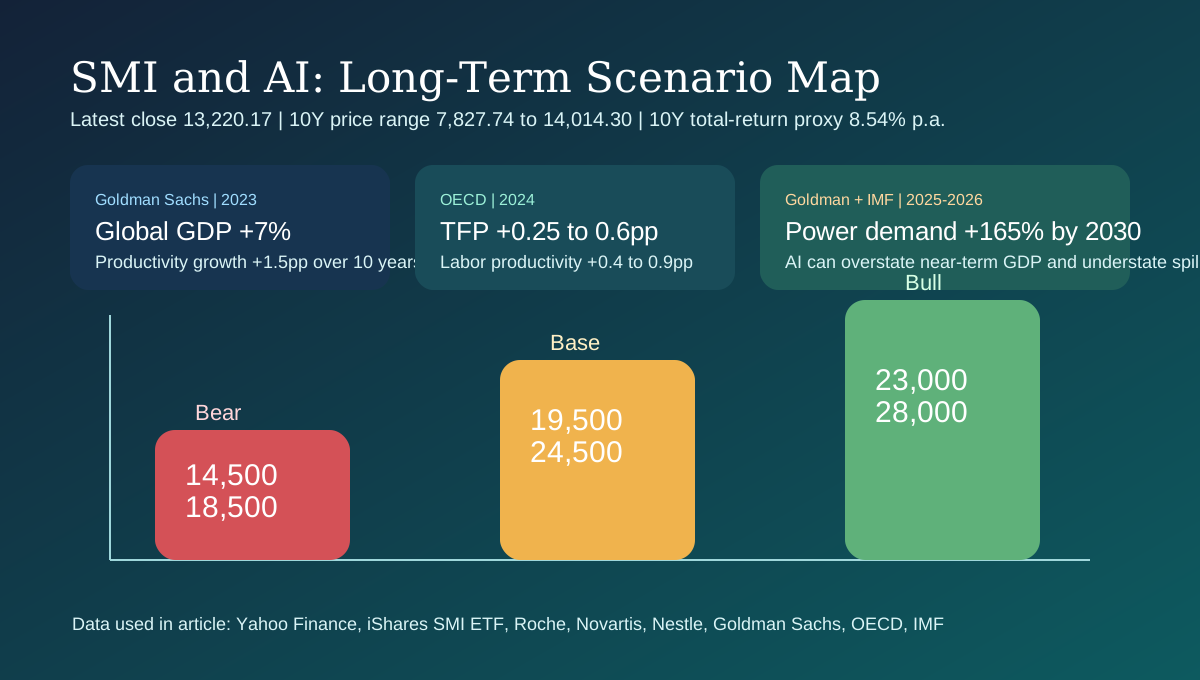
| Bull | 25% | 23,000 to 28,000 | Healthcare, diagnostics, and consumer leaders convert AI into persistent margin or EPS gains, and SMI maintains compounding close to or above its 10-year total-return proxy. | Review annually and after each full-year reporting cycle from the largest constituents. |
| Base | 50% | 19,500 to 24,500 | AI improves productivity gradually, but the index remains a defensive quality market rather than a direct AI winner. | Review every 12 months and after major AI adoption disclosures by SMI heavyweights. |
| Bear | 25% | 14,500 to 18,500 | AI stays concentrated in foreign platforms, power and integration costs rise, and SMI de-rates from around 21x trailing earnings without enough profit acceleration. | Review on any sustained earnings slowdown or evidence that AI capex is outrunning returns. |
The base case remains the most credible because it requires the fewest heroic assumptions. It does not ask Switzerland to dominate AI infrastructure. It only asks SMI companies to apply AI well enough to preserve and modestly improve a compounding model that already worked over the last decade.
The bull case is possible, but it needs proof of monetization. The bear case is also real, especially if investors mistake AI spending for AI value creation. Over the next decade, the winners will be the incumbents that convert AI into cash flows rather than presentations.
References
Sources
- Yahoo Finance quote page for SMI Index (^SSMI)
- Yahoo Finance 10-year chart data API for SMI Index (^SSMI)
- SIX overview page for the Swiss Market Index
- iShares SMI ETF (CH) product page
- Roche Annual Report 2025
- Novartis press release on AI-enabled research center, February 6, 2026
- Nestle digital core upgrade and AI automation article
- Goldman Sachs Research on generative AI and global GDP, April 5, 2023
- Goldman Sachs Research on AI-driven data center power demand, February 4, 2025
- OECD AI Paper No. 29, published November 22, 2024
- IMF Finance & Development article, March 2026