01. Historical Context
AI changes DXY through macro transmission, not direct monetization
DXY has no revenues, margins, free cash flow, EPS, or valuation multiple. Any serious AI analysis therefore has to start with the correct transmission channels: higher U.S. productivity, stronger capital inflows into U.S. assets, a potentially firmer growth differential, and a different Fed path if AI is disinflationary or inflationary.
| Horizon | Main AI channel | What would strengthen the thesis | What would weaken the thesis |
|---|---|---|---|
| 1-2 years | Capex and equity inflows | U.S. AI investment keeps attracting global capital | AI capex rises but macro payoffs stay thin |
| 3-5 years | Productivity and growth | U.S. output per worker rises faster than peers | AI benefits diffuse broadly across major economies |
| To the mid-2030s | Policy and relative rates | Higher U.S. potential growth preserves rate support | AI becomes globally disinflationary and narrows U.S. exceptionalism |
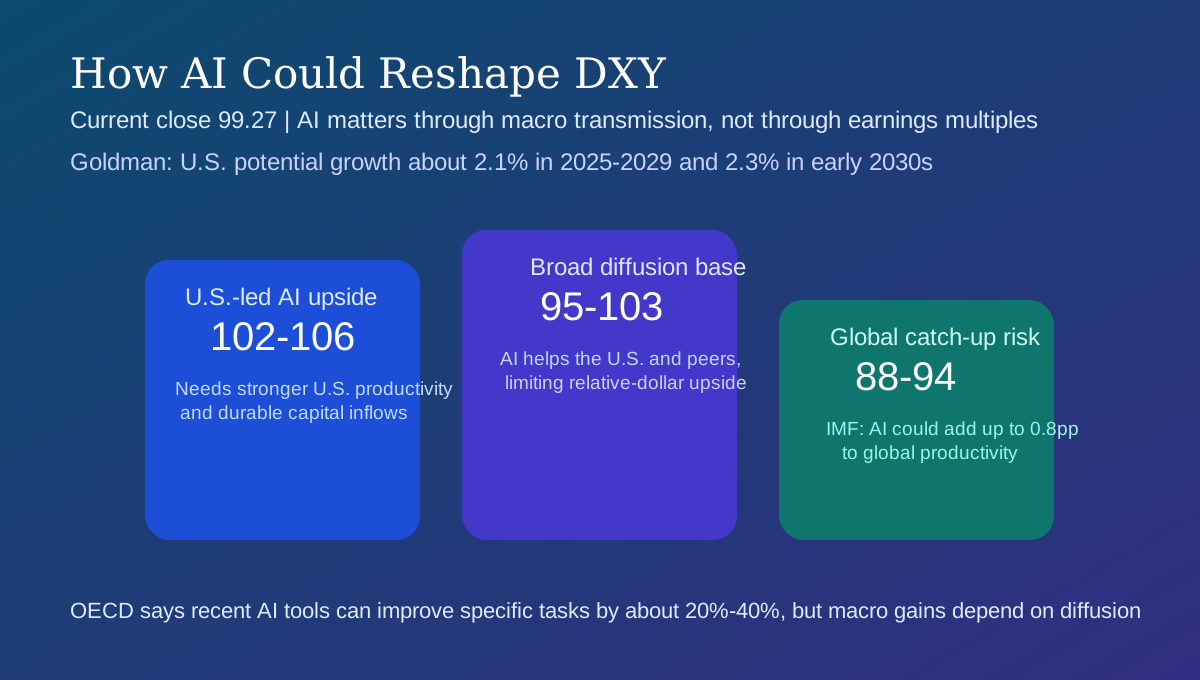
Goldman Sachs forecasts U.S. potential GDP growth of about 2.1% in 2025-2029 and 2.3% in the early 2030s as AI boosts growth further. IMF says AI could lift global productivity by up to 0.8 percentage points per year with the right policy settings. Those two facts are the core of the debate: AI may help the U.S., but it may also help everyone else.
That is why the AI case for DXY must stay relative. If AI raises all major economies' productivity together, DXY may not gain much even if the technology wave is real.
02. Key Forces
Five ways AI could materially change the DXY thesis
First, AI can raise U.S. potential growth. Goldman says labor productivity growth across the U.S. economy could average about 1.7% through 2029 and 1.9% in the early 2030s, helping potential GDP rise from about 2.1% to 2.3%. If that outperformance proves U.S.-specific, it is dollar supportive.
Second, AI can attract capital flows into U.S. assets. That effect is already visible in equity and infrastructure narratives around compute, data centers, and power demand. If those flows continue, DXY can benefit indirectly through stronger dollar demand.
Third, AI can change the inflation path. If AI is productivity-enhancing and disinflationary, the Fed may cut more over time, which would cap DXY. If AI mainly boosts capex, wages, and power demand before efficiency gains arrive, it can keep policy tighter for longer and help DXY in the medium term.
Fourth, AI can diffuse globally. IMF and OECD both argue that large productivity gains depend on adoption, institutions, and complementary investment, not on technology headlines alone. That means the U.S. may not keep the whole gain.
Fifth, DXY's basket structure matters. Even a strong U.S. AI cycle will not fully translate into higher DXY if the euro area and Japan also improve enough to offset the relative advantage. The euro's 57.6% weight remains the dominant constraint.
| Factor | Current Assessment | Bias | What would validate it |
|---|---|---|---|
| U.S. productivity lift | Goldman sees 2.1% potential growth in 2025-2029 and 2.3% in early 2030s | Neutral to bull | Persistent U.S. output and productivity outperformance |
| Global productivity lift | IMF says AI could add up to 0.8 percentage points globally with the right policies | Neutral to bear | Broad cross-country AI adoption |
| Task-level efficiency | OECD says recent tools can improve specific tasks by about 20%-40% | Neutral | Evidence that micro gains become macro gains |
| Capital-flow support | U.S. AI capex narrative still attracts global attention | Mild bull | Sustained U.S.-focused investment inflows |
| Policy-rate effect | Ambiguous: AI can be either disinflationary or capex-led inflationary | Neutral | Clear evidence on inflation transmission |
The AI bull case for DXY is therefore plausible, but conditional. It requires U.S.-centric gains, not just a global technology boom.
03. Countercase
Why the AI story can still disappoint DXY bulls
The first problem is diffusion. IMF's productivity estimate is global, not U.S.-exclusive. If AI improves Europe and Asia enough to narrow the U.S. macro premium, DXY can weaken even while AI adoption accelerates.
The second problem is the rate channel. If AI improves productivity and lowers inflation pressures, the Fed could gain room to cut more than currently expected. That would be constructive for risk assets, but not automatically for the dollar.
The third problem is overestimating financial-market transmission. DXY responds to relative growth and relative policy. A strong U.S. tech sector alone is not enough if the currency impact is offset by better non-U.S. growth or a lower U.S. rate path.
| Risk | Current Assessment | Why it matters | Bias |
|---|---|---|---|
| AI gains globalize | IMF and OECD both stress broad diffusion matters | Narrows U.S. exceptionalism | Bear |
| AI is disinflationary | Would reduce the need for restrictive policy | Weaker rate support for DXY | Bear |
| AI capex fails to lift macro productivity fast | Task-level gains do not guarantee economy-wide gains | Capital-flow support could fade | Neutral to bear |
The most common mistake is to assume that AI enthusiasm and dollar strength must travel together. They do not. The relationship is conditional on where the productivity and policy gains show up.
04. Institutional Lens
What the published AI research actually implies
Goldman Sachs is the clearest source for a U.S.-positive AI macro view. Its work says U.S. potential GDP growth could average about 2.1% through 2029 and 2.3% in the early 2030s, with labor productivity growth around 1.7% through 2029 and 1.9% in the early 2030s. That is supportive of a stronger U.S. macro base.
IMF's February 2026 AI note is the clearest source for the opposing possibility: with the right measures, AI could lift global productivity by up to 0.8 percentage points per year. That would make AI a convergence story, not just a U.S. outperformance story.
OECD adds a useful bridge between those views. It says recent generative AI tools can improve performance in specific tasks by roughly 20% to 40%, but warns that long-term macro gains depend on broad adoption and complementary investment. For DXY, that means the base case should assume partial help to the U.S., not an automatic secular dollar boom.
| Institution | Updated | What it says | DXY implication |
|---|---|---|---|
| Goldman Sachs | October 2025 | U.S. potential GDP about 2.1% in 2025-2029 and 2.3% in early 2030s as AI boosts productivity | Bullish if U.S. gains stay unique |
| IMF | February 2026 | AI could raise global productivity up to 0.8 percentage points annually with the right policies | Bearish if gains diffuse broadly |
| OECD | 2026 AI overview | Specific task performance can improve about 20%-40%, but macro gains remain uncertain | Supports a conditional, not automatic, thesis |
The research consensus is not that AI must strengthen DXY. The consensus is that AI can change the relative-growth map, and that DXY will respond to that map only if the U.S. gains are larger and more persistent than peers' gains.
05. Scenarios
How AI changes the next-decade DXY map
The most actionable AI framework is still probability-based and relative.
| Scenario | Probability | Range | Trigger | Review point |
|---|---|---|---|---|
| U.S.-led AI upside | 25% | 102-106 | U.S. productivity outperforms, capital inflows stay strong, and rates remain relatively firm | Annual review with productivity and GDP data |
| Broad diffusion base case | 50% | 95-103 | AI helps the U.S., but also helps peers enough to limit DXY upside | Review after each IMF and OECD macro update |
| AI narrows the U.S. edge | 25% | 88-94 | AI is disinflationary, global adoption broadens, and Fed support fades | Reassess if DXY falls below 95 on a sustained basis |
The AI case for DXY should therefore be treated as a conditional macro overlay, not as a separate standalone bullish thesis. If AI lifts everyone, the dollar may not win. If AI lifts the U.S. more than everyone else, DXY can stay structurally firmer than current consensus expects.
That is the right standard for a real financial analysis of DXY: no fake valuation metrics, no imaginary cash-flow story, and no unsupported claim that AI automatically means a stronger dollar.
References
Sources
- Yahoo Finance chart data for U.S. Dollar Index
- ICE FX Indexes methodology and DXY weights
- Goldman Sachs on U.S. potential growth and AI productivity
- IMF on AI preparedness and productivity, February 2026
- OECD artificial intelligence and productivity overview
- IMF World Economic Outlook, April 2026
- Federal Reserve Summary of Economic Projections, March 18, 2026
- J.P. Morgan Asset Management 2026 Long-Term Capital Market Assumptions