Home
» Today
»
How Electric Vehicles Work: Batteries, Charging, and Running Costs Explained
How Electric Vehicles Work: Batteries, Charging, and Running Costs Explained
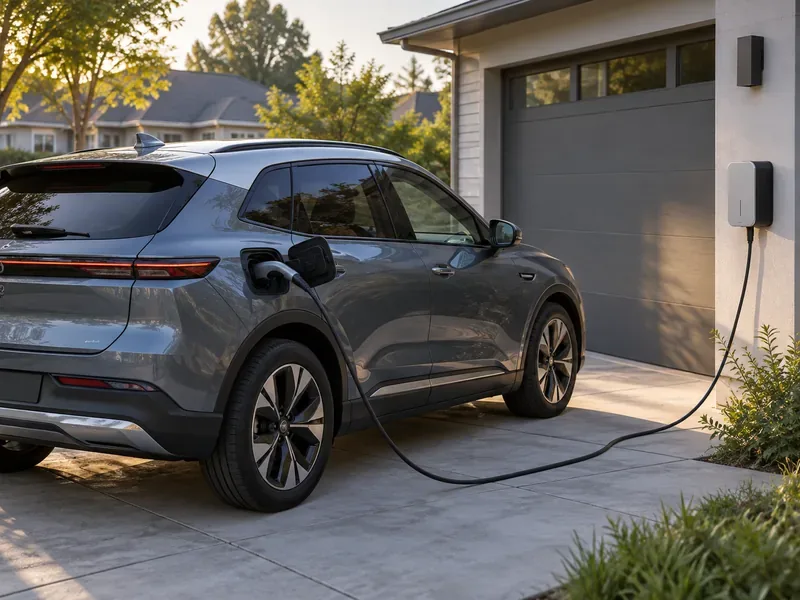
A home charging setup connects the vehicle’s charge port to a wall-mounted charger in a residential driveway.
An electric vehicle (EV) can look and feel familiar from the driver’s seat, but it stores energy and gets that energy to its wheels differently from a gasoline car. Understanding the battery, charging options, and a few cost formulas makes it easier to decide whether an EV fits your routine. This beginner’s guide focuses on battery-electric vehicles and plug-in hybrids in the United States. Prices and incentives vary by location and can change; figures in the examples below are illustrative, not a forecast of your bill.
Start with the kind of electric vehicle
A battery-electric vehicle (BEV) runs on electricity stored in a rechargeable battery and has no gasoline engine. A plug-in hybrid electric vehicle (PHEV) has a smaller rechargeable battery and a gasoline engine, so it can drive on electricity for some trips and use gasoline when the battery is depleted or extra range is needed. A conventional hybrid electric vehicle (HEV) has an electric motor and battery but does not plug in; gasoline remains its energy source. These categories are easy to mix up, so check the vehicle’s specifications before comparing advertised electric range or charging costs. The U.S. Department of Energy explains the differences in its EV consumer guide.
How does an EV turn battery power into motion?
The high-voltage traction battery stores electrical energy in kilowatt-hours (kWh), a unit of energy. A battery management system monitors conditions such as temperature, voltage, and charge so the pack can operate within limits set by the manufacturer. When you press the accelerator, power electronics control the electricity sent to the electric motor. The motor converts electrical energy into rotation, which turns the wheels through the vehicle’s drive system. Many EVs use one or more motors and may drive the front wheels, rear wheels, or both; the layout depends on the model.
The battery’s kWh rating describes how much energy it can store, while the motor’s kilowatt (kW) rating describes power. In simple terms, kWh is closer to the size of an energy “tank,” and kW is closer to how quickly energy can be delivered. A larger battery can support more range, but the actual distance also depends on vehicle efficiency, speed, temperature, terrain, tires, and heating or air-conditioning use. EPA range ratings help compare vehicles under standardized test conditions; your trip can differ. Find model-specific ratings on FuelEconomy.gov.
Many EVs also use regenerative braking: when the driver slows, the motor can act as a generator and send some motion energy back to the battery. This can recover energy that would otherwise mostly become heat at the brakes. It does not make every stop “free,” and it cannot recover all the energy used to accelerate. The vehicle’s friction brakes still matter, and the amount recovered depends on driving conditions and the vehicle’s system.
Charging basics: what you plug into
Charging equipment supplies electricity; the vehicle’s onboard charger converts alternating current (AC), as used by common household and Level 2 equipment, into the direct current (DC) the battery stores. A DC fast charger performs the conversion outside the car and sends DC to the battery. Charging speed is limited by the equipment, the vehicle’s hardware, the electrical service, and the battery’s current state and temperature. A charger’s maximum advertised power does not guarantee that every vehicle will accept that rate. The EPA’s charging details guide explains the relationship between power ratings and vehicle limits.
Level 1: Uses a standard household outlet and is usually the slowest option. It can be enough for some drivers with short daily trips and long parking periods, but it may not replace the energy used by a longer commute overnight.
Level 2: Uses higher-voltage AC equipment, commonly 240 volts in the United States. It is a common home and public option for faster charging. Home installation may require an electrician, permits, or electrical panel work, depending on the property and local code.
DC fast charging: Usually found at public sites and useful for road trips or a quick recharge away from home. It tends to cost more than home charging, but actual pricing is set by the charging network and may vary by location, time, or membership.
Before buying a home charger, check the vehicle’s charging connector and accepted charging rates, your parking arrangement, utility rates, and local installation requirements. The DOE’s home charging guidance notes that some drivers can cover everyday needs with Level 1, while others benefit from Level 2. Renters or residents without a dedicated parking space should check workplace, apartment, and nearby public options before deciding. For a long drive, plan charging stops and confirm station availability; a route planner is a guide, not a guarantee that a charger is working or unoccupied.
How to estimate the cost of charging
Start with the vehicle’s energy use, often listed in kWh per 100 miles, and the price you pay per kWh. Multiply the two and divide by 100 to estimate the electricity cost per mile. For example, if a vehicle uses 30 kWh per 100 miles and electricity costs $0.16 per kWh, then 30 × $0.16 = $4.80 per 100 miles, or about 4.8 cents per mile. These are sample inputs only. Use your utility bill’s actual energy rate and the specific model’s rating as a first estimate. Charging losses and fees can make the amount billed differ from the energy delivered to the wheels.
For an apples-to-apples illustration, a gasoline car rated at 30 miles per gallon costs about $11.67 per 100 miles at $3.50 per gallon (100 ÷ 30 × $3.50). The EV example above costs $4.80 per 100 miles at the assumed home rate. The difference will shrink or grow with local electricity and gasoline prices, each vehicle’s efficiency, and where you charge. Public fast charging can change the comparison, so do not assume every EV mile costs the home rate. DOE’s Vehicle Cost Calculator lets shoppers compare vehicles using local and personal assumptions.
Look beyond the electricity bill
“Running cost” includes more than charging. Compare purchase price, financing, insurance, registration, tires, scheduled service, repairs, and depreciation as well as fuel. EVs have fewer routine service items associated with an engine, such as oil changes, but they still need tire care, cabin filters, brake checks, and manufacturer-specified maintenance. Because EVs can be heavy and deliver strong acceleration, tire wear and replacement costs are worth checking for the model and tire size. The DOE’s consumer guide provides general maintenance comparisons, but it does not predict an individual owner’s costs.
Battery capacity gradually changes with age and use, and the rate varies with vehicle design, climate, charging habits, and other factors. Review the battery warranty’s time, mileage, capacity-retention terms, and exclusions before purchase, particularly for a used EV. Do not assume a battery will need immediate replacement just because capacity can decline, or assume every battery will retain a particular percentage for a fixed number of years. Ask for a vehicle-specific inspection and records when evaluating a used model.
A first-time buyer’s checklist
Estimate a typical week of driving, including the longest regular trip, and compare it with the model’s EPA range with a practical buffer.
Identify where the vehicle will park overnight and how often you can charge at home, work, or public locations.
Check connector compatibility, the car’s maximum AC and DC charging rates, and the charging network coverage on routes you actually drive.
Calculate energy cost using your real electricity rate and a model-specific efficiency figure; separately estimate occasional public charging.
Compare total ownership costs, including installation, insurance, tires, service, financing, and resale assumptions.
Verify current state, local, utility, and federal incentives directly before relying on them in a budget. As of October 3, 2026, the IRS says the new clean vehicle credit is unavailable for vehicles acquired after September 30, 2025; older articles that advertise it as generally available may be out of date. Check the IRS eligibility page and local programs for the rules that apply to your situation.
Common beginner mistakes to avoid
Comparing battery size with range alone: Two cars with similar kWh capacity can travel different distances because vehicle efficiency differs. Compare EPA range and kWh per 100 miles.
Assuming a faster charger makes every car charge faster: The vehicle has its own maximum acceptance rate, and charging often slows as the battery gets closer to full. Plan using the vehicle’s guidance, not the station’s peak number alone.
Budgeting every charge at the home rate: Public charging prices and fees vary. Include the charging mix you expect to use.
Ignoring winter, highway speed, or climate control: Conditions can reduce real-world range. Allow a buffer, especially on unfamiliar routes, and check the vehicle’s energy and route information.
Assuming a home charger is a simple plug-in purchase: Electrical capacity, permits, parking rights, and installation costs vary. Ask a qualified electrician and local authority before committing to equipment.
An EV works best when its range, charging access, and costs line up with how you actually travel. The useful next step is to choose one or two candidate models, check their official efficiency and charging specifications, then run the numbers with your own electricity rate, mileage, and charging locations.