Home
» Today
»
How to Check Your Voter Registration Status Before the 2026 Election
How to Check Your Voter Registration Status Before the 2026 Election
The most important thing to do before the 2026 election is to confirm your voter registration on your state or territory’s official election website. The federal Vote.gov site can route you to the right place. Do not assume that voting in a previous election means every detail in your record is still current.
The next regularly scheduled federal general election is Tuesday, November 3, 2026, according to the Federal Election Commission. Registration deadlines, lookup systems, and correction procedures are controlled by the states and territories, so there is no single nationwide status-check page that works the same way everywhere.
For the safest route, start at Vote.gov’s voter registration page, select your state or territory, and follow the link to the official election website. The U.S. Election Assistance Commission also recommends checking through your state election site or contacting your local elections office.
Step 1: Go to your state’s official voter registration lookup
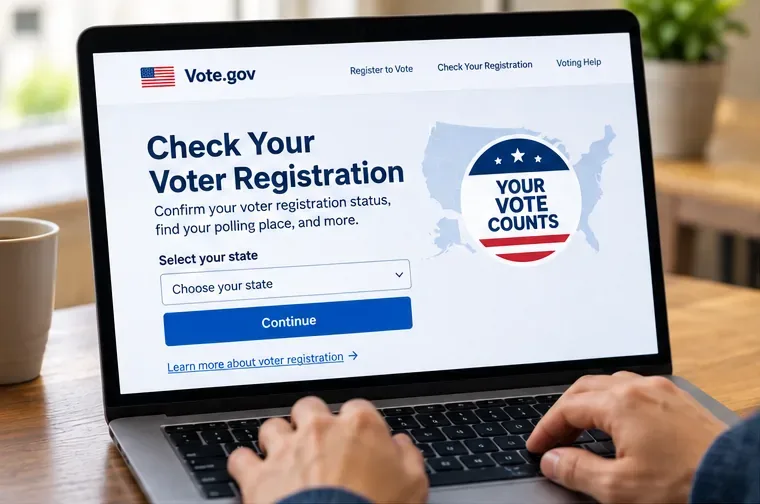
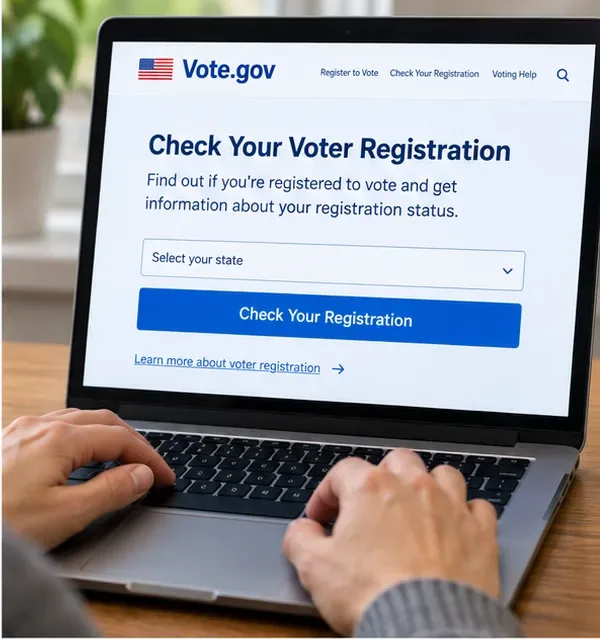
Vote.gov is useful because it acts as a federal starting point rather than asking you to guess which state website is legitimate. Select your state or territory and look for the option to check registration status. The exact wording and page design vary by jurisdiction.
This matters because voter registration is decentralized. Some states provide a dedicated online lookup tool. Others may route you through a broader voter portal. If you cannot find an online lookup, the U.S. Election Assistance Commission says you can usually confirm your information by contacting your local elections office.
A voter begins by selecting a state before being directed to the appropriate election authority. Exact page appearance and wording vary by jurisdiction.
How to avoid the wrong website
Use Vote.gov or a state election authority’s official website rather than relying on an unfamiliar search result, text message, or social media link. Voter lookup forms can ask for personal information such as your name, birth date, address, or ZIP code. That makes it especially important to know who is operating the site before entering anything.
A useful rule is simple: use Vote.gov as the starting point, then follow its state-specific path. If you instead navigate directly to your state’s site, verify that it is the official election authority.
Step 2: Enter the information the state asks for
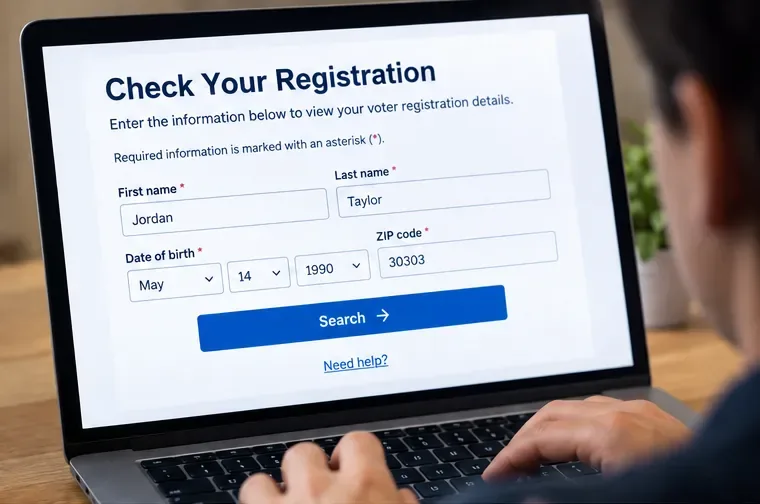
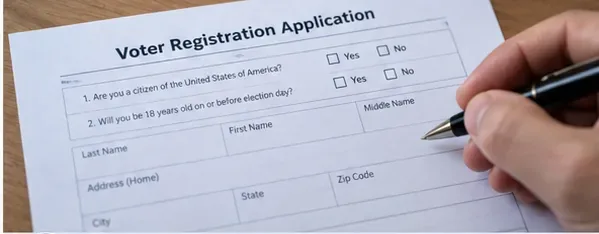
State lookup tools do not all require the same fields. A portal may ask for your legal name and date of birth, while another may also request your address, ZIP code, county, driver’s license information, or another identifier.
Enter the information as it appears on your voter registration record. If you recently changed your legal name or moved, try to determine whether your registration was already updated. A mismatch between the information you enter and the information on file can prevent the search from finding your record even when you are registered.
An example lookup form shows the kind of identifying information a state may request. Required fields differ by state, so follow the instructions on the official state site.
Example: you moved across town
Suppose you voted in 2024 but moved to a new apartment in the same state in 2026. Your old registration may still exist, but the address may be outdated. Vote.gov specifically advises voters to update their registration after a change of address, whether the move was within the state or to another state.
If you moved to a different state, you generally need to register in the new state rather than simply changing the address on the old state’s record. Because deadlines vary and can be as early as 30 days before an election, do not wait until the final week to investigate.
Step 3: Check more than the word “registered”
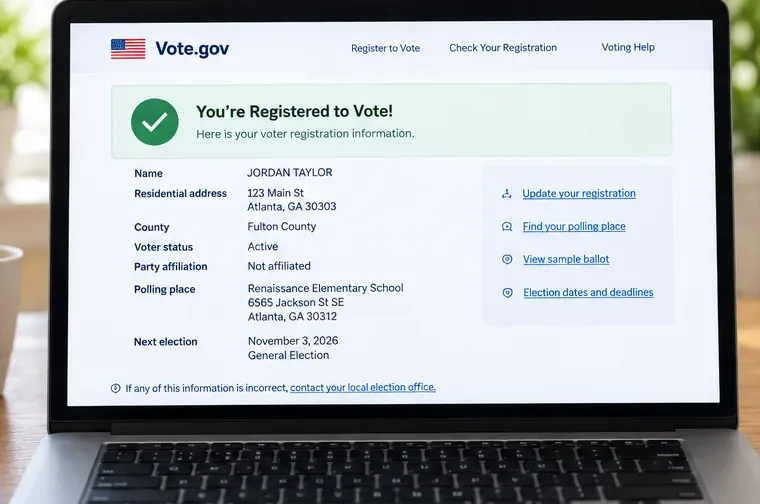
Finding a record is only the first check. Review the details the state makes available. At a minimum, make sure your legal name and current residential address are correct. Depending on the jurisdiction, the lookup may also show your registration status, party affiliation, precinct, polling place, voting districts, or sample-ballot information.
Vote.gov warns that a registration can be marked “inactive” if a voter did not vote in at least two federal elections and did not respond when election officials tried to contact them. An inactive record does not automatically mean the same thing in every state, so follow your state’s instructions or contact the local election office to learn what action is required.
An example registration record shows the types of details worth reviewing: status, legal information, address, polling place, and election information. Actual state lookup pages differ.
What should match before you stop checking?
Item
What to confirm
Why it matters
Registration status
Your state shows a valid status for voting
An inactive or missing record may require follow-up
Legal name
Spelling and current legal name are correct
Name mismatches can complicate check-in or lookup
Residential address
Your current residence is on file
Your address can determine precinct and ballot contests
Party affiliation
Correct if your state records it
It can matter for certain primary elections
Polling information
Current location or official instructions
Polling sites can change between elections
Step 4: Fix missing or outdated information before your state’s deadline
If the lookup cannot find you, do not immediately assume that you are ineligible. First, check for simple problems: a misspelled name, an old address, a different ZIP code, or the wrong state portal. If the record still cannot be found, contact your state or local election office.
If your information is outdated, follow the state’s official process to update it. Vote.gov says voters should update their registration after changing their address or legal name. Some states also require a registration update if you want to change political party affiliation.
There is no national voter registration deadline. Some states close ordinary registration well before Election Day, while others allow later registration or Election Day registration. Your state’s rules control, so an instruction that is correct for a friend in another state may be wrong for you.
When online lookup is not enough
Contact the election office directly if your status is unclear, your record is marked inactive, you recently moved, your name changed, you believe a correction has not been processed, or the website produces conflicting information. The Election Assistance Commission recommends state and local election offices as the authoritative source for current registration details.
Step 5: Recheck after you submit an update
Submitting a change does not necessarily mean the online record updates instantly. Processing time varies by jurisdiction. If you changed your address, name, or other registration information, give the election office time to process it and then check again.
Save any confirmation number, email, receipt, or printable acknowledgment that the official system provides. That record can help if you need to follow up with election officials.
If Election Day is approaching and the online record still does not reflect a correction, contact the election office instead of repeatedly submitting new applications unless officials tell you to do so. Duplicate submissions can make the situation harder to understand without necessarily solving the underlying issue.
Step 6: Confirm your voting plan for November 3, 2026
Once your registration record is correct, use official election information to confirm how you plan to vote. The FEC lists November 3, 2026 as the next regularly scheduled federal general election date. State and local election offices control details such as polling locations, early voting, voter identification rules, and mail-ballot procedures.
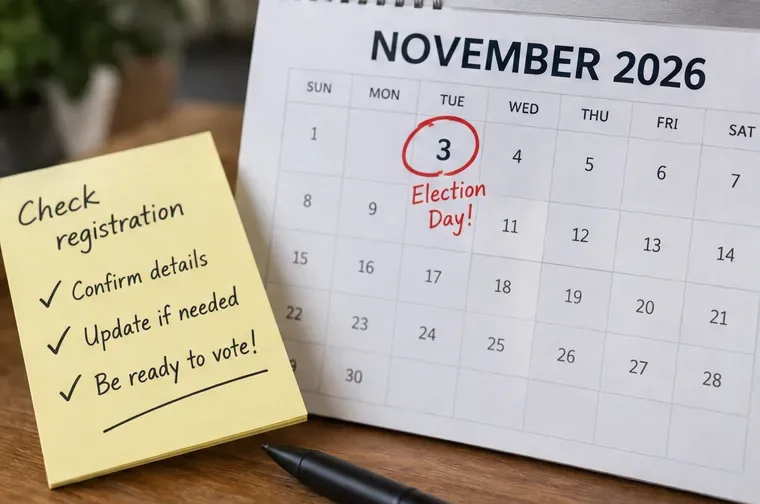
November 3, 2026 is the regularly scheduled federal general election date. Checking registration early leaves time to correct errors before state deadlines.
Do not rely on an old polling-place card or the location you used in a previous election. A precinct assignment or voting site can change. Recheck official information close enough to the election to catch updates, while still leaving yourself time to act if something looks wrong.
Which checking method is best for you?
Use the online state lookup if your state offers one and your record is straightforward. It is usually the fastest way to confirm basic information.
Call or visit the local election office if the online result is missing, inactive, contradictory, or does not reflect a recent update. Human assistance is also the better choice if your situation involves a recent interstate move, a legal name change, or another issue the website does not explain clearly.
Use Vote.gov as a routing tool when you are not sure which site is official. It is especially useful if search results show several organizations offering voter-related services and you want to avoid entering personal information on the wrong site.
Special situations worth checking early
If you are a U.S. citizen living abroad, a military service member, or an eligible military family member, your registration and absentee-voting process may use federal forms and different timelines. Vote.gov links overseas and military voters to the appropriate federal resources.
If you have not voted for several federal elections, check early because your record may need attention. If you recently became a U.S. citizen, Vote.gov advises confirming whether you registered at your naturalization ceremony or completing registration if you did not. If you moved, changed your legal name, or changed party affiliation, treat the status check as an opportunity to verify all of those details at once.
Final self-check before the 2026 election
Did you reach your state’s official registration lookup through Vote.gov or the official election authority?
Does your record show a valid registration status under your state’s terminology?
Are your legal name and current residential address correct?
Did you review party affiliation if your state records it?
Did you resolve an inactive, missing, or outdated record with election officials?
Did you recheck after submitting any changes?
Do you know where to get current polling, early-voting, or mail-voting information for November 3, 2026?
If all of those answers are yes, you have done more than simply search for your name—you have verified the parts of the voter record most likely to affect your ability to vote smoothly.