01. Historical Context
HSBC Holdings in context: what kind of long-term asset this is now
HSBC's long-term chart already tells an important truth. At 1,317p on May 15, 2026, the stock sits near the top of a 10-year range of 300.5p to 1,393.1p after compounding at 11.0%.
The business is stronger than it was for most of that period. For FY 2025, HSBC reported profit before tax of USD 29.9 billion, revenue of USD 68.3 billion, net interest income of USD 34.8 billion, banking NII of USD 44.1 billion and a CET1 ratio of 14.9%. HSBC reported Q1 2026 profit before tax of USD 9.4 billion, profit after tax of USD 7.4 billion, revenue of USD 18.6 billion and annualised RoTE of 17.3%. That means the long-term case does not require a turnaround, only the preservation of a much better franchise.
For 2035, that shifts the analytical burden. The key question is no longer whether HSBC can survive or stabilize, but whether it can keep earning high returns while rates, regulation and geopolitics change.
| Horizon | What matters now | Current datapoint | What would strengthen the thesis |
|---|---|---|---|
| 1-3 months | Quarterly execution versus guidance | HSBC reported Q1 2026 profit before tax of USD 9.4 billion, profit after tax of USD 7.4 billion, revenue of USD 18.6 billion and annualised RoTE of 17.3%. | The next result still tracks or beats management guidance. |
| 6-18 months | Valuation versus estimates | MarketScreener showed HSBC on about 13.2x 2025 earnings, 11.2x 2026 earnings and 9.84x 2027 earnings. Using the current London price and those forward P/E ratios implies roughly 117.6p of 2026 EPS and 133.8p of 2027 EPS, or about 13.8% growth. | Consensus earnings keep rising while the stock does not need an aggressive rerating. |
| To 2035 | Structural profitability | 10-year range 300.5p to 1,393.1p; 10-year CAGR 11.0%. | Capital returns, book-value growth and operating discipline remain intact. |
02. Key Forces
Five forces that will shape the path to 2035
First, HSBC needs RoTE durability. A bank that can keep earning in the mid-to-high teens on tangible equity over many years deserves a solid valuation floor.
Second, it needs a healthier revenue mix. Wealth, transaction banking and fee businesses have to matter more by the 2030s if rates eventually normalize lower.
Third, it needs capital flexibility. Long-run total return for a bank like HSBC is heavily driven by how much capital it can safely distribute.
Fourth, it needs geopolitical resilience. HSBC's global footprint is a strategic edge when trade flows are healthy, but a vulnerability when fragmentation intensifies.
Fifth, it needs technology leverage. AI and process simplification matter over a decade because a small efficiency gain applied across a giant balance-sheet business compounds meaningfully.
| Factor | Current Assessment | Bias | Why it matters now |
|---|---|---|---|
| Return durability | 17%+ target through 2028 | Bullish | This is the foundation of the decade view. |
| Distribution power | 50% payout target remains in place | Bullish | Dividends are a large share of the long-term return case. |
| Geographic breadth | Global footprint supports growth but adds event risk | Neutral | Valuable in normal times, fragile in stressed ones. |
| Rate dependence | Banking NII still a major earnings driver | Neutral to Bearish | A lower-rate future would need more fee-income replacement. |
| Technology adoption | HSBC is already scaling AI across hundreds of use cases | Bullish | Efficiency matters more over ten years than over ten weeks. |
03. Countercase
What would break the long-term case
The 2035 bear case is that HSBC remains profitable but grows less than investors expect once the easy rate tailwind fades.
A second risk is that geopolitical shocks become frequent enough to keep the valuation capped even when quarterly results remain respectable.
A third risk is that capital returns remain good but not exceptional because CET1 stays at the lower end of the target range too often.
A fourth risk is that inflation and policy normalize, but fee growth and AI-driven productivity gains are not large enough to replace the margin benefit cleanly.
| Risk | Latest datapoint | Current assessment | Bias |
|---|---|---|---|
| Lower-rate future | Still an unresolved medium-term question | Important long-term risk | Neutral |
| Capital tightness | CET1 at 14.0% in Q1 2026 | Constrains upside if persistent | Neutral |
| Geopolitical shocks | Management explicitly models downside stress | Persistent overhang | Bearish |
| Mature valuation | Shares already near a 10-year high | Limits dramatic rerating | Neutral |
04. Institutional Lens
How institutional inputs help frame the decade view
For 2035, the most useful institutional inputs are still macro and policy sources, not heroic brokerage targets. The IMF says global growth stays positive but vulnerable, while the BoE and ONS still show a world with sticky inflation and positive rates.
That background helps explain why HSBC can still earn well, but it also tells you the bank's long-term path will remain tied to macro regimes more than many non-financial stocks.
The long-term conclusion is therefore practical: HSBC can still be a good decade asset, but the return case rests on compounding and cash distributions rather than on narrative multiple expansion.
| Source | Latest update | What it says | Why it matters here |
|---|---|---|---|
| MarketScreener, May 2026 | MarketScreener's May 2026 HSBC consensus page showed 17 analysts with an average target price of USD 18.87 on the ADR, versus USD 18.20 at the quoted last close, with a high target of USD 23.06 and a low target of USD 10.54. | The Street is constructive, but the average target only implies modest ADR upside from recent trading levels. | That tells you HSBC is not a deep-value cleanup story anymore; execution matters more than multiple rescue. |
| Bank of England, April 2026 | Bank Rate was maintained at 3.75% by an 8-1 vote. | The BoE is still not rushing into a deep easing cycle. | That helps explain why HSBC's banking NII guidance stayed robust. |
| ONS, March 2026 | UK CPIH was 3.4% and UK GDP rose 0.6% over the three months to March. | Inflation is still above target, but growth has not rolled over. | That is supportive for deposit-rich UK banking franchises, though it does not remove credit risk. |
| IMF, April 2026 | Global growth is projected at 3.1% in 2026 and 3.2% in 2027, with downside risks dominating. | The IMF sees a slower but still positive global backdrop, with war, fragmentation and tighter conditions as the main threats. | That matters for HSBC because Asia, the UK and global trade flows all drive its earnings mix. |
05. Scenarios
Bull, base and bear paths with explicit review points
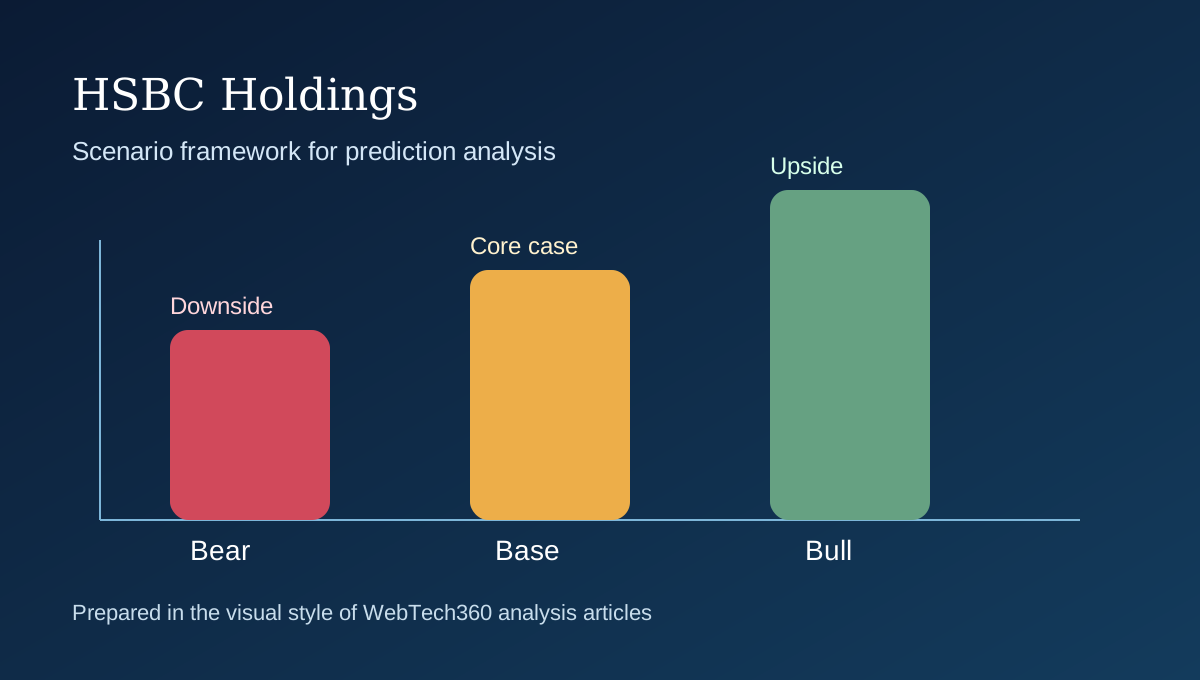
A 2035 scenario map for HSBC should be built around payout durability, sustainable RoTE and how much of the current NII advantage is replaced by fees and efficiency over time.
Review the thesis when the 2026-2028 target window ends, then again when the bank's next strategic cycle makes it clear whether the post-rate-cycle business mix is genuinely stronger.
| Scenario | Probability | Target range | Trigger | When to review |
|---|---|---|---|---|
| Bull case | 20% | 2,100p to 2,600p | HSBC keeps high-teens returns, broadens fee income, and maintains strong capital return without major geopolitical shocks. | Review at each strategic plan update. |
| Base case | 55% | 1,550p to 2,000p | Returns stay solid, dividends remain central, and price appreciation is steady rather than spectacular. | Review annually and after the 2028 target window. |
| Bear case | 25% | 1,000p to 1,450p | Rates normalize lower, credit costs rise and distributions stay more constrained than investors expect. | Review if RoTE slips decisively below target. |
References
Sources
- Yahoo Finance chart endpoint for HSBC Holdings (HSBA.L), used for current price and 10-year range
- HSBC Holdings plc 1Q 2026 Earnings Release, published May 5, 2026
- HSBC Holdings plc Annual Results 2025, published February 25, 2026
- HSBC 1Q 2026 quick read
- Bank of England Monetary Policy Summary, April 2026
- ONS Consumer price inflation, UK: March 2026
- ONS GDP monthly estimate, UK: March 2026
- IMF World Economic Outlook, April 2026
- MarketScreener HSBC analyst consensus
- MarketScreener HSBC valuation page