01. Historical Context
HSBC Holdings in context: the 2027 call starts from today's valuation and return profile
As of May 15, 2026, HSBC Holdings traded at 1,317p, not far below its 52-week high of 1,410.6p and far above its 52-week low of 847.0p. The 10-year range of 300.5p to 1,393.1p and 10-year CAGR of 11.0% show that a large part of the rerating has already happened.
The fundamental backdrop is still strong. HSBC reported Q1 2026 profit before tax of USD 9.4 billion, profit after tax of USD 7.4 billion, revenue of USD 18.6 billion and annualised RoTE of 17.3%. Net interest income was USD 8.9 billion, banking net interest income was USD 11.3 billion, CET1 was 14.0%, and the first interim dividend was USD 0.10 per share. HSBC retained all 2026-2028 group targets in May 2026, including RoTE of 17% or better, target-basis operating expense growth of around 1%, a CET1 operating range of 14.0%-14.5%, and banking NII of around USD 46 billion in 2026. It also lifted 2026 ECL guidance to around 45 basis points from around 40 basis points previously.
The valuation is no longer distressed, but it is still not stretched if management delivers. MarketScreener showed HSBC on about 13.2x 2025 earnings, 11.2x 2026 earnings and 9.84x 2027 earnings. Using the current London price and those forward P/E ratios implies roughly 117.6p of 2026 EPS and 133.8p of 2027 EPS, or about 13.8% growth.
| Horizon | What matters now | Current datapoint | What would strengthen the thesis |
|---|---|---|---|
| 1-3 months | Quarterly execution versus guidance | HSBC reported Q1 2026 profit before tax of USD 9.4 billion, profit after tax of USD 7.4 billion, revenue of USD 18.6 billion and annualised RoTE of 17.3%. | The next result still tracks or beats management guidance. |
| 6-18 months | Valuation versus estimates | MarketScreener showed HSBC on about 13.2x 2025 earnings, 11.2x 2026 earnings and 9.84x 2027 earnings. Using the current London price and those forward P/E ratios implies roughly 117.6p of 2026 EPS and 133.8p of 2027 EPS, or about 13.8% growth. | Consensus earnings keep rising while the stock does not need an aggressive rerating. |
| To 2027 | Structural profitability | 10-year range 300.5p to 1,393.1p; 10-year CAGR 11.0%. | Capital returns, book-value growth and operating discipline remain intact. |
02. Key Forces
What has to go right for the 2027 target to move higher
The first driver is banking NII. Management is guiding to around USD 46 billion of banking NII for 2026, which matters because HSBC remains one of the clearest global beneficiaries of rates that stay positive for longer.
The second driver is Wealth and transaction banking. Q1 revenue growth was led by Wealth fees and Hong Kong activity, which is a healthier mix than relying only on rate windfalls.
The third driver is capital return. HSBC still targets a 50% payout ratio for 2026-2028 and will only restart buybacks if CET1 remains comfortably in range, which is a disciplined rather than promotional stance.
The fourth driver is macro resilience. The BoE still has Bank Rate at 3.75%, and ONS showed UK GDP growing in the three months to March. That backdrop is not booming, but it is good enough to support NII and fee activity.
The fifth driver is execution credibility. The market is now pricing HSBC as a high-return bank, so the stock needs clean delivery on RoTE, CET1 and ECL, not just narrative support.
| Factor | Current Assessment | Bias | Why it matters now |
|---|---|---|---|
| Core profitability | RoTE 17.3% in Q1 2026; 18.7% excluding notable items. | Bullish | High-teens returns justify a better-than-crisis multiple. |
| Rate support | 2026 banking NII guide around USD 46 billion. | Bullish | This is the biggest current earnings pillar. |
| Capital cushion | CET1 14.0%, within the 14.0%-14.5% operating range. | Neutral to Bullish | Capital is adequate, but no longer visibly surplus after the Hang Seng privatization impact. |
| Credit cost risk | 2026 ECL guide raised to around 45 bps. | Neutral | The stock needs higher NII to continue offsetting higher credit costs. |
| Valuation | 13.2x 2025, 11.2x 2026, 9.84x 2027 earnings. | Neutral | The stock is not expensive, but it is not a cleanup special anymore. |
03. Countercase
What could break the 2027 thesis
The clearest risk is credit normalization. Expected credit losses rose, and management explicitly said a more severe Middle East stress scenario could cut profit before tax by a mid-to-high single-digit percentage amount and push RoTE below the 17% target if unmitigated. That is not a remote warning; management put it directly in the Q1 release.
The second risk is that rates ease faster than the market expects. HSBC's guidance still benefits from relatively firm policy rates, so a faster easing cycle would reduce the NII cushion.
The third risk is that capital stays tight enough to limit buybacks. CET1 dropped to 14.0% in Q1 2026 from 14.9% at year-end 2025, which means the bank has less room for aggressive distributions than it had a quarter earlier.
The fourth risk is valuation fatigue. A bank that has already compounded at 11% annually for a decade can still stall even on good numbers if the market thinks the best of the rerating is behind it.
| Risk | Latest datapoint | Current assessment | Bias |
|---|---|---|---|
| Credit costs | 2026 ECL guide around 45 bps | Active risk | Neutral to Bearish |
| Geopolitical overlay | HSBC modeled mid-to-high single-digit PBT downside under severe Middle East stress | Explicit management warning | Bearish |
| Capital flexibility | CET1 down to 14.0% from 14.9% at end-2025 | Adequate but tighter | Neutral |
| Rate sensitivity | Banking NII still central to the thesis | High dependency | Neutral |
04. Institutional Lens
What the better institutional inputs say right now
HSBC's institutional setup is practical rather than dramatic. MarketScreener's analyst consensus still leans positive, but the average target only implies modest upside from the recent ADR quote, which means the Street now expects execution, not rescue.
The Bank of England and ONS matter more than broad equity strategists here. A 3.75% Bank Rate, 3.4% CPIH and 0.6% three-month GDP growth keep the earnings corridor supportive for NII, but they also argue against assuming credit losses stay abnormally low forever.
The IMF adds the wider frame. Global growth of 3.1% in 2026 and 3.2% in 2027 is enough for HSBC's geographic footprint to keep growing, but the downside-risk language matters because this bank is unusually exposed to geopolitical and cross-border shocks.
| Source | Latest update | What it says | Why it matters here |
|---|---|---|---|
| MarketScreener, May 2026 | MarketScreener's May 2026 HSBC consensus page showed 17 analysts with an average target price of USD 18.87 on the ADR, versus USD 18.20 at the quoted last close, with a high target of USD 23.06 and a low target of USD 10.54. | The Street is constructive, but the average target only implies modest ADR upside from recent trading levels. | That tells you HSBC is not a deep-value cleanup story anymore; execution matters more than multiple rescue. |
| Bank of England, April 2026 | Bank Rate was maintained at 3.75% by an 8-1 vote. | The BoE is still not rushing into a deep easing cycle. | That helps explain why HSBC's banking NII guidance stayed robust. |
| ONS, March 2026 | UK CPIH was 3.4% and UK GDP rose 0.6% over the three months to March. | Inflation is still above target, but growth has not rolled over. | That is supportive for deposit-rich UK banking franchises, though it does not remove credit risk. |
| IMF, April 2026 | Global growth is projected at 3.1% in 2026 and 3.2% in 2027, with downside risks dominating. | The IMF sees a slower but still positive global backdrop, with war, fragmentation and tighter conditions as the main threats. | That matters for HSBC because Asia, the UK and global trade flows all drive its earnings mix. |
05. Scenarios
Scenario analysis with probabilities, triggers and review points
The 2027 path for HSBC is best framed around RoTE, ECL and CET1 rather than around macro slogans. The stock already reflects a lot of improvement, so upside requires clean delivery on all three.
The practical review windows are the interim 2026 results, the FY 2026 release, and whether banking NII and credit costs still match the current guidance band.
| Scenario | Probability | Target range | Trigger | When to review |
|---|---|---|---|---|
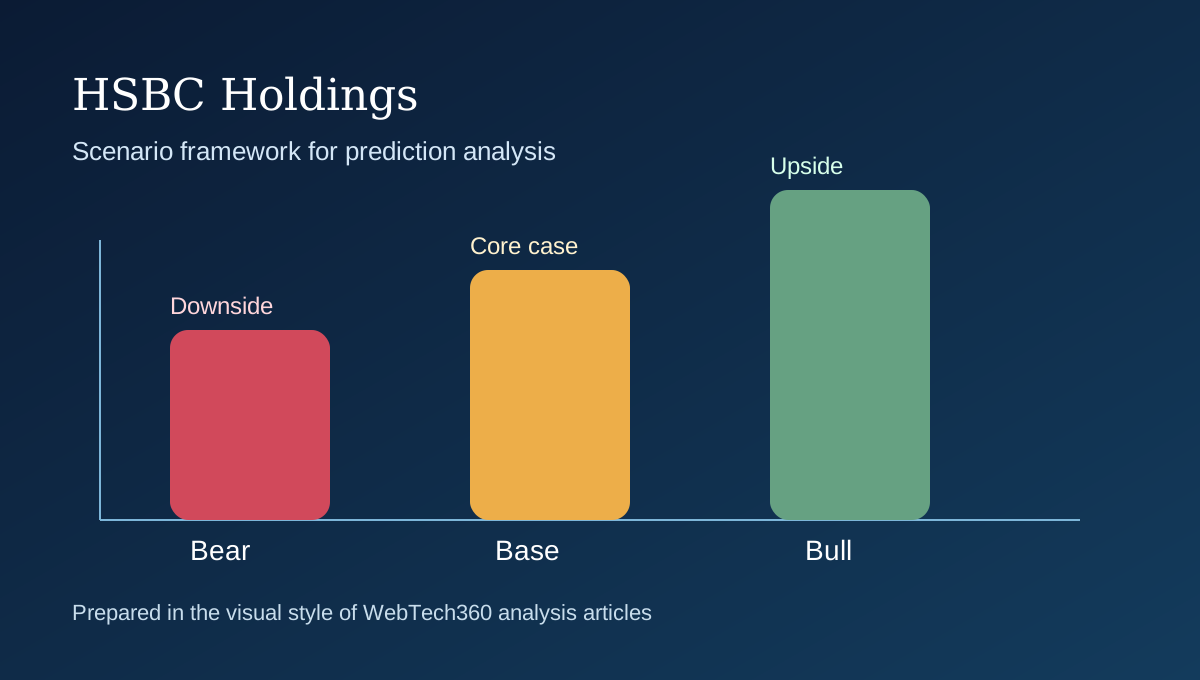
| Bull case | 25% | 1,500p to 1,700p | RoTE stays at or above 17%, banking NII stays around or above USD 46 billion, and ECL stays near management guidance rather than materially above it. | Review after H1 2026 and FY 2026. |
| Base case | 50% | 1,280p to 1,480p | HSBC hits its return targets, but buyback flexibility remains measured and the stock mostly compounds with earnings and dividends. | Review after each quarterly or interim update. |
| Bear case | 25% | 1,000p to 1,220p | Credit costs rise above 45 bps, rates ease faster than expected, or CET1 stays too tight for meaningful excess distributions. | Review if NII guidance is cut or ECL guidance rises again. |
References
Sources
- Yahoo Finance chart endpoint for HSBC Holdings (HSBA.L), used for current price and 10-year range
- HSBC Holdings plc 1Q 2026 Earnings Release, published May 5, 2026
- HSBC Holdings plc Annual Results 2025, published February 25, 2026
- HSBC 1Q 2026 quick read
- Bank of England Monetary Policy Summary, April 2026
- ONS Consumer price inflation, UK: March 2026
- ONS GDP monthly estimate, UK: March 2026
- IMF World Economic Outlook, April 2026
- MarketScreener HSBC analyst consensus
- MarketScreener HSBC valuation page