Home
» Discover
»
Illinois Fishing in October 2026: Seasons, Licenses, Limits and Water-Specific Access Rules
Illinois Fishing in October 2026: Seasons, Licenses, Limits and Water-Specific Access Rules
October can look simple on an Illinois fishing calendar: most sport fishing is open year-round. The complication is that Illinois regulations are layered. A statewide rule may apply until a named lake, river reach, refuge, forest preserve or state fish and wildlife area imposes something stricter. In October, trout stocking closures, waterfowl refuges, seasonal site shutdowns and boundary-river rules make that distinction especially important.
Example scenario: imagine an angler planning three October outings: Lake Michigan near Chicago, an inland trout lake, and a weekend at a southern Illinois refuge. The right answer is not “Illinois fishing is open in October.” The angler has to identify the exact water, the managing jurisdiction, the species and the method of take before deciding what is legal.
This guide uses the Illinois Department of Natural Resources (IDNR) 2026 fishing regulations, effective April 1, 2026 through March 31, 2027, plus current IDNR site pages and U.S. Fish & Wildlife Service rules where federal refuge jurisdiction applies. Check the 2026 Illinois Fishing Regulations before departure because IDNR states that emergency site-specific changes can be posted during the year.
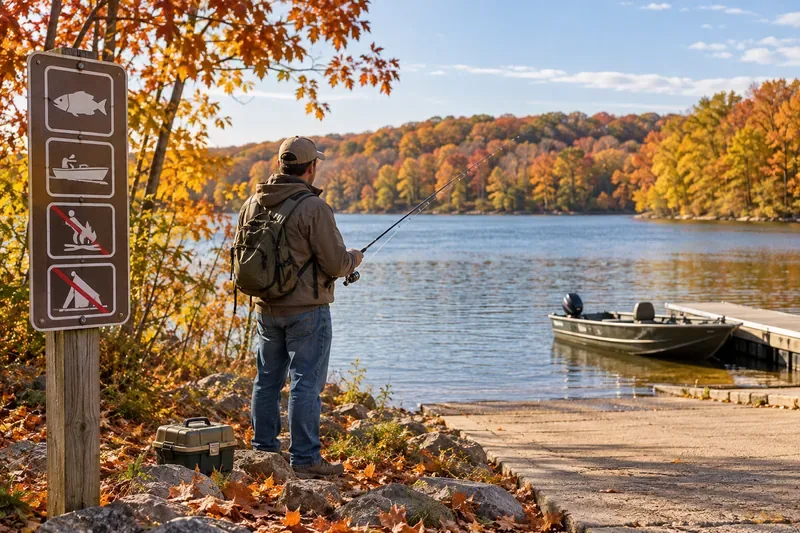
An autumn fishing trip in Illinois can involve statewide regulations, site-specific limits and seasonal access restrictions at the same time.
What is definitely open statewide in October?
Verified: IDNR says sport fishing is open year-round unless the site-specific regulations say otherwise. That means common targets such as largemouth bass, crappie, catfish, walleye and northern pike do not have a blanket statewide October closure. The important catch is that size and daily harvest rules differ by species, and many individual waters are more restrictive.
Action: start with the statewide table, then search the exact water name in the current regulation digest before keeping a fish.
Species/group
Current statewide rule relevant in October 2026
Important limitation
Largemouth, smallmouth and spotted bass
6 fish daily in aggregate; no statewide size minimum
Many listed waters impose minimum lengths, protected slots or lower bag limits. The spring smallmouth release-only period on most rivers ends June 15, so it does not create an October statewide closure.
Walleye, sauger and saugeye
14-inch minimum; 6 fish daily in aggregate
The Mississippi and Wabash Rivers are exceptions, and many lakes have separate limits.
Northern pike
24-inch minimum; 3 fish daily
The Mississippi River has no statewide pike size minimum; listed waters may differ.
Muskellunge and tiger muskie
36-inch minimum; 1 fish daily
Numerous trophy waters have higher site-specific minimums, often 42 or 48 inches.
Crappie
No statewide daily harvest or size limit
This is easy to misread. Many popular public lakes have strict crappie limits, so “no statewide limit” does not mean “unlimited everywhere.”
Blue, channel and flathead catfish
No statewide daily harvest or size limit
Site-specific rules commonly set creel limits.
Lake sturgeon
Protected; no possession
Release immediately. Other state-listed endangered or threatened aquatic species also may not be taken.
October trout rules: the biggest seasonal trap
Verified statewide program rule: at waters covered by the fall Catchable Trout Program closure, it is illegal to possess trout caught from October 1 until 5:00 a.m. on the third Saturday in October. In 2026, that third Saturday is October 17. IDNR’s official iFish Illinois page also states that the 2026 fall opener is October 17 and the early catch-and-release period begins October 3 at select sites.
The statewide catchable-trout daily harvest limit is five. A licensed angler who takes trout from inland waters must also have an Inland Trout Stamp unless exempt. The 2026 stamp fee listed by IDNR is $6.50 for licensed anglers.
What is not yet fully published: as of September 29, 2026, the official iFish Illinois page says the 2026 fall trout sites have not yet been announced. That means it would be wrong to copy last year’s stocking list and present it as a 2026 schedule.
Action: check iFish Illinois immediately before traveling for the final 2026 fall site list and any delayed stocking notices.
Why “trout closed” does not always mean the whole lake is closed
Verified distinction: the regulation-code definition for a “Fall Closed Season” prohibits possession of trout during the closure period. The Catchable Trout Program section says anglers may use those waters for other species during the closed period. However, an individual site can impose a broader access closure.
For example, the IDNR page for Loon Lake at Silver Springs State Fish and Wildlife Area says all fishing is prohibited there from October 1 until the third Saturday in October before the fall stocking. That local rule is stricter than the generic trout-possession closure.
Lake Michigan: open in October, but with its own limits and stamp
Jurisdiction: these rules apply to the Illinois portion of Lake Michigan in Cook and Lake counties, not to Wisconsin, Indiana or Michigan waters.
Verified October rules: Lake trout have a two-fish daily limit. Lake whitefish and round whitefish have a 12-fish aggregate daily limit. Largemouth or smallmouth bass have a 21-inch minimum and a one-fish daily limit. Trout and salmon other than lake trout have a 10-inch minimum and a five-fish aggregate daily limit. Yellow perch have a 15-fish daily limit across the combined waters specified by IDNR, and their seasonal closure is May 1 through June 15, so that closure does not apply in October.
Licensed anglers who take salmon or trout from Lake Michigan must have the Lake Michigan Salmon Stamp. IDNR lists the 2026 annual stamp at $6.50 for licensed anglers.
Method-specific exception: snagging for Chinook and Coho salmon is permitted October 1 through December 31 only at four listed shoreline locations: Lincoln Park Lagoon from the Fullerton Avenue Bridge to the southern end of the lagoon, the North Harbor basin at Waukegan Harbor, the Winnetka Power Plant discharge area, and Jackson Harbor’s inner and outer harbors. No snagging is allowed within 200 feet of a moored watercraft or where posted.
Action: do not treat the October salmon snagging rule as a Lake Michigan-wide permission. Match the exact shoreline location to the digest before using snagging gear.
Popular waters with October access changes
LaSalle Cooling Lake: closes after October 15
Jurisdiction: LaSalle Lake State Fish and Wildlife Area, IDNR, LaSalle County.
The current IDNR site page says LaSalle Lake is open seven days a week from 6:00 a.m. to sunset from March 15 through October 15, and all anglers must be off the lake by closing time. Therefore, it is available October 1-15 under those hours and not under the normal seasonal schedule after that date. Site-specific rules include two-pole-and-line fishing only, an 18-inch minimum and one-fish daily limit for largemouth/smallmouth bass, and a 10-fish aggregate daily limit for striped, white or hybrid striped bass, with no more than three fish 17 inches or longer.
Banner Marsh: October waterfowl restrictions are not a statewide fishing closure
Jurisdiction: Banner Marsh State Fish and Wildlife Area, IDNR, Peoria/Fulton counties. The 2026 digest classifies the Banner Marsh lakes and ponds as waterfowl refuge or hunting areas, where special access restrictions apply. IDNR’s current iFish listing for Johnson Lake at Banner Marsh gives an October 16 fall fishing closure and states that bank fishing is allowed after 1:00 p.m. during the closure.
Common misunderstanding: a waterfowl restriction at Banner Marsh does not automatically mean every Illinois lake closes to fishing on the same date.
Action: verify the named Banner Marsh lake and current posted access signs, especially if you planned to launch a boat.
Crab Orchard National Wildlife Refuge: federal refuge rules overlay Illinois fishing law
Jurisdiction: U.S. Fish & Wildlife Service, Crab Orchard National Wildlife Refuge, southern Illinois. State fishing limits still matter, but the refuge adds its own access rules.
The refuge’s current official rules say Crab Orchard Lake west of Wolf Creek Road is open to boating and fishing year-round. East of Wolf Creek Road, boating and fishing are allowed only March 1 through October 15; bank fishing remains available year-round at the Wolf Creek and Illinois Route 148 causeways. A-41 and Bluegill ponds in the restricted area are open sunrise to sunset March 1 through October 15, while Visitors Pond and Honkers Corner Pond are open year-round. The refuge also prohibits fishing within 250 yards of an occupied waterfowl blind.
Cache River State Natural Area: some nature preserves are completely off-limits to fishing
Jurisdiction: IDNR, Cache River State Natural Area, primarily Johnson, Pulaski and Massac counties. The 2026 site-specific regulation says there is no fishing in the Nature Preserves at Section 8 Woods, Heron Pond and Little Black Slough. That does not mean all 18,000-plus acres of the broader state natural area are closed.
Mississippi River boundary rules can differ sharply from inland Illinois
Verified: the 2026 digest has separate entries for the Mississippi River between Illinois and Iowa and between Illinois and Missouri. Do not apply one segment’s limits to the other.
On the Illinois-Missouri segment, the current site-specific rule allows eight walleye or sauger per day. The statewide 14-inch walleye/sauger minimum is expressly excepted on the Mississippi River. Paddlefish snagging is allowed September 15 through December 15 within the specified 300-yard downstream limits below locks and dams, except at the Chain of Rocks low-water dam, where snagging is prohibited. In addition, boating is prohibited in the Ellis Bay refuge area immediately upstream of Melvin Price Lock and Dam 26 from October 15 through April 15.
On the Illinois-Iowa segment, by contrast, the current rule includes a 15-inch walleye minimum, a protected slot from 20 inches up to 27 inches, and a six-fish daily walleye/sauger limit with no more than one fish 27 inches or longer.
Action: identify which state is on the opposite bank before relying on a Mississippi River limit.
Do you need an Illinois fishing license in October 2026?
Usually, yes. The 2026 license year began March 1, 2026. Annual licenses purchased for that license year expire March 31, 2027. Illinois residents under 16 may fish without a license; nonresidents under 16 also may fish without an Illinois sport fishing license. Certain Illinois residents who are legally blind or qualifying disabled persons may fish without a license when carrying the proof specified by IDNR. Resident owners or tenants may fish waters wholly on their land without a license, subject to the conditions in the digest.
October is not a Free Fishing Days month. The 2026 statewide free fishing dates were June 19-22.
Action: confirm your specific exemption, license and any needed trout or salmon stamp on the IDNR fishing license page before fishing.
Public water does not always mean public shoreline access
Verified: Illinois defines public waters by navigability and public-use criteria, but the fishing digest separately requires consent before fishing on another person’s property. A legal fishery can therefore exist beside shoreline that you cannot lawfully cross.
Action: use a public boat ramp, designated bank-fishing area or other authorized access. If you are unsure whether a bank is public, check IDNR’s Public Waters information and the managing agency’s site map rather than assuming access from the water’s status.
2026 rule changes worth noticing
IDNR flags several new or revised rules in the 2026 digest. Examples include a revised crappie rule at Coffeen Lake, a walleye/sauger change on the Mississippi River between Illinois and Missouri, revised largemouth bass regulations at Jim Edgar/Panther Creek State Fish and Wildlife Area, a crappie change at Kinkaid Lake, and new regulations at several newly listed public waters.
For Coffeen Lake, the current 2026 rule is 25 crappie per day, with no more than 10 fish measuring 10 inches or longer. For the Mississippi River between Illinois and Missouri, the current walleye/sauger daily limit is eight. These are water-specific rules, not statewide changes.
Action: if you have not read the 2026 digest since last season, recheck the exact lake or river entry rather than relying on a saved screenshot from 2025.
A practical October 2026 pre-trip check
Identify the exact water body and managing agency.
Confirm whether statewide or site-specific size and daily limits apply.
Check whether October trout, waterfowl-refuge or seasonal site closures affect the date.
Carry the correct fishing license and any Inland Trout or Lake Michigan Salmon Stamp required for your target.
Confirm public access; do not assume a navigable water creates a right to cross private land.
Read signs at the launch or site office because IDNR can post emergency changes after the annual digest is printed.
For federal refuges such as Crab Orchard, check both Illinois fishing law and the federal refuge’s access rules.
The safest way to plan an October trip is to treat “Illinois rules” as the first layer, not the last one. The species may be open statewide while the ramp is closed, the lake may be open while one refuge bay is off-limits, or a trout rule may change at 5:00 a.m. on October 17. Matching the rule to the exact jurisdiction is what turns a general season calendar into a legal trip plan.