Home
» Today
»
Jensen Huang’s Nvidia Return: What It Means for NVDA and AI Chips | Nov. 23, 2026 Update
Jensen Huang’s Nvidia Return: What It Means for NVDA and AI Chips | Nov. 23, 2026 Update
Updated November 23, 2026, 3:36 p.m. PST (UTC−08:00)
Jensen Huang is back as Nvidia’s CEO after the board voted unanimously to reinstate him, a reversal that has given Nvidia stock and the broader AI trade a powerful short-term lift. Reuters reported that Nvidia shares jumped about 33% in early trading Monday. For investors, the immediate takeaway is restored leadership continuity at the chipmaker that anchors much of the AI infrastructure market. The longer-term question is whether that confidence holds while the company’s board investigation, export-control oversight, and governance questions remain active.
The return does not change Nvidia’s reported sales or guarantee that customers will keep spending at the same pace. Nvidia’s latest quarter showed strong demand—$115.8 billion in revenue, including $107.6 billion from its Data Center business—but the stock’s next direction will still depend on orders, margins, supply, competition, and how the company handles its open compliance issues. The announcement is confirmed by Nvidia and an SEC filing; market effects beyond the initial rally remain uncertain.
Highlights
Nvidia announced on November 23 that Huang was reinstated immediately as president, CEO, and board director.
Reuters reported NVDA rose about 33% in early trading, alongside a wider rebound in AI-linked shares; that move records investor reaction, not a forecast.
The company’s independent investigation and new national-security and export-control oversight continue after Huang’s return.
Investors tracking the AI chip sector should watch future revenue, customer capital spending, export rules, and governance disclosures alongside the stock price.
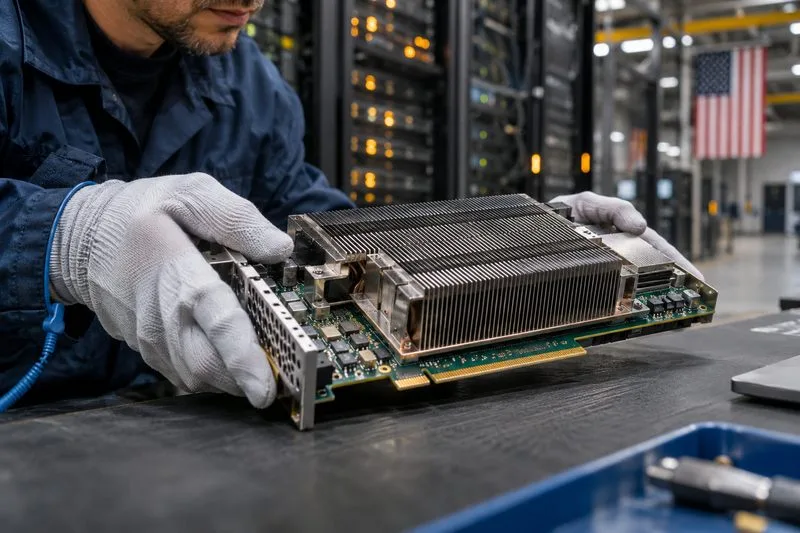
An illustrative AI-chip image, not a photograph of a specific Nvidia product or the events surrounding Huang’s return.
What changed at Nvidia, and what did not?
Nvidia’s November 23 announcement says its board voted unanimously to reinstate Huang as president and CEO and return him to the board, effective immediately. CFO Colette Kress remains CFO after her period as interim CEO. The board said it received input from senior levels of the U.S. government and was confident Huang’s return posed no national-security risk. Reuters separately reported that President Donald Trump had pressed for Huang’s return. Those are attributed accounts of the decision process, not a measure of the company’s future performance.
The leadership interruption began November 11, when Nvidia’s SEC filing recorded that the board had accepted Huang’s resignation and appointed Kress interim CEO. The newer November 22 Form 8-K records the reinstatement. But the reinstatement did not close the board’s independent investigation into reports that Huang was targeted by a foreign intelligence effort. Nvidia says that investigation will proceed, and the board has also formed a National Security and Export Control Committee and begun a search for a Chief Compliance Officer. The company says it will continue cooperating with government investigations and inquiries.
Why did Nvidia stock jump, and does the rally change its value?
The stock’s sharp rise reflects the market’s reaction to a specific risk easing: uncertainty over who would lead Nvidia, and whether the leadership change could disrupt customers, suppliers, and the company’s AI roadmap. Reuters described a broad relief rally in AI-exposed shares after the reinstatement. That reaction suggests investors had priced in meaningful uncertainty during the leadership crisis.
It does not establish a new fair value for NVDA. Nvidia’s November 17 results reported $115.8 billion in revenue for the third quarter of fiscal 2027, up 103% from a year earlier, with Data Center revenue of $107.6 billion, up 110%. Those reported figures show the scale and momentum of demand before the reinstatement. They do not prove that the same growth rate will continue, and Huang’s return itself does not add revenue to the quarter already reported.
For a shareholder, the practical distinction is between a sentiment rebound and a change in business fundamentals. A one-day move can reverse. Watch the company’s next guidance and reported results, customer commitments, gross margins, product delivery schedules, and the evolution of the board’s investigation. Compare the share price with those operating measures instead of treating the rally as proof that risk has disappeared.
What could Huang’s return mean for the AI chip sector?
Nvidia’s position matters beyond its own ticker because its accelerators, systems, and software are central to many AI data-center plans. Restored executive continuity may reassure customers deciding how to plan deployments and may support investor confidence in AI infrastructure spending. If those customers keep building, demand can benefit parts of the semiconductor supply chain as well as Nvidia.
That is a conditional outlook, not a guaranteed spillover. The return could also sharpen the competitive challenge for AMD and other accelerator providers if Nvidia retains customer confidence and executes its product roadmap. At the same time, any sustained questions about governance, export controls, or access to China could weigh on the risk premium applied to Nvidia and the wider AI trade. No single leadership announcement determines how much capital cloud providers will spend or which chips their customers will choose.
Investors comparing AI-chip companies can separate four questions: how much revenue is tied to AI data centers; whether customers are concentrating orders with one supplier or testing alternatives; whether production capacity and advanced packaging can meet demand; and how export restrictions affect the addressable market. The reinstatement changes the leadership answer today. It does not settle those other questions.
What should investors watch next?
Governance: whether Nvidia provides updates on the independent investigation, its new compliance role, and the board committees’ work.
Financial execution: whether upcoming revenue, margins, and guidance confirm continued demand rather than a one-day market rebound.
Customer spending: whether large cloud and data-center buyers maintain planned AI investment and diversify suppliers.
Policy and China: any company or government updates on export controls, licensing, and permitted shipments.
Sector breadth: whether gains extend to other chip and infrastructure firms over subsequent sessions, or remain concentrated in Nvidia.
These indicators can help readers evaluate what is changing without assuming a particular stock outcome. The rally is a verified market response reported by Reuters; whether it marks a durable repricing is still a forecast that depends on later evidence.
FAQ
Is Jensen Huang Nvidia’s CEO again?
Yes. Nvidia announced on November 23 that the board reinstated Huang as president and CEO, effective immediately. The SEC filing records the reinstatement as a November 22 board action.
Does Huang’s return guarantee Nvidia stock will keep rising?
No. The rally reflects investor reaction to the leadership reversal. Future performance still depends on Nvidia’s business results, customer spending, competition, and regulatory and governance developments.
Could the return affect other AI chip stocks?
It can influence sentiment across AI-linked stocks, but the effect on any one competitor depends on its own products, customers, and financial results. A broad or lasting sector impact is not yet established.