01. Historical Context
LVMH is now a recovery-and-discipline story, not a straight luxury momentum trade
Yahoo Finance monthly adjusted data show MC.PA traded between EUR113.80 and EUR808.59 from May 2016 through May 15, 2026. That historical range is useful because it shows how strongly the market can re-rate LVMH when demand is synchronized, but it also shows how hard the stock can mean-revert when luxury demand softens.
| Horizon | What matters most | What would strengthen the thesis | What would weaken the thesis |
|---|---|---|---|
| 3-12 months | Fashion & Leather Goods trend and China demand | Return to positive organic growth in the key division | Another year of muted growth in the biggest profit engine |
| 12-36 months | Earnings recovery and valuation support | EPS growth begins to re-accelerate into the 2027 consensus path | Luxury demand remains sluggish and the stock stays trapped near 20x earnings |
| To 2030 | Brand pricing power and category mix | Travel retail, China, and aspirational demand all recover | Luxury sector growth remains flatter than the pre-2023 trend |
LVMH's fundamental base is still large. The group reported EUR80.8 billion of revenue in 2025, EUR17.8 billion of profit from recurring operations, EUR11.3 billion of operating free cash flow, and net financial debt of EUR6.857 billion. But Q1 2026 showed the market's hesitation: revenue of EUR19.1 billion translated to only 1% organic growth, with Fashion & Leather Goods down 2% organically and management saying the conflict in the Middle East cut group growth by about 1 point.
That mix is why LVMH should be framed as a cyclical-quality recovery into 2030. The brands remain elite, but the stock needs a visible demand turn to justify moving materially higher from current levels.
02. Key Forces
The setup is still investable, but demand has to do more of the work
Valuation is still meaningful. MarketScreener's current figures put LVMH at about 20.5x 2026 earnings and 17.8x 2027 earnings, with EPS expected to rise from EUR21.85 in 2025 to EUR22.26 in 2026 and EUR25.55 in 2027. That implies only about 1.9% EPS growth in 2026 before a stronger 14.8% rebound in 2027. In other words, the stock already assumes some recovery, but not a complete luxury boom.
The second force is geography. LVMH said in Q1 2026 that Europe remained stable, the United States grew 3%, Japan was stable against a high prior-year base, and Asia ex-Japan grew 7%. That split is important because it shows the group is not facing a broad collapse, but it is still relying on Asia to do much of the incremental work.
The third force is sector context. Bain said the global personal luxury goods market stabilized at EUR358 billion in 2025, flat in constant currency and down 2% on a reported basis from EUR364 billion in 2024. That is a much weaker industry backdrop than the market enjoyed in the post-pandemic surge, and it helps explain why LVMH no longer commands the same valuation enthusiasm as it did at the peak.
Macro still matters as well. The IMF's April 2026 WEO cut 2026 world growth to 3.1% and forecast 4.4% growth for China, 2.0% for the United States, and 1.2% for the euro area. Eurostat's April 2026 flash estimate showed euro-area inflation at 3.0%. Those numbers point to a world that is still growing, but not one that naturally supports a rapid luxury reacceleration.
| Factor | Current Assessment | Bias | Why it matters now |
|---|---|---|---|
| Asia demand | Asia ex-Japan was up 7% organically in Q1 2026 | Bullish | That region remains the clearest source of incremental growth |
| Fashion & Leather Goods | Organic growth was -2% in Q1 2026 | Bearish | The most important profit pool still needs a recovery |
| Cash generation | 2025 operating free cash flow was EUR11.3 billion | Bullish | Strong cash flow gives LVMH flexibility while waiting for demand to recover |
| Valuation | About 20.5x 2026 PE and 17.8x 2027 PE | Neutral | Reasonable for quality, but not cheap enough to ignore softer growth |
| Macro and geopolitics | Middle East disruption cut Q1 growth by about 1 point | Neutral to Bearish | Luxury demand remains exposed to travel and confidence shocks |
The conclusion from these factors is that LVMH's upside remains real, but it is contingent on a cleaner demand recovery than the company has shown so far in 2026.
03. Countercase
The downside case is a longer luxury slowdown, not a brand failure
The first risk is that Fashion & Leather Goods remains weak for longer. That division still generated EUR41.1 billion of 2025 revenue, so a soft trend there matters more than strength in smaller divisions. Q1 2026 already showed a 2% organic decline, and Reuters-syndicated reporting noted that the result missed expectations for roughly 1.95% growth.
The second risk is macro and geopolitical noise. LVMH itself said Middle East tensions reduced Q1 group growth by about 1 point. If travel flows stay uneven or consumer confidence weakens further, luxury can remain softer even without a recession.
The third risk is valuation without acceleration. At about 20.5x 2026 earnings, LVMH is no longer priced like a bubble, but it still assumes investors will pay a premium for recovery quality. If 2027 EPS estimates start falling, that premium can compress quickly.
| Risk | Latest data point | Current Assessment | Bias |
|---|---|---|---|
| Core-division weakness | Fashion & Leather Goods organic growth was -2% in Q1 2026 | Still the biggest risk to a full recovery case | Bearish |
| Sector growth | Bain put 2025 personal luxury goods at EUR358 billion, down 2% reported | The industry has stabilized, not re-accelerated | Neutral to Bearish |
| Macro and geopolitical drag | Middle East conflict trimmed Q1 growth by 1 point | Temporary so far, but still a live risk | Neutral |
| Valuation support | 2026 PE around 20.5x | Manageable only if 2027 earnings rebound remains credible | Neutral |
A 2030 bear case of EUR350 to EUR470 therefore does not require a collapse in the franchise. It only requires a slower luxury cycle and a market that stops paying up for a rebound that takes too long.
04. Institutional Lens
What serious outside research is signaling now
The IMF's April 14, 2026 update is the first anchor: world growth at 3.1%, China at 4.4%, the United States at 2.0%, and the euro area at 1.2%. For LVMH, that is a growth corridor that can support demand stabilization but does not by itself argue for a return to the old luxury super-cycle.
Bain's 2025 luxury study is the second anchor. It said the global personal luxury goods market stabilized at EUR358 billion after a weaker 2025, flat in constant currency and down 2% reported. That is a useful sector reality check against any claim that luxury demand has already fully normalized.
The third anchor is sell-side consensus. MarketScreener showed 26 analysts with an average target of EUR588.54, implying about 29.18% upside from EUR455.60. That is constructive, but Reuters-syndicated reporting also highlighted more cautious calls such as Jefferies maintaining a hold rating and a EUR510 target after the Q1 update. Institutions are therefore not unanimous; they are waiting for proof.
| Source | Updated | What it says | Why it matters here |
|---|---|---|---|
| IMF WEO | April 14, 2026 | World growth 3.1%; China 4.4%; U.S. 2.0%; euro area 1.2% | Supports stabilization, not a luxury boom |
| Bain luxury study | November 2025 | Personal luxury goods market at EUR358 billion, flat constant currency | Shows the sector is steadying but still subdued |
| MarketScreener consensus | May 2026 | 2026 EPS EUR22.26, 2027 EPS EUR25.55, average target EUR588.54 | Sell side still expects recovery into 2027 |
| Reuters-syndicated coverage | April 2026 | Q1 sales missed expectations; some brokers kept cautious ratings | Confirms institutions still want cleaner evidence |
The key insight is that the institutional lens is still constructive on quality, but cautious on timing. That fits a probability-weighted base case better than a heroic single target.
05. Scenarios
Probability-weighted 2030 scenarios
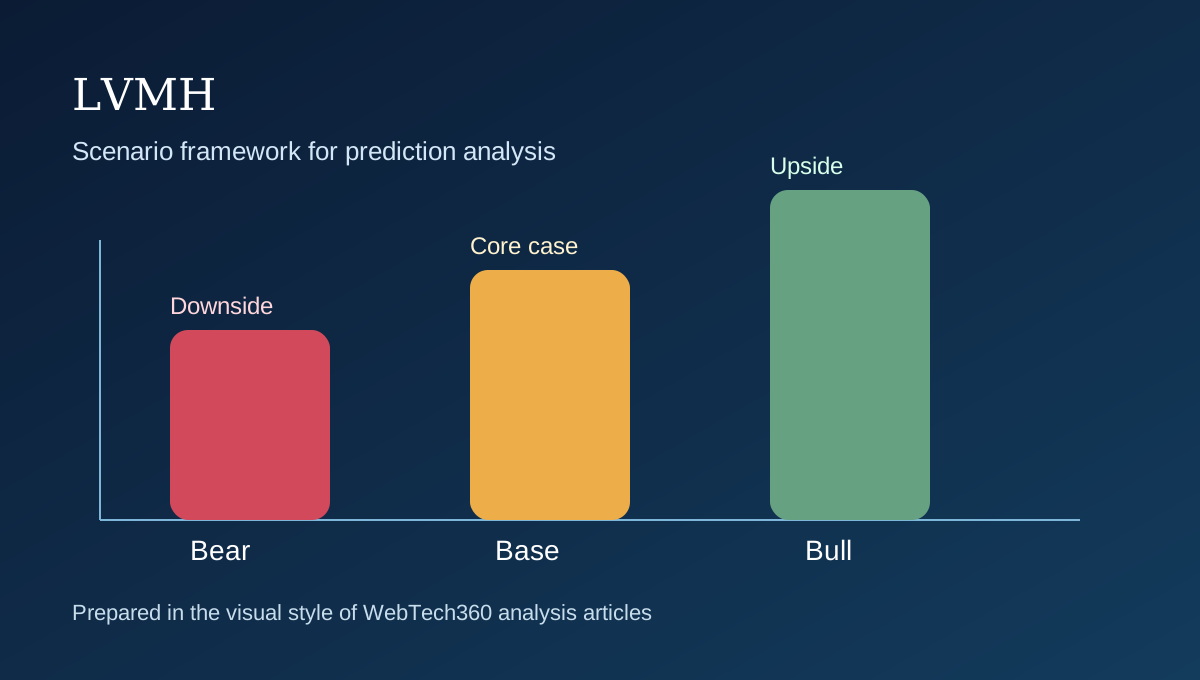
LVMH's 2030 path should be framed around recovery timing. The stock can work well if the largest division turns positive again and Asia stays firm, but the current data do not yet justify assuming an immediate return to peak-cycle conditions.
| Scenario | Probability | Trigger | Target range | Review point |
|---|---|---|---|---|
| Bull | 25% | Fashion & Leather Goods turns positive again, Asia ex-Japan keeps growing above 5%, and the sector re-rates back toward a stronger luxury cycle | EUR680 to EUR820 | Reassess after the 2026 half-year and full-year results to confirm the division recovery |
| Base | 45% | LVMH grows through a gradual recovery, 2027 EPS moves toward EUR25.55, and valuation remains near high-teens to low-20s earnings | EUR540 to EUR650 | Review after each half-year report, with the first key checkpoint at H1 2026 |
| Bear | 30% | Luxury demand stays muted, Fashion & Leather Goods remains soft, and valuation compresses toward the mid-to-high teens | EUR350 to EUR470 | Review if organic growth stays around 1% or lower through the next two reporting periods |
The current evidence supports the base case because LVMH still has exceptional brand quality and cash generation, but the stock needs better demand data before a materially more bullish 2030 call is justified.
References
Sources
- Yahoo Finance 10-year chart data for LVMH (MC.PA)
- LVMH 2025 full-year results
- LVMH Q1 2026 revenue update
- MarketScreener quote page for LVMH
- MarketScreener earnings estimates for LVMH
- IMF World Economic Outlook, April 2026
- Eurostat flash estimate for euro-area inflation in April 2026
- Bain luxury market outlook after 2025 stabilization
- Euronews coverage of LVMH's Q1 2026 sales slowdown
- Reuters-syndicated report on LVMH's sales miss and broker reactions