01. Historical Context
The 2027 setup depends on whether 2026 turns into a trough year or a new normal
LVMH's 2025 base was still strong, with EUR80.8 billion of revenue and EUR17.8 billion of recurring operating profit. The uncertainty comes from 2026. Q1 revenue was EUR19.1 billion with only 1% organic growth, and the most important division, Fashion & Leather Goods, declined 2% organically. That means 2027 is best framed as a recovery year, not a continuation of a broad luxury boom.
| Horizon | What matters most | What would strengthen the thesis | What would weaken the thesis |
|---|---|---|---|
| Next 3 months | Whether H1 results show improvement from Q1 | Fashion & Leather Goods stabilizes and group growth improves | Organic growth remains around 1% or lower |
| 6-12 months | 2027 EPS confidence | Consensus still points toward EUR25.55 EPS in 2027 | Estimate cuts or weaker regional demand |
| To 2027 | Recovery credibility | The stock moves closer to the EUR588.54 analyst mean target | The market keeps treating the business as late-cycle luxury |
The key point is that the stock no longer needs perfection, but it still needs evidence. A 2027 move higher depends on better growth data, not just on LVMH's reputation for quality.
02. Key Forces
The 2027 catalysts are concentrated and easy to track
The first catalyst is a recovery in the core division. Fashion & Leather Goods is still the most important profit driver, so investors should treat a return to positive organic growth there as the single most important trigger for a 2027 rerating.
The second catalyst is the earnings bridge. MarketScreener's estimate path from EUR21.85 EPS in 2025 to EUR22.26 in 2026 and EUR25.55 in 2027 implies the market still expects a meaningful rebound next year. If that estimate path holds through the next two reporting periods, the stock has room to close some of the gap to the analyst mean target.
The third catalyst is regional resilience. Q1 2026 showed Asia ex-Japan up 7% and the United States up 3%. If those markets stay firm while Europe and Japan avoid deeper weakness, the company can still rebuild momentum even without a spectacular global macro backdrop.
| Factor | Current Assessment | Bias | Why it matters for 2027 |
|---|---|---|---|
| Core division | Fashion & Leather Goods was -2% organically in Q1 2026 | Bearish | This is still the gating item for a stronger rerating |
| Asia demand | Asia ex-Japan grew 7% in Q1 2026 | Bullish | Provides the cleanest regional support for a rebound |
| Cash flow | 2025 operating free cash flow was EUR11.3 billion | Bullish | Gives the group resilience while waiting for demand to improve |
| Valuation | Roughly 20.5x 2026 PE, 17.8x 2027 PE | Neutral | The stock can rise, but only with better evidence |
| Macro and confidence | Middle East disruption already hit Q1 growth | Neutral to Bearish | Luxury remains sensitive to travel and sentiment shocks |
The stock has identifiable catalysts, but they are concentrated enough that investors should monitor the next two results cycles closely rather than assume mean reversion will happen automatically.
03. Countercase
What could stop the 2027 recovery from taking hold
The first risk is that the Q1 softness was not just temporary noise. Reuters-syndicated reporting highlighted that the Q1 result missed consensus expectations for roughly 1.95% growth. If that pattern persists, the stock will struggle to justify a move toward the analyst mean target.
The second risk is sector demand. Bain's finding that personal luxury goods were flat in constant currency in 2025 is a reminder that this is no longer a broad-based high-growth market. If the sector remains merely stable, LVMH can stay profitable and cash generative while the stock still underwhelms.
The third risk is valuation compression. A stock trading around 20x next year's earnings can fall simply because investors decide the recovery will take longer. That is especially true if Fashion & Leather Goods remains negative or if travel-related disruptions persist.
| Risk | Latest data point | Current Assessment | Bias |
|---|---|---|---|
| Sales miss continuation | Q1 group organic growth only 1% | Still a live near-term risk | Bearish |
| Sector ceiling | Luxury market stable at EUR358 billion in 2025 | Suggests slower upside than prior cycles | Neutral to Bearish |
| Geopolitical drag | Middle East conflict cut Q1 growth by about 1 point | Could fade, but not yet gone | Neutral |
| Valuation cushion | 2026 PE about 20.5x | Leaves room for a lower multiple if demand disappoints | Neutral |
The 2027 bear case therefore does not require a brand problem. It only requires a softer and slower luxury recovery than the market still hopes for.
04. Institutional Lens
Institutions still see upside, but only with cleaner evidence
The IMF's April 2026 macro corridor remains supportive enough for a recovery case, especially with China still forecast to grow 4.4% in 2026. But Bain's luxury work argues the sector is stabilizing, not booming, which means stock selection and division-level execution matter more than broad macro beta.
Sell-side positioning is constructive but measured. MarketScreener showed 26 analysts with an average target of EUR588.54. Reuters-syndicated coverage after the Q1 result also highlighted more cautious broker views, including Jefferies holding to a hold rating and a EUR510 target. That split explains why the 2027 base case should be constructive but not aggressive.
| Source | Updated | What it says | Why it matters for 2027 |
|---|---|---|---|
| IMF WEO | April 14, 2026 | China growth forecast of 4.4% in 2026 | Supports the regional recovery case investors want to see |
| Bain luxury study | November 2025 | Luxury market stabilized rather than re-accelerated | Sets a lower base-rate assumption for near-term sector growth |
| MarketScreener | May 2026 | Average target EUR588.54 and 2027 EPS EUR25.55 | Sell-side base case still expects a rebound |
| Reuters-syndicated coverage | April 2026 | Q1 sales missed forecasts and some brokers stayed cautious | Confirms the market still wants proof |
The institutional lens therefore supports a probability-weighted recovery framework rather than a one-way bullish call.
05. Scenarios
Probability-weighted 2027 scenarios
LVMH's 2027 range should be judged by what the business has to prove over the next year, not by what it achieved at the old cycle high.
| Scenario | Probability | Trigger | Target range | Review point |
|---|---|---|---|---|
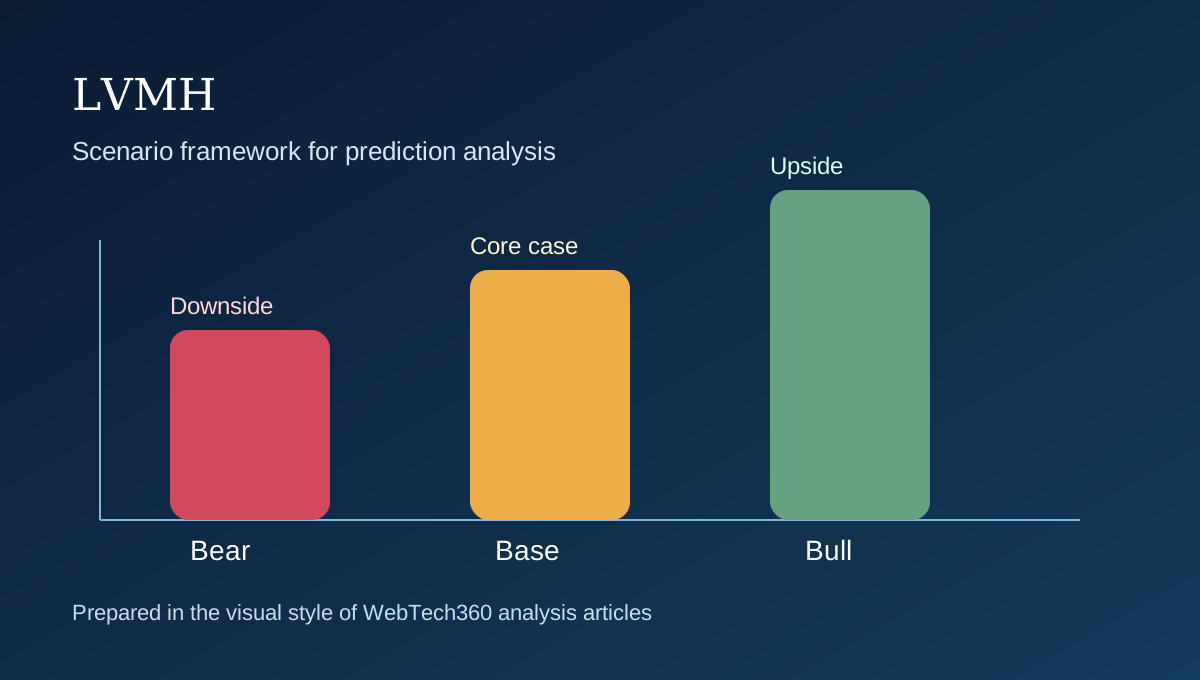
| Bull | 25% | Fashion & Leather Goods turns positive again, Asia stays strong, and investors regain confidence in the 2027 EPS rebound | EUR576 to EUR650 | Review after H1 2026 results and again after FY2026 results |
| Base | 45% | The group recovers gradually, 2027 EPS stays near EUR25.55, and the stock trades toward the middle of the current analyst band | EUR500 to EUR575 | Reassess after each reporting cycle, especially on the key division's growth rate |
| Bear | 30% | Organic growth stays close to 1%, the key division remains soft, or valuation compresses below the current recovery setup | EUR380 to EUR455 | Review immediately if the next two updates fail to show an improvement from Q1 |
The base case remains the best fit because LVMH still has the balance sheet, brands, and consensus support for a recovery. The missing piece is simply clearer evidence that demand has turned.
References
Sources
- Yahoo Finance 10-year chart data for MC.PA
- LVMH 2025 full-year results
- LVMH Q1 2026 revenue update
- MarketScreener quote page for LVMH
- MarketScreener earnings estimates for LVMH
- IMF World Economic Outlook, April 2026
- Bain luxury market outlook after 2025 stabilization
- Reuters-syndicated report on LVMH's sales miss and broker reactions
- Eurostat flash estimate for euro-area inflation in April 2026