Home
» Today
»
Macquarie Puts Australia’s Recession Risk at 50%: What the Warning Means | Nov. 24
Macquarie Puts Australia’s Recession Risk at 50%: What the Warning Means | Nov. 24
Updated: November 24, 2026, 8:07 p.m. AEDT (UTC+11).
Macquarie Group’s chief economist Ric Deverell has put the chance of an Australian recession at 50%, citing weak business confidence and the possibility of economic contraction in the December quarter. He also said Macquarie’s own estimates make a fourth-quarter contraction unlikely, while warning that the bank is now alert to that risk. The figure is a forecast, not confirmation that Australia is in recession.
The warning lands after October employment fell by 43,500 and the unemployment rate rose to 4.9%, its highest level in five years. Yet the latest published national accounts still show GDP growing: output increased 0.4% in the June quarter and 2.1% over the year to June. The contrast explains the concern: recent labour and confidence signals have weakened, while official GDP data arrives later and still records expansion.
Destaques
Macquarie’s 50% figure describes risk, not a certainty or an official recession call.
October employment dropped 43,500 and unemployment reached 4.9%, according to the ABS.
Australia’s latest published GDP reading showed 0.4% quarterly growth in June 2026.
The RBA’s November outlook expects below-potential growth, but its central forecast does not predict a recession.
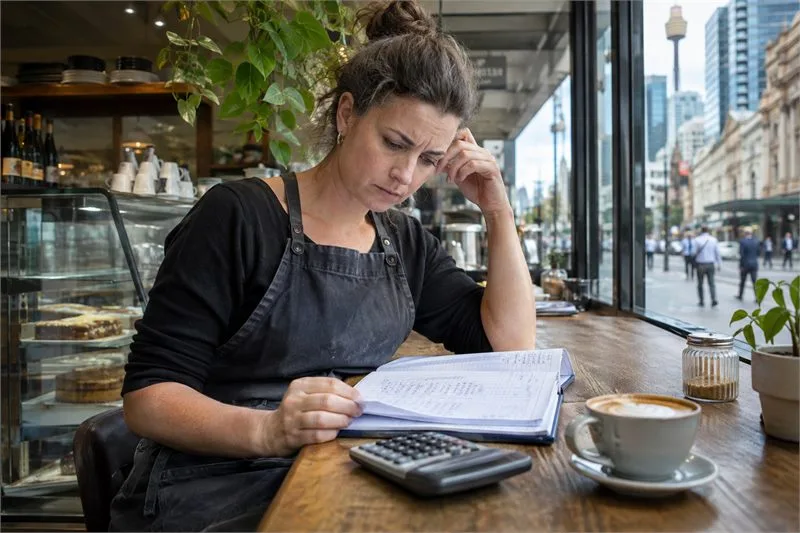
Illustrative image: a small-business owner reviewing accounts in a Sydney cafe. It does not depict an actual event.
What exactly did Macquarie warn about?
Macquarie’s concern is that slowing momentum could become a contraction. Deverell told The Nightly that business surveys were sending a consistent message of weaker activity. He said the bank’s bottom-up GDP estimates suggested a December-quarter contraction was unlikely, but that Macquarie was now alert to the possibility. The reported 50% recession probability therefore signals substantial uncertainty, not a prediction that a downturn must happen.
The distinction matters. A forecast can rise as evidence worsens, but it remains conditional on what households, businesses, policymakers and overseas markets do next. A single quarter of falling output would be a setback; it would not, by itself, meet the conventional Australian definition of a technical recession.
Why are economists worried about Australia’s economy?
The clearest recent warning sign is the labour market. The ABS reported that employment fell by 43,500 in October, while unemployment rose by 17,800 and the seasonally adjusted unemployment rate reached 4.9%. Monthly labour data can be volatile, so the figures do not prove that a prolonged downturn has begun. They do, however, show a sharper deterioration than a stable jobs market would.
Business and consumer confidence also matter because expectations can influence real decisions. If firms see fewer orders, they may delay hiring or investment. If households worry about work and bills, they may postpone discretionary spending. A pullback in spending can then reduce revenue for businesses, reinforcing the initial weakness. These are possible feedback effects, not proof that a recession is already under way.
Interest rates complicate the outlook. The Reserve Bank of Australia raised its cash rate target five times in 2026, to 4.85% at its November meeting. Higher borrowing costs are intended to restrain demand and bring inflation down, but they also put pressure on borrowers and interest-sensitive sectors such as housing. At its November press conference, Governor Michele Bullock said the RBA’s central forecasts did not show a recession, while warning that growth was expected to slow markedly and that people could feel poorer.
Is Australia already in a technical recession?
No official GDP data currently confirms one. The ABS’s latest national accounts, for the June quarter, showed real GDP rising 0.4% from the previous quarter and 2.1% over the year. Those figures are backward-looking: the June quarter ended months before the latest October jobs report and November confidence concerns.
In Australia, a technical recession is commonly described as two consecutive quarters of falling real GDP. Because GDP estimates are released after each quarter ends, confirmation can lag the conditions that households and businesses are experiencing. ABC News reported that the December-quarter and March-quarter GDP results would be needed to assess a two-quarter contraction, with both results not expected until around the middle of 2027. That timing means current warnings are about risk and leading indicators, not a confirmed recession.
What does the RBA expect next?
The RBA’s November Statement on Monetary Policy describes growth as below potential and expects labour-market conditions to ease further. Its central outlook forecasts unemployment reaching 5.1% by the end of 2028. The Bank also says the risks to domestic growth appear broadly balanced; a larger housing decline or global shocks could weaken activity more than its central forecast assumes, while investment linked to data centres is an upside risk.
That is a more measured picture than a definite recession call. The RBA’s baseline is for a subdued expansion, not an outright contraction. Macquarie’s warning highlights the possibility that actual conditions could prove weaker than baseline forecasts, particularly if poor confidence and falling employment translate into less spending and investment.
What should households and businesses watch?
For households, the useful response to an uncertain outlook is to review cash flow rather than assume either a recession or a quick recovery. Check upcoming loan repayments, essential expenses and accessible savings. Anyone worried about repayments can contact their lender early to ask what support or hardship options may apply. This is practical preparation, not a prediction about interest rates or personal finances.
For business owners, watch orders, customer demand, hiring plans and payment times alongside headline confidence surveys. A sustained fall across several measures would be more concerning than one weak monthly reading. For everyone, the next key evidence will include updated employment, inflation and GDP data, plus any change in the RBA’s assessment of demand and price pressures.
The main takeaway is that Macquarie’s warning reflects a genuine increase in downside risk, but the evidence remains mixed: jobs and confidence have weakened, while the latest official GDP figure still shows growth and the RBA’s baseline does not forecast recession. Whether the warning becomes reality depends on how those trends develop over coming quarters.
Has Macquarie confirmed Australia will enter recession?
No. Macquarie has warned of a 50% chance, while saying its own estimates made a December-quarter contraction unlikely.
What is a technical recession in Australia?
It is commonly defined as two consecutive quarters of falling real GDP.
When will Australia’s next GDP results clarify the risk?
The December-quarter and March-quarter results will help establish whether output contracted in consecutive quarters; ABC News reported that both would be available around the middle of 2027.