Home
» Today
»
Mark Carney’s Trump Trade Warning: What It Means for Canada’s Auto Economy | Nov. 16, 2026
Mark Carney’s Trump Trade Warning: What It Means for Canada’s Auto Economy | Nov. 16, 2026
Updated November 16, 2026, at 12:15 p.m. UTC.
Mark Carney says Canada could look to European, Chinese or Japanese automakers if trade negotiations with U.S. President Donald Trump fail to preserve a viable North American auto industry. His comments, made in Phnom Penh on November 16 ahead of a planned meeting with Chinese President Xi Jinping, put Canadian manufacturing jobs and investment at the centre of the trade debate. Carney says talks with Washington remain the priority, but Canada is prepared to pursue other opportunities.
The stakes extend well beyond vehicle sales. Canada’s auto plants are tied to cross-border supply chains, while the United States remains the destination for most Canadian goods exports. If U.S. trade actions keep disrupting that integration, companies may rethink where they build vehicles and source parts. That could affect jobs, investment and the pace of Canada’s shift toward electric vehicles.
Destaques
Carney says Canada may explore other automaker partnerships if U.S. talks do not protect a viable domestic auto industry.
He says any Chinese investment would need substantial Canadian manufacturing, local supply chains and proper labour standards.
The United States received 72% of Canada’s goods exports in 2025, according to figures cited by the Congressional Research Service.
The remarks signal a contingency plan; they do not confirm that a new automaker deal or investment has been secured.
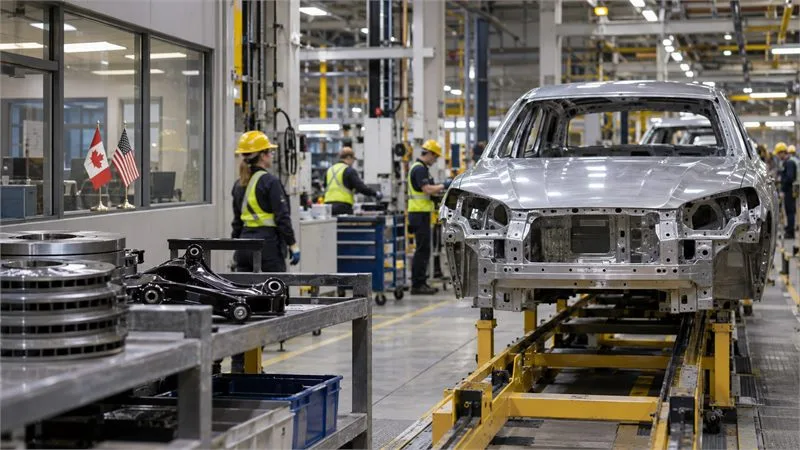
An illustrative view of the cross-border auto manufacturing relationship discussed by Carney. The image is representative, not a photograph of a specific Canadian factory.
What did Mark Carney say about Trump and trade?
Carney told reporters that Canada wants its auto workers to have “full opportunity” in an integrated North American market, but said U.S. trade actions have made that market less integrated. He also said negotiations with Washington remain his priority, while the outcome could shape whether Canada pursues alternatives involving European, Chinese or Japanese automakers.
Carney rejected the idea that possible Chinese investment was simply a bargaining tactic, describing it as “action, reaction.” He said investment would need to include real manufacturing in Canada, appropriate labour standards, facilities and domestic supply chains that grow over time. In his framing, assembling imported components alone would not meet the test.
The comments follow a prolonged period of trade tension. In August, Carney suspended negotiations after saying changes to U.S. proposed terms were unfair and uneconomic. He listed Canada’s objectives as preserving tariff-free access for most businesses, improving stability, reducing tariffs on strategic sectors and protecting Canadian policy flexibility and sovereignty. Read the Prime Minister’s August statement on negotiations.
Why does the auto industry matter to Canada’s economy?
Auto manufacturing depends on parts and vehicles crossing borders during production. Ford, General Motors and Stellantis operate plants across Canada, the United States and Mexico, and components may cross borders multiple times before a vehicle is complete. Tariffs or uncertainty can raise costs, complicate investment decisions and make it harder for plants to compete across the region.
The exposure is significant. The Congressional Research Service reports, using Statistics Canada data, that 72% of Canada’s goods exports went to the United States in 2025. Its September 2026 briefing also describes the two countries’ auto and energy markets as highly integrated and notes that the USMCA review could bring significant changes. See the Congressional Research Service overview of U.S.–Canada trade.
For workers and suppliers, the central question is whether production remains anchored in Canada as companies adapt to tariffs and changing trade rules. For consumers, changes in sourcing or production could influence costs and the availability of vehicles over time. Those are possible effects, not guaranteed outcomes; company decisions depend on trade terms, demand, investment costs and government policy.
Could Chinese automakers invest in Canada?
Carney’s remarks make the possibility part of the public discussion, but they do not announce a specific investment. The Canadian government has also described its China relationship as one part of a broader effort to diversify trade and attract investment. In an announcement about Carney’s November overseas trip, Ottawa said China was Canada’s second-largest single-country merchandise trading partner in 2025, with two-way trade of $125.7 billion. See the government’s trip announcement and trade figures.
Any new manufacturing partnership would have to answer practical questions: how much production would take place in Canada, which parts would be made locally, what jobs and training would result, and how the investment would fit with trade rules and North American supply chains. Carney’s stated conditions point to domestic industrial capacity, rather than a simple import-and-assembly model.
What happens next for Canada–U.S. trade?
The immediate test is whether negotiations can deliver terms that both sides accept, especially for autos. Canada’s public position is that it wants a workable U.S. deal while developing more export and investment options elsewhere. Ottawa has pointed to diversification efforts in Europe and Asia, but those relationships cannot quickly replace the scale and proximity of the U.S. market.
For now, Carney’s remarks are best read as a signal of Canada’s negotiating priorities and a contingency if talks fail—not proof that the country is leaving the North American auto system. Companies will watch for concrete tariff changes, investment commitments and the direction of the USMCA review. Until those details emerge, uncertainty itself remains a cost for manufacturers deciding where to put their next plant or production line.
Frequently asked questions
Is Canada abandoning auto trade with the United States?
No. Carney says negotiations with Washington remain the priority. He is also outlining alternatives if a deal does not protect a viable Canadian auto industry.
Has Canada announced a Chinese automaker factory?
No. Carney discussed possible investment and set conditions for it; he did not announce a specific company, project or factory.
Why are the comments important for Canadian workers?
Auto plants rely on integrated cross-border supply chains. Trade changes can influence production costs and where companies choose to invest, with potential effects on Canadian jobs and suppliers.