Information checked: November 28, 2026, 2:06:34 a.m. UTC (UTC+00:00).
The Maryborough meteorite is a 17-kilogram (about 37-pound) stony meteorite that a gold prospector found with a metal detector near Maryborough, Victoria, Australia. The discovery began as a stubborn, rusty-looking rock that resisted attempts to cut or break it. Museum scientists later identified it as an H5 ordinary chondrite: a fragment of ancient solar-system material, not a gold-bearing stone.
David Hole found the rock in May 2015, about 2 kilometers (1.2 miles) south of Maryborough. Its story is a useful reminder that a meteorite’s age, its arrival on Earth, and the date someone finds it are three different things.
Destaques
David Hole found the 17-kilogram stone while prospecting for gold in May 2015.
Museums Victoria classifies it as a stony H5 ordinary chondrite.
The meteorite formed about 4.6 billion years ago; that is not the same as the time it fell to Earth.
Researchers found no evidence linking historic fireball reports in the district to this particular stone.
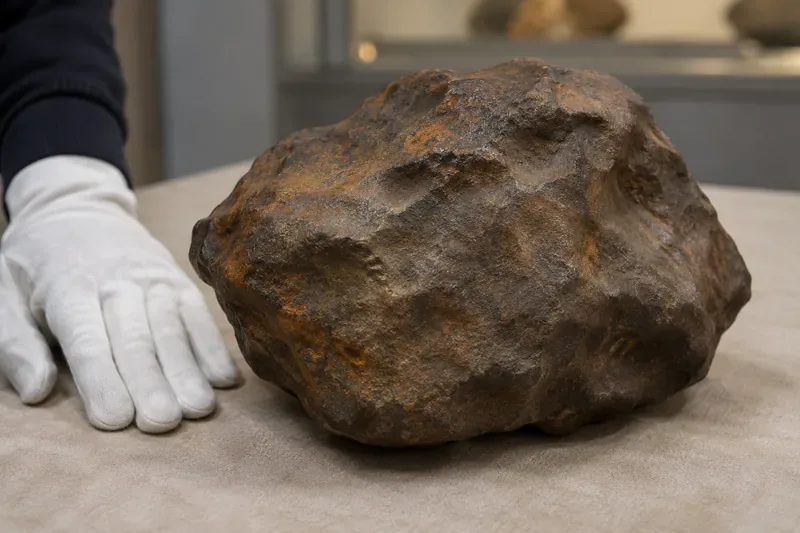
Illustrative image of a weathered stony meteorite. It is not a photograph of the Maryborough specimen.
How did David Hole discover the Maryborough meteorite?
Hole was searching for gold with a metal detector in Maryborough Regional Park, in Victoria’s central goldfields, when the detector signaled a heavy object. The region’s gold-rush history made a nugget a reasonable hope. Instead, he dug up a dense, reddish-brown rock with an irregular, dimpled surface.
He took the rock home and spent years trying to work out what it was. Museums Victoria recounts that he tried tools including a drill and an angle grinder, but the stone was unusually hard. Those marks did not identify it; they were simply part of the object’s route from the ground to scientific examination.
About three years after the find, Hole brought it to Melbourne Museum. Geologists Dermot Henry and Bill Birch recognized that it warranted a closer look. Their identification was later formally described in a 2019 research paper. The paper records a single stone weighing 17 kilograms and measuring about 39 by 14 by 14 centimeters. The museum collection record lists the main specimen at 15.9 kilograms and the total mass at 17 kilograms, reflecting the cataloged specimen and total material.
What does “H5 ordinary chondrite” mean?
“Chondrite” describes a stony meteorite that contains chondrules: small, rounded mineral structures that formed from droplets of molten or partly molten material in the early solar nebula. They are among the primitive building blocks preserved from the solar system’s beginnings. The Maryborough paper reports chondrules up to about one millimeter across, set in a recrystallized mineral matrix.
The “H” identifies the high-iron chemical group among ordinary chondrites. The number “5” is a petrologic type describing the degree of heating and alteration the rock experienced inside its parent asteroid. As the Buseck Center for Meteorite Studies at Arizona State University explains, type 5 records enough thermal metamorphism to homogenize key minerals and blur chondrule outlines. It is a classification, not a count of the meteorite’s age or the number of stones found.
The meteorite contains iron-nickel metal as well as silicate minerals such as olivine and orthopyroxene. Its dark, weathered exterior and metal-bearing interior helped distinguish it from a typical local rock, but appearance alone is not a reliable way to identify a meteorite.
How old is the Maryborough meteorite?
The stone’s material dates to roughly 4.6 billion years ago, near the time the solar system formed. That figure refers to the meteorite’s origin as early solar-system material, not to the moment it hit the ground in Victoria.
A separate estimate based on carbon-14 dating places its terrestrial age—the time since it arrived on Earth—at less than 1,000 years. That is an upper-bound estimate, not an exact fall date. Researchers note that historical meteor sightings have been reported in the wider Maryborough district, but none can be tied to the stone’s recovery location. The fall itself was not witnessed in a way that links it to this specimen.
Where did the meteorite come from, and why does it matter?
Museums Victoria says the stone most likely formed in the asteroid belt between Mars and Jupiter. The 2019 paper focuses on its measured minerals, structure, mass, and classification. Together, these details let researchers compare it with other meteorites and study material that formed before Earth existed.
Maryborough is especially notable locally because researchers described it as the third H5 ordinary chondrite and the second-largest single chondritic mass recorded in Victoria at the time of the paper. “Ordinary” is a scientific group name, not a claim that every specimen is unimportant. Even a relatively common class can preserve useful clues about the early solar system.
The find also illustrates why meteorites can be scientifically valuable without being rare in every chemical respect. They deliver samples from beyond Earth that can be examined directly, and their mineral textures preserve evidence of conditions on their parent bodies.
Where is the Maryborough meteorite now?
The specimen is part of the Museums Victoria collection. The museum’s online catalog currently says the 17-kilogram total is in storage and not on display. Display arrangements can change, so visitors should check the collection record or contact the museum before planning a visit specifically to see it.
Yes. David Hole found it in May 2015 while using a metal detector to search for gold near Maryborough, Victoria.
Is the Maryborough meteorite older than Earth?
Its source material formed about 4.6 billion years ago, around the solar system’s formation. That is ancient material, but it does not mean the rock landed on Earth 4.6 billion years ago.
Can visitors see the Maryborough meteorite in a museum?
Museums Victoria’s current collection record says it is in storage and not on display. Check with the museum for the latest access information.