01. Current Data
The current operating and valuation picture
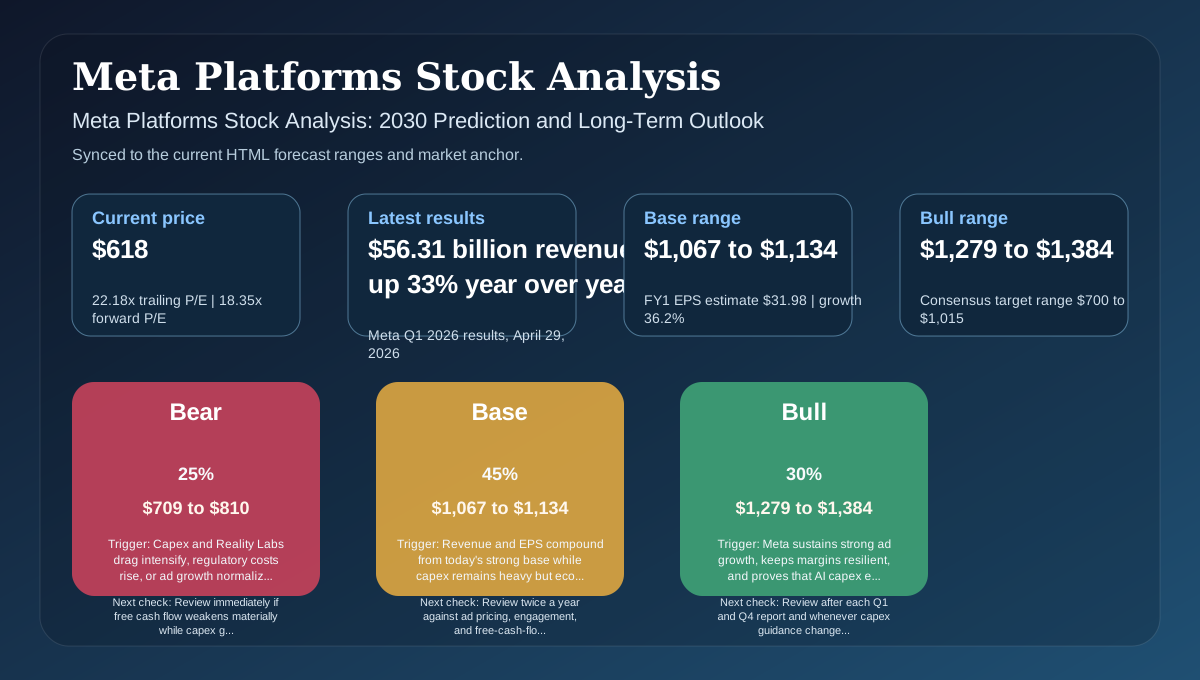
| Metric | Latest figure | Why it matters |
|---|---|---|
| Share price | $618 | Sets the market starting point for every scenario |
| Market cap | $1.52 trillion | Shows how much scale is already reflected in the equity value |
| Valuation | 22.18x trailing P/E; 18.35x forward P/E | Defines whether the stock still has room for multiple expansion |
| Latest results | $56.31 billion revenue, up 33% year over year | Meta Q1 2026 results, April 29, 2026 |
| EPS setup | TTM EPS $27.49; next-year consensus EPS $31.98 | Shows the bridge between current earnings and forward expectations |
| Consensus range | $836.39 average target; $700 low; $1,015 high | Frames how much upside the Street still sees from here |
| Capital allocation / guide | Q2 revenue guide of $58 billion to $61 billion and FY2026 capex guide raised to $125 billion to $145 billion | Creates the next measurable checkpoints for the thesis |
Base case: Meta still looks constructive because ad demand, engagement, and margins remain strong, while the forward multiple at 18.35x is not stretched by megacap standards. The complication is that the AI and data-center bill is now large enough to become a first-order valuation debate every quarter.
The latest quarter was powerful. Meta reported revenue of $56.311 billion, up 33% year over year, operating income of $22.872 billion, operating margin of 41%, and diluted EPS of $10.44. Family of Apps revenue reached $55.909 billion, ad impressions rose 19%, average price per ad increased 12%, and Family daily active people averaged 3.56 billion. Cash flow from operations was $32.23 billion and free cash flow was $12.39 billion.
There is also an important EPS adjustment to keep in view. Meta said first-quarter diluted EPS included an $8.03 billion income tax benefit tied to U.S. Treasury Notice 2026-7; excluding that benefit, diluted EPS would have been $3.13 lower. In other words, the quarter was genuinely strong, but the headline EPS number was stronger than the underlying operating run-rate.
The capex story is now inseparable from the equity story. Capital expenditures were $19.84 billion in Q1, and Meta raised full-year 2026 capex guidance to $125-145 billion from $115-135 billion. U.S. real GDP rose 2.0% annualized in Q1 2026, while real final sales to private domestic purchasers increased 2.5% and the gross domestic purchases price index rose 3.6%. April 2026 CPI rose 3.8% year over year and core CPI rose 2.8%; March 2026 PCE inflation was 3.5% year over year. In a friendly macro tape that spend can be rewarded. In a higher-rate tape it can become the main reason investors trim the multiple.
02. Key Factors
Five factors shaping the next move
The first force is advertising momentum. Meta is still proving that AI can improve relevance, engagement, and ad delivery economics at the same time. The second force is expense discipline. A 41% operating margin on this level of AI investment is impressive, but it also sets a high expectation for future quarters.
The third force is capex efficiency. Raising the annual capex range to as high as $145 billion is only bullish if those data centers and components translate into better monetization, not just a bigger depreciation burden. The fourth and fifth forces are regulatory risk and consensus positioning. Meta explicitly warned that active legal and regulatory matters in the EU and the U.S. could significantly affect results, while the stock still trades well below the Street's average target despite the recent rally.
| Factor | Why it matters | Current Assessment | Bias | Current evidence |
|---|---|---|---|---|
| Valuation | Shows whether the market is already paying for the AI buildout | Constructive | + | 22.18x trailing P/E and 18.35x forward P/E are elevated but not excessive for 30%+ revenue growth |
| Recent earnings | Confirms whether AI is supporting the core ad engine | Strong | + | $56.31 billion revenue, 41% operating margin, and Family of Apps revenue of $55.909 billion |
| Estimate backdrop | Tells you what needs to stay true next | Positive | + | Consensus FY2026 EPS is $31.98 and the average target is $836.39, well above the current price |
| Capex burden | Measures whether the AI thesis is becoming too expensive | Mixed | 0 | Q1 capex was $19.84 billion and the FY2026 capex guide was raised to $125-145 billion |
| Regulatory and tax noise | Separates operating performance from non-core volatility | Mixed | 0 | Q1 EPS was helped by a tax benefit, and management still highlights meaningful legal and regulatory risk |
03. Countercase
What could weaken the stock from here
The main bear case is that Meta's AI spending bill keeps climbing faster than the market can monetize it. A capex range of $125-145 billion for 2026 is not a small variance item; it is a central investment thesis variable.
The second risk is earnings quality. Reported diluted EPS of $10.44 included a tax benefit that added $3.13 to EPS. That does not invalidate the quarter, but it does mean investors should lean more on revenue, ad pricing, margins, and free cash flow than on headline EPS alone.
The third risk is regulatory. Meta explicitly said active legal and regulatory matters in the EU and the U.S. could significantly impact business and financial results. That warning matters more in a stock already expected by consensus to recover further.
The final risk is macro and ad cyclicality. April CPI at 3.8% and March PCE inflation at 3.5% are not disastrous for digital advertising, but they do keep alive the possibility of slower brand spending and a lower justified multiple if risk appetite weakens.
| Risk | Latest data point | Why it matters now | What would confirm it |
|---|---|---|---|
| Capex overspend | FY2026 capex guide was raised to $125-145 billion | The market will tolerate the spend only if AI monetization stays visible | Another capex raise arrives without a matching acceleration in revenue or free cash flow |
| Headline EPS distortion | Q1 diluted EPS was $10.44, but would have been $3.13 lower without the tax benefit | Headline EPS can make the quarter look cleaner than the operating cash economics | Future quarters show less EPS leverage once the tax benefit rolls off |
| Regulatory overhang | Meta flagged active legal and regulatory matters in the EU and U.S. | Legal outcomes can affect monetization, data use, and investor risk appetite | Management updates indicate a material financial impact or remedy |
| Macro and ad demand | April CPI 3.8%; March PCE inflation 3.5% | Digital ad budgets remain cyclical even when engagement is strong | Ad impressions or pricing trends soften while costs remain elevated |
04. Institutional Lens
How current source material changes the thesis
Meta's own release gives the cleanest institutional lens. On April 29, 2026, Meta reported $56.311 billion of revenue, 41% operating margin, $32.23 billion of operating cash flow, and a Q2 revenue guide of $58-61 billion. It also raised the 2026 capex guide to $125-145 billion and held the expense guide at $162-169 billion.
The most important nuance in the release was not bullish or bearish by itself; it was analytical. Meta said the quarter included an $8.03 billion income tax benefit and that diluted EPS would have been $3.13 lower without it. That is exactly the kind of detail investors should use to avoid overstating or understating the quarter.
Consensus remains supportive. As of May 14, 2026, StockAnalysis showed 36 analysts with a Strong Buy consensus, an average target of $836.39, and FY2026 EPS consensus of $31.98. On April 1, 2026, the IMF said U.S. GDP growth should rise to 2.4% in 2026 on a Q4/Q4 basis and core PCE inflation should move back to 2% in the first half of 2027. The institutional takeaway is that Meta still has room to rerate, but only if ad momentum and margin resilience continue to offset the market's concern over capex intensity.
| Source type | Concrete datapoint | Why it matters for the stock |
|---|---|---|
| Meta IR release, April 29, 2026 | $56.311 billion revenue, 41% operating margin, $32.23 billion operating cash flow, Q2 guide of $58-61 billion, capex guide of $125-145 billion | Anchors the thesis in reported and guided numbers |
| Meta IR footnote, April 29, 2026 | $8.03 billion income tax benefit added $3.13 to diluted EPS | Explains the quality of the headline EPS beat |
| Meta segment disclosure, April 29, 2026 | Family of Apps revenue of $55.909 billion and Reality Labs loss of $4.028 billion | Shows what is funding the AI buildout and what remains a drag |
| StockAnalysis snapshot, May 14, 2026 | 22.18x trailing P/E, 18.35x forward P/E, FY2026 EPS estimate of $31.98, average target of $836.39 | Shows the current valuation and consensus upside |
| BLS, BEA, and IMF, April-May 2026 | Inflation is still above target even as growth remains positive | Defines the macro environment for a capex-heavy ad platform |
05. Scenarios
Scenario analysis with probabilities and review points
The 2030 range is built around current ad growth, Family of Apps economics, capex intensity, and whether Meta can keep converting AI investment into higher monetization.
Each scenario below is designed to be monitored with current valuation, earnings, and macro data rather than a vague long-term story. When the trigger changes, the range should change with it.
| Scenario | Probability | Range / implication | Trigger | When to review |
|---|---|---|---|---|
| Bull | 30% | $1,279 to $1,384 | Meta sustains strong ad growth, keeps margins resilient, and proves that AI capex expands monetization faster than depreciation | Review after each Q1 and Q4 report and whenever capex guidance changes materially |
| Base | 45% | $1,067 to $1,134 | Revenue and EPS compound from today's strong base while capex remains heavy but economically justified | Review twice a year against ad pricing, engagement, and free-cash-flow conversion |
| Bear | 25% | $709 to $810 | Capex and Reality Labs drag intensify, regulatory costs rise, or ad growth normalizes faster than expected | Review immediately if free cash flow weakens materially while capex guidance is raised again |
References