01. Current Data
The current operating and valuation picture
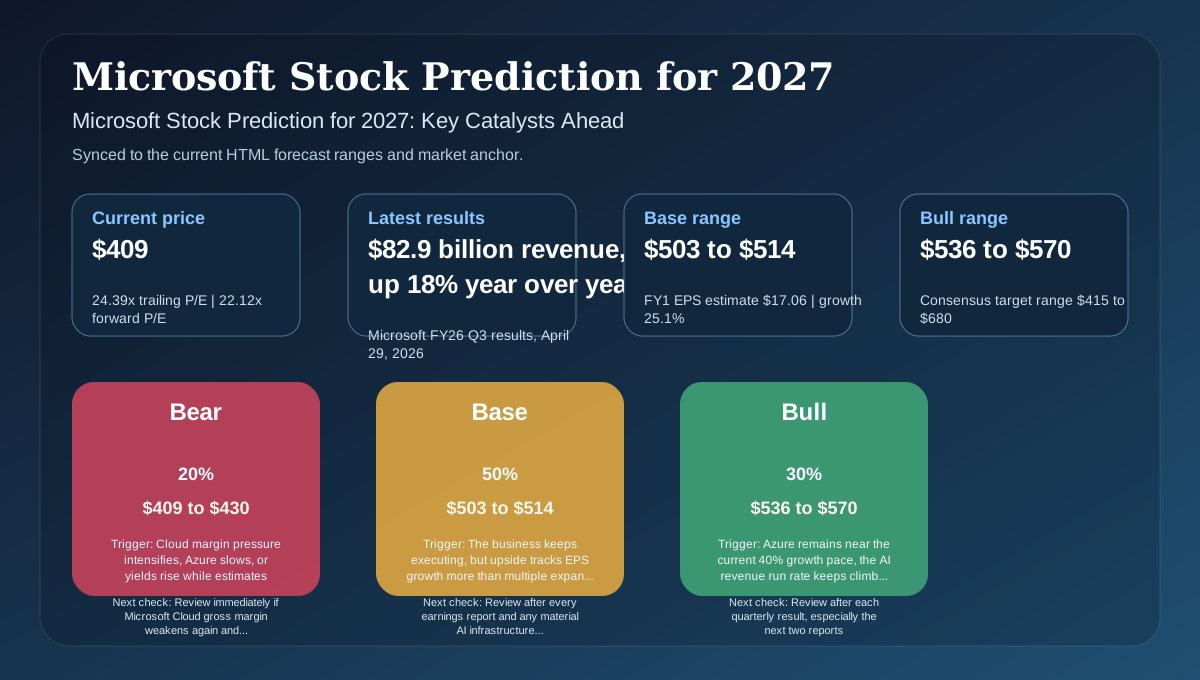
| Metric | Latest figure | Why it matters |
|---|---|---|
| Share price | $409 | Sets the market starting point for every scenario |
| Market cap | $3.01 trillion | Shows how much scale is already reflected in the equity value |
| Valuation | 24.39x trailing P/E; 22.12x forward P/E | Defines whether the stock still has room for multiple expansion |
| Latest results | $82.9 billion revenue, up 18% year over year | Microsoft FY26 Q3 results, April 29, 2026 |
| EPS setup | TTM EPS $16.79; next-year consensus EPS $17.06 | Shows the bridge between current earnings and forward expectations |
| Consensus range | $569.46 average target; $415 low; $680 high | Frames how much upside the Street still sees from here |
| Capital allocation / guide | AI business annual revenue run rate above $37 billion and Microsoft returned $10.2 billion to shareholders in the quarter | Creates the next measurable checkpoints for the thesis |
Base case: Microsoft still deserves a constructive long-term stance because Azure, Microsoft Cloud, and AI monetization are scaling together, while the valuation at 24.39x trailing earnings and 22.12x forward earnings is demanding but not extreme for the quality of the business.
The latest official quarter was strong on nearly every line. Microsoft reported fiscal third-quarter revenue of $82.9 billion, up 18% year over year, operating income of $38.4 billion, up 20%, net income of $31.8 billion, up 23%, and diluted EPS of $4.27, up 23%. Microsoft Cloud revenue reached $54.5 billion, up 29%, Azure and other cloud services revenue grew 40%, and commercial remaining performance obligation increased 99% to $627 billion. Satya Nadella also said the AI business surpassed a $37 billion annual revenue run rate, up 123% year over year.
Macro still matters because Microsoft trades as a high-duration earnings compounder. U.S. real GDP rose 2.0% annualized in Q1 2026, while real final sales to private domestic purchasers increased 2.5% and the gross domestic purchases price index rose 3.6%. April 2026 CPI rose 3.8% year over year and core CPI rose 2.8%; March 2026 PCE inflation was 3.5% year over year. On April 1, 2026, the IMF said U.S. GDP growth should rise to 2.4% in 2026 on a Q4/Q4 basis and core PCE inflation should move back to 2% in the first half of 2027. That backdrop is good enough to support the current thesis, but not benign enough to remove valuation risk if AI infrastructure spending pressures margins or Treasury yields move back up.
02. Key Factors
Five factors shaping the next move
The first force is the balance between growth and valuation. Microsoft no longer needs a story about future AI optionality alone; it already has one of the clearest revenue monetization profiles in large-cap tech, so the market will judge whether Azure, Microsoft 365, and Copilot can keep supporting both growth and margin durability.
The second force is backlog conversion. A $627 billion commercial remaining performance obligation figure is powerful, but investors still need to see those obligations convert into recognized revenue without margin compression becoming the dominant narrative. The third, fourth, and fifth forces are AI capex efficiency, cash returns, and macro sensitivity. Microsoft can finance AI aggressively, but the stock still reacts to whether those investments expand future earnings faster than they dilute current cloud gross margin.
| Factor | Why it matters | Current Assessment | Bias | Current evidence |
|---|---|---|---|---|
| Valuation | Defines the hurdle for further upside | Reasonable for quality, not cheap | 0 | 24.39x trailing P/E and 22.12x forward P/E imply the market still pays a premium for visibility |
| Recent earnings | Shows whether AI demand is turning into reported revenue | Strong | + | $82.9 billion revenue, $38.4 billion operating income, and $4.27 diluted EPS all grew double digits |
| Estimate backdrop | Frames what the market expects next | Positive | + | Consensus FY2026 EPS is $17.06 and FY2027 EPS is $19.63, with a $569.46 average target |
| Cloud and backlog | Measures whether demand remains broad and contracted | Very strong | + | Microsoft Cloud revenue reached $54.5 billion and commercial RPO rose 99% to $627 billion |
| Macro and margin risk | Controls how much multiple support survives | Mixed | 0 | GDP is still expanding, but CPI at 3.8% and AI infrastructure spend are keeping margin scrutiny alive |
03. Countercase
What could weaken the stock from here
The main risk is not that Microsoft lacks growth. It is that the market has become used to high-quality beats and can still punish any sign that Azure growth, backlog conversion, or Copilot monetization is flattening. At 22.12x forward earnings, the stock is not absurdly priced, but it is priced for continuity.
The second risk is margin pressure from AI infrastructure. Microsoft Cloud gross margin fell to 66% in the quarter because of continued investment in AI infrastructure and growing AI product usage. That is acceptable while revenue growth is strong, but it becomes a problem if Azure growth cools before those investments mature.
The third risk is macro. April CPI at 3.8% and March PCE inflation at 3.5% leave room for a higher-for-longer rate debate. For a stock that still trades at a premium multiple, that means valuation compression can happen even if the business itself remains excellent.
| Risk | Latest data point | Why it matters now | What would confirm it |
|---|---|---|---|
| Azure deceleration | Azure and other cloud services revenue grew 40% | The premium multiple assumes cloud growth remains well above enterprise software averages | Azure growth falls meaningfully below the current pace for two consecutive quarters |
| AI margin drag | Microsoft Cloud gross margin declined to 66% | Heavy infrastructure investment is acceptable only if monetization scales with it | Cloud gross margin keeps falling while revenue growth slows |
| Backlog realization risk | Commercial remaining performance obligation reached $627 billion | RPO strength supports confidence only if it converts to revenue efficiently | Bookings stay strong but recognized revenue growth fades |
| Macro and duration risk | April CPI 3.8%; March PCE inflation 3.5% | Higher discount rates can compress software and cloud multiples quickly | Inflation remains sticky and long-term yields rise while estimates stop moving up |
04. Institutional Lens
How current source material changes the thesis
The most useful institutional read starts with Microsoft itself. On April 29, 2026, the company reported $82.9 billion of revenue, $31.8 billion of net income, $54.5 billion of Microsoft Cloud revenue, Azure growth of 40%, and a $37 billion AI annual revenue run rate. That is the real evidence behind the bull case.
The broader backdrop is still supportive for large-cap technology. FactSet said on April 2, 2026 that total estimated S&P 500 Q1 earnings had increased 0.4% since December 31, and that Information Technology had the second-largest increase in expected dollar earnings at +8.0% while posting the highest count of positive EPS guidance at 33 companies. That matters for Microsoft because it indicates the company is not relying on idiosyncratic accounting noise or only one product line to sustain the premium. Software and cloud demand remain part of a broader supportive earnings tape.
Consensus is also explicit. As of May 14, 2026, StockAnalysis showed 37 analysts with a Strong Buy consensus, a $569.46 average price target, and average FY2026 EPS of $17.06. On April 1, 2026, the IMF said U.S. GDP growth should rise to 2.4% in 2026 on a Q4/Q4 basis and core PCE inflation should move back to 2% in the first half of 2027. The implication is straightforward: Microsoft remains one of the cleaner long-duration winners, but the market now expects it to keep proving that status every quarter.
| Source type | Concrete datapoint | Why it matters for the stock |
|---|---|---|
| Microsoft IR release, April 29, 2026 | $82.9 billion revenue, $4.27 diluted EPS, $54.5 billion Microsoft Cloud revenue, Azure +40%, AI run rate above $37 billion | Anchors the operating thesis in reported results |
| Microsoft IR performance page, April 29, 2026 | Microsoft Cloud gross margin declined to 66% and AI infrastructure spending remained elevated | Shows the main margin debate inside the bull case |
| StockAnalysis snapshot, May 14, 2026 | 24.39x trailing P/E, 22.12x forward P/E, FY2026 EPS estimate of $17.06, average target of $569.46 | Shows the valuation and consensus hurdle |
| FactSet, April 2, 2026 | Technology estimate revision breadth stayed positive ahead of Q1 reporting | Supports the broader cloud and software backdrop |
| IMF, BLS, and BEA, April-May 2026 | GDP remained positive while inflation stayed above target | Explains why the multiple is constructive but still rate-sensitive |
05. Scenarios
Scenario analysis with probabilities and review points
For 2027, the measurable review points are Azure growth, Microsoft Cloud revenue, commercial backlog conversion, and whether FY2026-FY2027 EPS estimates keep stepping higher.
Each scenario below is designed to be monitored with current valuation, earnings, and macro data rather than a vague long-term story. When the trigger changes, the range should change with it.
| Scenario | Probability | Range / implication | Trigger | When to review |
|---|---|---|---|---|
| Bull | 30% | $536 to $570 | Azure remains near the current 40% growth pace, the AI revenue run rate keeps climbing, and consensus EPS moves above $17.06 | Review after each quarterly result, especially the next two reports |
| Base | 50% | $503 to $514 | The business keeps executing, but upside tracks EPS growth more than multiple expansion | Review after every earnings report and any material AI infrastructure update |
| Bear | 20% | $409 to $430 | Cloud margin pressure intensifies, Azure slows, or yields rise while estimates flatten | Review immediately if Microsoft Cloud gross margin weakens again and estimates stop rising |
References
Sources
- Microsoft FY26 Q3 press release and webcast
- Microsoft FY26 Q3 performance page
- StockAnalysis Microsoft statistics and valuation snapshot
- StockAnalysis Microsoft analyst target and EPS forecast snapshot
- U.S. CPI April 2026 release
- BEA PCE price index page
- U.S. GDP advance estimate for Q1 2026
- IMF 2026 U.S. Article IV consultation
- FactSet S&P 500 earnings season preview for Q1 2026