01. Historical Context
What matters for a 2030 view
Nestle's long-term case rests on resilience, category depth, and cash generation, but the 2030 path depends on whether the current reset is cyclical or structural. The stock has compounded at roughly 3.38% annually on an adjusted price basis over the last ten years, moving inside a broad range of about CHF 50.95 to CHF 109.06. That history argues for discipline: the market has rewarded Nestle for consistency, not for narrative.
The next four years therefore matter more than the next four quarters. If management converts the current savings plan, the digital core upgrade, and the category focus into steadier volume growth and better margins, 2030 can look better than the trailing decade. If not, the historic CAGR is the more honest baseline.
| Horizon | What matters most | Current assessment | Bias |
|---|---|---|---|
| 2026 | Proof of margin and volume repair | Good enough to keep the story alive, not good enough to declare success | Neutral |
| 2027-2028 | Delivery of the CHF 3 billion savings program and category recovery | The program is measurable and therefore testable | Neutral to bullish |
| 2029-2030 | Whether Nestle behaves like a 4%+ growth and 17%+ margin business again | That remains aspirational today | Neutral |
02. Key Forces
Structural drivers into 2030
The most important structural driver is capital discipline around strong categories. Nestle's own investor materials still emphasize Coffee, Petcare, Nutrition, and Food & Snacks as the core portfolio. If the company uses that focus to improve mix and fund innovation without further margin erosion, 2030 earnings quality should be better than 2025's reset year.
The second driver is that Nestle remains a scale cash-flow machine. Even after a difficult 2025 it generated more than CHF 9 billion of free cash flow, and 2026 guidance again calls for more than CHF 9 billion. Over a five-year window, that matters at least as much as short-term sentiment swings.
| Factor | Current data point | Current assessment | Bias |
|---|---|---|---|
| Category depth | Coffee, Petcare, and Nutrition remain the strategic core | The portfolio still has attractive global assets | Bullish |
| Profitability base | 2025 UTOP margin 16.1% | Below the 17%+ normal-environment ambition, so there is room to improve | Neutral |
| Cash generation | 2025 FCF CHF 9.154 billion; 2026 guide above CHF 9 billion | Supports a credible long-run compounding case | Bullish |
| Savings plan | CHF 3 billion by end-2027 | The key bridge from reset to recovery | Bullish if delivered |
| Valuation starting point | Price still below the 52-week high and below the 10-year adjusted peak | Gives the 2030 case room without assuming a new all-time high immediately | Neutral |
03. Countercase
What could keep 2030 returns subdued
The long-term bear case is not that Nestle loses relevance. It is that the company remains operationally useful but financially middling. That can happen if volume growth stays weak, if commodities and freight keep eating into the gross margin, or if the portfolio shift does not fully offset weaker legacy businesses.
A second risk is valuation math. Even a quality staple can disappoint if earnings growth is too soft for the multiple investors pay. A stock starting near 22 times trailing earnings is fine for a compounding story, but not forgiving enough for repeated execution slippage.
| Risk | Latest data point | Why it matters | Bias |
|---|---|---|---|
| Margin ambition stays out of reach | 2025 UTOP margin 16.1% versus 17%+ normal-environment ambition | Without a better margin, 2030 upside compresses | Bearish |
| Growth remains narrow | Q1 2026 Coffee strong, Nutrition weak | A broad-based recovery is needed for a higher 2030 range | Bearish |
| Below-the-line pressure | 2025 basic EPS CHF 3.51 versus CHF 3.91 pre-result consensus | Reported EPS volatility can keep the stock from rerating | Neutral to bearish |
| Long-run price history | 10Y adjusted CAGR 3.38% | The historic run rate is decent but not strong enough to justify inflated assumptions | Neutral |
04. Institutional Lens
The most useful institutional anchors for a 2030 model
For a 2030 model, the official strategy page is more important than any single quarterly soundbite. Nestle still says it aims to return to 4%+ organic growth in a normal operating environment, with 17%+ UTOP margin and CHF 3 billion of savings by end-2027. That is a specific, measurable framework rather than a vague long-term aspiration.
The 2030 base case in this article therefore does not assume an aggressive rerating. It assumes Nestle partially closes the gap between the 2025 reset and those strategic targets. If it closes more than expected, the bull case opens. If it fails, the stock likely stays in a lower-return defensive lane.
| Source and date | What it said | Specific number | Why it matters |
|---|---|---|---|
| Nestle strategy page, crawled May 2026 | Normal-environment growth ambition | 4%+ organic growth | Sets the top end of a credible 2030 operating case |
| Nestle strategy page, crawled May 2026 | Normal-environment profitability ambition | 17%+ UTOP margin | Defines the margin bridge investors need to monitor |
| Nestle strategy page, crawled May 2026 | Savings target | CHF 3 billion by end-2027 | A measurable mechanism for funding the margin rebuild |
| Nestle FY2025 results, February 19, 2026 | Actual starting point | UTOP margin 16.1%; FCF CHF 9.154 billion | Shows the business is still strong enough to self-fund the repair |
05. Scenarios
Probability-weighted 2030 ranges
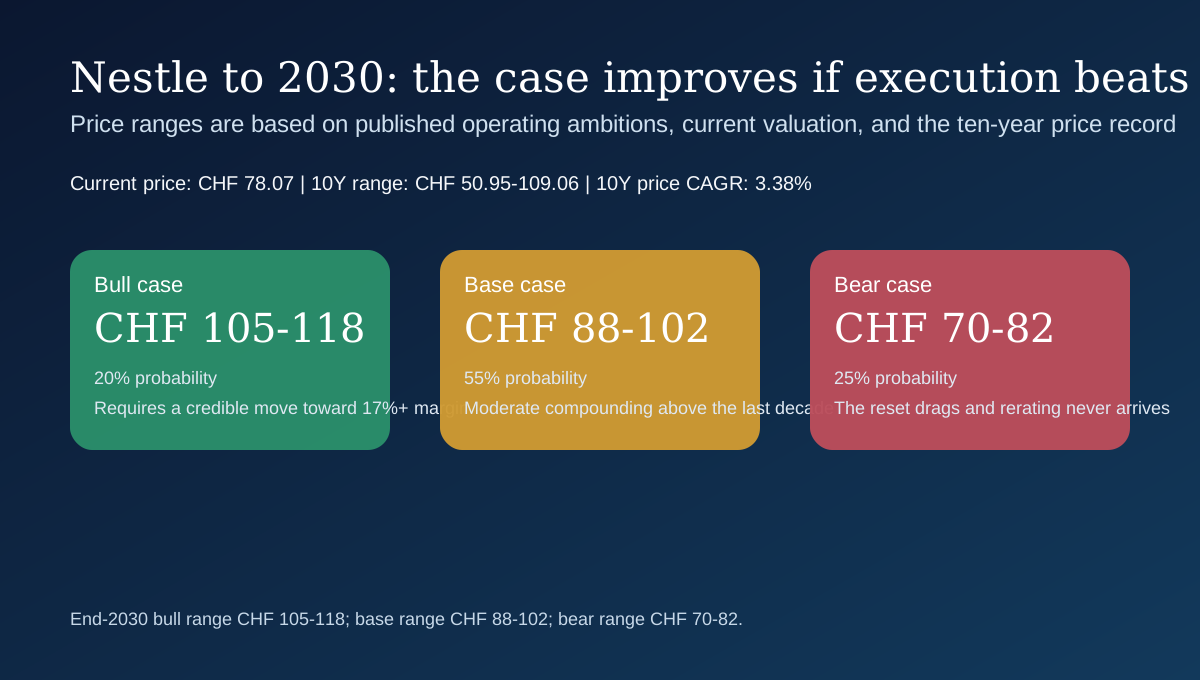
The 2030 range should be revisited every time the company updates the progress of the savings plan, RIG, and the margin line. By 2030, what matters is not whether one quarter was strong. It is whether the operating model looks closer to the stated normal-environment ambition.
Because the last decade compounded at just over 3% on price, the base case here only assumes moderate improvement above history. The bull case is reserved for a cleaner and broader operational recovery.
| Scenario | Probability | Trigger | Review date | Target range |
|---|---|---|---|---|
| Bull case | 20% | Nestle moves materially toward 4%+ OG and 17%+ UTOP by the late 2020s | Annual results through 2028 and 2029 | CHF 105-118 |
| Base case | 55% | Growth and margin improve, but only part of the strategic gap closes | Annual results through 2028 and 2029 | CHF 88-102 |
| Bear case | 25% | Recovery stays incomplete and the stock tracks more like a dividend instrument than a rerating story | Annual results through 2028 and 2029 | CHF 70-82 |
References
Sources
- Yahoo Finance chart API for Nestle (NESN.SW) 10-year price history and latest market data
- Nestle three-month sales 2026 press release, published April 23, 2026
- Nestle full-year 2025 results and 2026 guidance, published February 19, 2026
- Nestle analysts and consensus page, including the latest company-compiled consensus references
- Nestle pre-full year 2025 company-compiled consensus PDF, published January 2026
- Nestle strategy page with 4%+ organic growth, 17%+ margin, and CHF 3 billion savings ambition
- StockAnalysis valuation page for Nestle ADR (NSRGY), used for forward P/E reference