01. Historical Context
A 2035 view should be built from durability, not excitement
The best reason to own Nestle through 2035 is not that it will become a high-growth consumer company. It is that the business still throws off large cash flow, owns globally scaled categories, and can compound if management closes even part of the performance gap exposed in 2025. The current price remains below both the 52-week high and the ten-year adjusted peak, so the starting point is not extreme.
The long-run question is whether the company can convert operational focus into a higher-quality earnings stream. The investor materials still point to 4%+ organic growth and 17%+ UTOP margin in a normal environment. If Nestle spends the next several years rebuilding toward that corridor, the 2035 bull case becomes realistic. If not, the stock may still be safe, but not particularly dynamic.
| Horizon | What matters most | Current assessment | Bias |
|---|---|---|---|
| 2026-2027 | Recovery from the 2025 reset | Still in progress | Neutral |
| 2028-2031 | Evidence that the operating model is structurally stronger | Savings and mix need to show up in margin and RIG | Neutral |
| 2032-2035 | Whether Nestle compounds above its historic pace | Possible, but only with better execution than the last cycle | Neutral to bullish |
02. Key Forces
The long-run forces that can shape 2035 returns
Category leadership and pricing power remain the main long-run positives. Nestle still controls leading positions across Coffee, Petcare, Nutrition, and Food & Snacks, and that breadth matters over a decade because it gives management more than one way to generate growth and protect cash flow.
The second long-run positive is that the digital and AI work is more likely to affect efficiency than to create speculative revenue. That is a feature, not a bug, for a company like Nestle. Productivity gains, faster product launches, and better marketing asset reuse can lift returns without turning the investment case into a hype cycle.
| Factor | Current data point | Current assessment | Bias |
|---|---|---|---|
| Category leadership | Coffee and Petcare remain core growth engines | Still a structural strength | Bullish |
| Margin runway | 2025 UTOP margin 16.1% versus 17%+ ambition | There is room to improve, but it is not guaranteed | Neutral |
| Cash flow durability | 2025 FCF CHF 9.154 billion; 2026 guide above CHF 9 billion | Supports long-run compounding and capital return capacity | Bullish |
| Valuation reset risk | Current price below prior cycle highs but not distressed | Long-duration returns still depend on execution, not just defensiveness | Neutral |
| Historic pace | 10Y adjusted price CAGR 3.38% | A useful floor for conservative modelling | Neutral |
03. Countercase
What could keep Nestle from compounding well into 2035
The long-run bear case is that Nestle stays solid but never regains a better growth algorithm. That would mean slower volume growth, limited margin improvement, and a stock that behaves like a bond proxy with dividends rather than a true compounder.
A second risk is that repeated portfolio fixes become the story. If too much of the decade is spent repairing categories, navigating recalls, or absorbing inflation, shareholders get stability without much operating leverage.
| Risk | Latest data point | Why it matters | Bias |
|---|---|---|---|
| The reset proves structural | 2025 basic EPS down 16.3% | A low-growth decade usually starts with repeated earnings disappointments | Bearish |
| Margin fails to rebuild | 2025 UTOP margin 16.1% | A defensive multiple cannot expand much without a stronger margin structure | Bearish |
| Category weakness returns | Q1 2026 Nutrition OG -3.9% | Shows how one weak category can still drag a global portfolio | Neutral to bearish |
| Historic compounding stays low | 10Y price CAGR 3.38% | A conservative model should not assume a sharp break from history without proof | Neutral |
04. Institutional Lens
Useful long-range institutional anchors
The strongest official anchor for a 2035 model is still Nestle's own long-run operating ambition. Management is not asking investors to underwrite a very high-growth path. It is asking them to believe the company can return to a 4%+ organic growth and 17%+ margin profile in a normal environment.
That is why the 2035 base case here is deliberately moderate. It assumes Nestle becomes a somewhat better operating business than it was in 2025, not a radically different one. For a company with Nestle's scale, that distinction matters.
| Source and date | What it said | Specific number | Why it matters |
|---|---|---|---|
| Nestle strategy page, crawled May 2026 | Normal-environment operating model | 4%+ OG; 17%+ UTOP margin | The key framework for a decade-long model |
| Nestle FY2025 results, February 19, 2026 | Current profitability starting point | UTOP margin 16.1% | Shows how much work remains |
| Nestle FY2025 results, February 19, 2026 | Cash generation starting point | FCF CHF 9.154 billion | Supports long-duration resilience |
| Yahoo Finance chart API, May 15, 2026 market data | Actual long-term trading history | 10Y adjusted price CAGR about 3.38% | Keeps the model anchored to what the stock has really done |
05. Scenarios
Probability-weighted 2035 price ranges
Long-horizon targets should be handled as ranges, not promises. The right review cadence is yearly: has Nestle moved closer to the strategic margin and growth corridor, or is it still only defending the base? That distinction will shape the multiple more than any one product cycle.
The 2035 base case here sits above the last decade's pace but below a heroic turnaround. The bull case assumes a cleaner and more consistent operating model across the 2030s.
| Scenario | Probability | Trigger | Review date | Target range |
|---|---|---|---|---|
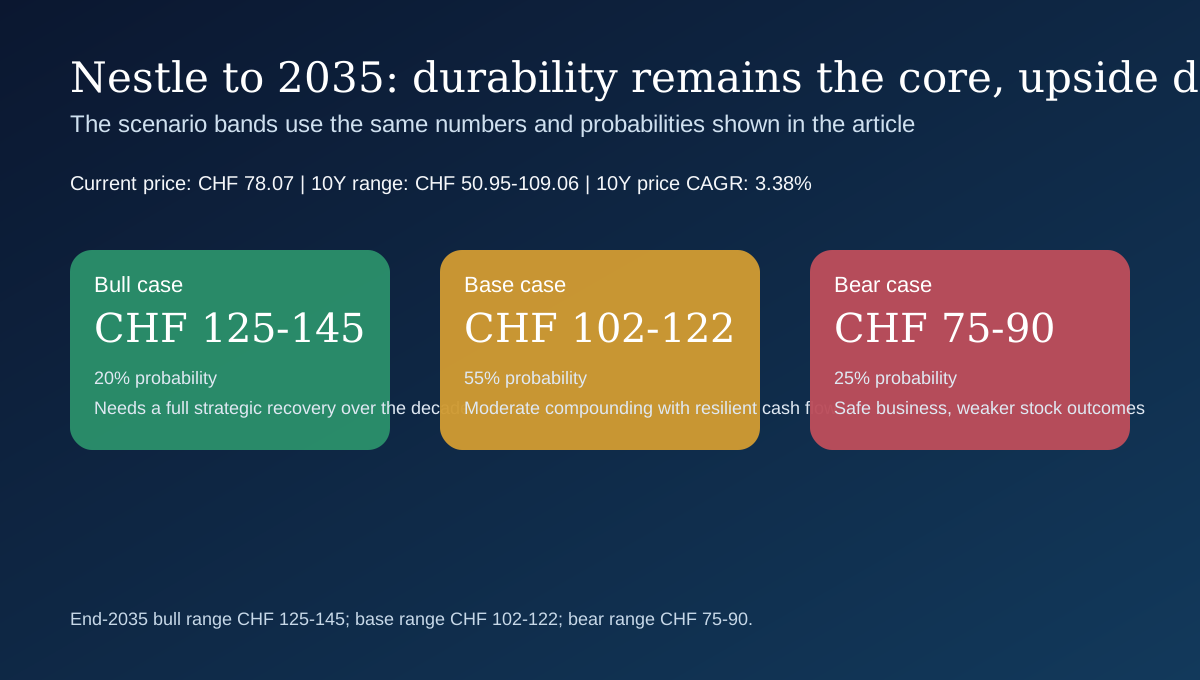
| Bull case | 20% | Nestle spends much of the decade operating near or above the normal-environment growth and margin corridor | Annual results through 2030-2034 | CHF 125-145 |
| Base case | 55% | Cash flow stays resilient and operating quality improves, but only partially | Annual results through 2030-2034 | CHF 102-122 |
| Bear case | 25% | The business remains safe but low-energy, with little rerating and repeated operating setbacks | Annual results through 2030-2034 | CHF 75-90 |
References
Sources
- Yahoo Finance chart API for Nestle (NESN.SW) 10-year price history and latest market data
- Nestle three-month sales 2026 press release, published April 23, 2026
- Nestle full-year 2025 results and 2026 guidance, published February 19, 2026
- Nestle analysts and consensus page, including the latest company-compiled consensus references
- Nestle pre-full year 2025 company-compiled consensus PDF, published January 2026
- Nestle strategy page with 4%+ organic growth, 17%+ margin, and CHF 3 billion savings ambition
- StockAnalysis valuation page for Nestle ADR (NSRGY), used for forward P/E reference