Home
» Today
»
New Jaguar Electric Car: Type 01 Features, Range and What to Expect
New Jaguar Electric Car: Type 01 Features, Range and What to Expect
If you are searching for the new Jaguar electric car, you may be looking at three different things: the older I-PACE, the dramatic Type 00 concept, or the newly unveiled Type 01. That confusion matters when you compare range, charging claims, and availability. A concept’s ambitions are not the same as a customer car’s certified specifications.
The latest development is the Jaguar Type 01, a four-door electric grand tourer unveiled in New York on October 6, 2026, with Jaguar’s detailed announcement published October 7. Its official world-premiere release says orders are planned for early 2027 and first customer deliveries for the second half of 2027. As of October 8, 2026, this is an unveiling, not confirmation that cars are already being delivered.
Which new Jaguar is the production model?
Type 01 is the model to follow for Jaguar’s new electric-car launch. GT stands for grand tourer: a car intended to combine performance with comfort over longer journeys. It is a different proposition from an electric SUV.
The December 2024 Type 00 announcement presented a design vision and previewed a future four-door production GT. It quoted targets of up to 430 miles under the EPA framework and 478 miles under WLTP. Those older targets should not be carried forward as the current Type 01 specifications. The production announcement now gives different estimates.
Type 01: the announced specifications at a glance
Jaguar’s October 2026 Type 01 technical announcement provides the following manufacturer figures. They are announced specifications and estimates, not results from an independent road test.
Item
Jaguar’s announced figure
Layout
Four-door luxury electric GT; dedicated Jaguar Electric Architecture.
Battery
118 kWh usable capacity.
Electrical architecture
850 volts.
Powertrain
Three motors; up to 1,030 PS and 1,365 Nm.
Acceleration
0–62 mph in 3.2 seconds.
Expected EPA range
Up to 400 miles.
Estimated WLTP range
Up to 450 miles / 720 km.
Fast-charge claim
Up to 200 miles added in as little as 13 minutes with 350 kW DC charging.
PS is metric horsepower; it should not be labeled as the same numerical value in U.S. mechanical horsepower. Likewise, 0–62 mph is not a 0–60 mph measurement. Keeping the original units avoids turning a specification into a different claim.
How should you interpret the range?
The 400-mile EPA figure is an expectation, not a final certified rating established in the launch material. Jaguar’s technical footnotes describe range figures as manufacturer estimates ahead of full certification and warn that actual results vary. Treat that distinction as part of the specification, not fine print to discard.
EPA refers to the U.S. Environmental Protection Agency. WLTP is the Worldwide Harmonized Light Vehicles Test Procedure used in markets including Europe. Compare vehicles within the same testing framework; do not rank one car’s EPA estimate against another car’s WLTP number.
The EPA’s explanation of EV range testing describes laboratory city and highway testing, adjustments for real-world factors, and a combined range label. That combined figure is a comparison tool, not a promise of the same distance on every highway trip.
The EPA’s consumer guidance on electric vehicles notes that high-speed driving, cold weather, and accessory use can reduce range. For planning, record your longest regular trip, the likely weather, and a charging reserve. Avoid calculating your itinerary as though every journey starts at 100% and ends at an empty battery.
A useful decision is whether your routes remain comfortable under less favorable conditions. Until customer-car testing becomes available, there is no verified basis here for assigning Type 01 a specific winter range or guaranteeing a nonstop trip of a given length.
What the fast-charging numbers actually tell you
A kilowatt-hour, or kWh, measures stored energy; a kilowatt, or kW, measures power. Battery capacity and charger output therefore answer different questions. A large battery does not, by itself, establish a short charging stop.
Jaguar’s Type 01 product page also advertises a 10–80% charge in as little as 22 minutes using 350 kW rapid DC charging. That percentage-based interval is useful alongside the added-range claim because it identifies a charging window. Neither number means a full recharge takes 13 minutes.
The practical question is whether a compatible charging site on your route can support the advertised conditions. Ask for the regional connector specification, network access arrangements, battery-preconditioning instructions, and charging behavior at less powerful stations. Those details should be confirmed for the car you would actually order.
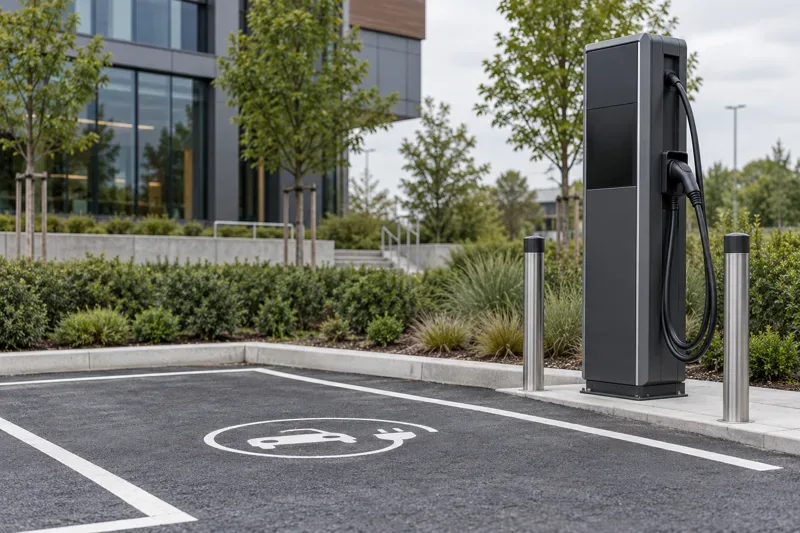
A charging pedestal stands beside an empty EV parking bay. Station capability and compatibility matter when assessing a vehicle’s fast-charging claims; no charger output is shown here.
For home use, EPA charging guidance distinguishes standard 120-volt charging from a dedicated 240-volt charging setup. Get a site-specific installation assessment instead of assuming your existing outlet will meet your daily needs. This article does not establish a Type 01 home-charging duration or installation cost.
Key features to assess beyond performance
The product page describes a four-occupant cabin, a 24-inch OLED display combining instruments and infotainment, and a secondary 7-inch control screen. It also lists a Panoramic Soundbar, active road-noise cancellation, air suspension, and all-wheel steering. Jaguar warns that final customer models and features may vary before launch.
These features suggest what to evaluate when demonstrators become available. Check whether screen controls are easy to use while stationary, whether the seating position suits you, and whether rear passengers and luggage fit your normal trips. A large display does not prove that the interface is easy to operate, just as an audio specification does not establish how the cabin sounds.
All-wheel steering and adjustable suspension deserve a real-world assessment of maneuverability and ride comfort. No first-hand drive, cabin measurement, or sound-system test is claimed in this guide. The launch provides a feature list; the next evidence should be how a customer-specification car behaves.
Price, availability, and what remains to be confirmed
The published order and delivery windows are plans, not a delivery appointment for an individual buyer. Confirm your market’s ordering date and allocation with Jaguar. An international launch can precede regional pricing, configurators, and detailed ownership terms.
A complete U.S. price and trim schedule was not verified in the official pages reviewed for this article, so no starting-price figure is presented as a confirmed U.S. offer. Request a written quote specifying the vehicle, options, destination charges, taxes, deposit terms, and expected delivery timing. A converted overseas price is not a substitute for that quote.
Also obtain the applicable battery-warranty conditions, service arrangements, software or connected-service charges, and included charging equipment. Regional terms should govern the comparison. Do not assume that an international product page describes every feature or ownership benefit available in the United States.
How to check whether it belongs on your shortlist
Start with the checks that require no commitment: confirm the model name, dated specification sheet, test cycle, and sales status. Then check your parking space, charging access, and longest routine journeys. Finally, when a demonstrator is available, assess the cabin, controls, ride, and visibility yourself.
Match every range figure to its test cycle and certification status.
Use your market’s specification and written price rather than an older concept target.
Confirm charging compatibility at home and along the routes you actually use.
Check which features are standard, optional, or still subject to change.
Verify that the proposed delivery date and ownership terms are documented.
If those checks align, Type 01 may warrant a closer look as a luxury electric GT. If they leave important gaps, keep it on a watchlist until the relevant evidence arrives. The useful result is a comparison you can verify—not a purchase decision built on an attractive launch image or an unqualified range headline.