Home
» Today
»
New Observational Surveys Renew the Hunt for Solar Systems Elusive Planet Nine
New Observational Surveys Renew the Hunt for Solar Systems Elusive Planet Nine
Last verified and updated: November 23, 2026, at 12:03 UTC (07:03 EST / Ottawa, ON, UTC-05:00)
Astronomical survey teams probing the outer boundaries of our solar system have significantly intensified their search for the hypothetical Planet Nine, eliminating legacy blind spots and deploying next-generation observational pipelines. By combining newly completed systematic re-analyses of Pan-STARRS1 and Dark Energy Survey datasets with initial wide-field commissioning streams from high-altitude optical observatories, researchers have now ruled out roughly 78 percent of the orbital parameter space previously predicted for a distant five-to-ten Earth-mass planet. The remaining undiscovered territory has been narrowed down to deep, high-obscuration corridors near the galactic plane and distant aphelion distances that require unprecedented light-gathering sensitivity.
Destaques
Narrowed Search Grid: Recent comprehensive survey sweeps across Pan-STARRS1, ZTF, and archival datasets have formally ruled out approximately 78% of Planet Nine's predicted orbital phase space.
Vera C. Rubin Commissioning: The ramp-up of the Simonyi Survey Telescope and its 3.2-gigapixel camera in Chile begins probing the faint, distant aphelion regime ($V > 21$) where previous detectors were blind.
Accelerated TNO Discoveries: New high-cadence sky surveys are detecting dozens of extreme Trans-Neptunian Objects (TNOs), testing whether orbital clustering is physical or an observational selection bias.
Near-Term Definitive Verdict: Scientists estimate that current and incoming five-year wide-field survey iterations will either directly image Planet Nine or definitively discard the clustering hypothesis within its standard predicted mass bounds.
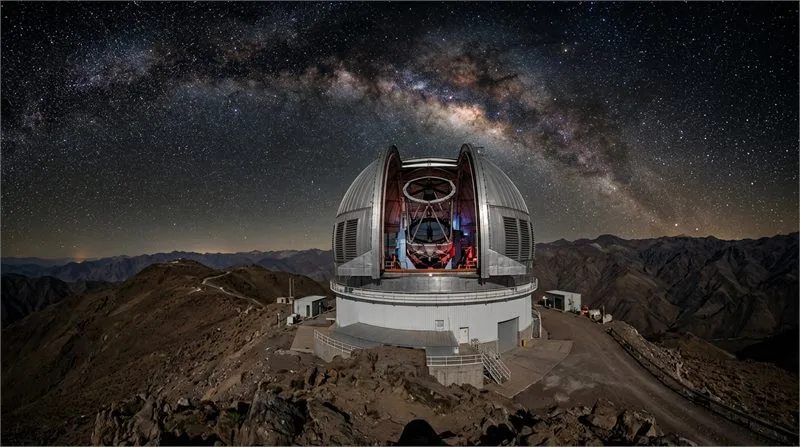
Illustrative: Modern high-altitude astronomical observatories employ wide-field deep sky surveys to systematically search for faint moving bodies at the outer edges of the solar system.
How Do New Observational Surveys Narrow the Planet Nine Search?
For nearly a decade, the case for Planet Nine has rested on the peculiar orbital alignment of extreme Trans-Neptunian Objects (eTNOs)—distant icy bodies whose eccentric orbits share clustered perihelia and orbital inclinations. Yet direct optical detection has eluded researchers due to the sheer vastness of the outer solar system and the planet's suspected faintness ($V \approx 20\text{–}22$), compounded by immense distances exceeding 400 to 800 astronomical units (AU).
Recent survey initiatives spearheaded by research teams at Caltech and international collaborations have systematically mined multi-epoch sky catalogs, cross-referencing Pan-STARRS1 optical surveys with the Dark Energy Survey (DES) and the Zwicky Transient Facility (ZTF). By tracking slow apparent motion against dense background starfields, these efforts eliminated large swaths of the sky, demonstrating that Planet Nine is unlikely to be positioned at its closer orbital perihelion in unobstructed northern declinations.
Why Is the Vera C. Rubin Observatory a Game-Changer?
The turning point for outer-solar-system astronomy centers on the commissioning of the NSF-DOE Vera C. Rubin Observatory in Chile. Equipped with an 8.4-meter primary mirror and a 3.2-gigapixel digital sensor, Rubin's Legacy Survey of Space and Time (LSST) scans the entire visible Southern Hemisphere sky every few nights with unprecedented depth.
Unlike targeted pointings from space telescopes like Hubble or James Webb, which possess narrow fields of view, Rubin surveys massive areas of space simultaneously. This capability allows astronomers to:
Detect solar system objects down to apparent magnitudes fainter than 24 in co-added exposures.
Rapidly identify hundreds of previously unseen TNOs, dwarf planet candidates, and extreme eccentric asteroids.
Probe deep into the Southern sky near the plane of the Milky Way, where stellar crowding has historically blinded automated motion-detection pipelines.
Is the Orbital Clustering Real or an Observational Artifact?
A central scientific debate revolves around selection effects. Critical astronomers from the Outer Solar System Origins Survey (OSSOS) have argued that existing eTNO clustering might stem from observational biases—telescopes look preferentially toward specific celestial patches and during favorable seasonal windows, artificially creating clusters where none exist in nature.
The latest observational releases are resolving this question through statistical rigor. As uniform surveys catalog dozens of new distant objects with isotropic spatial sensitivity, researchers are testing whether the physical clustering holds. If the orbital clustering persists as sample sizes grow fivefold, the gravitational perturbation of an undiscovered super-Earth remains the leading explanation. If the clustering dissipates into an isotropic background, the theoretical necessity for Planet Nine will largely vanish.
What Are the Next Steps and Expected Timelines?
Over the next two to four years, data processing pipelines combining advanced machine learning with synthetic orbital trajectory insertion will process Rubin's data releases alongside secondary far-infrared search archives from space-based platforms. Should Planet Nine exist within its predicted mass range (5 to 10 Earth masses) and orbital distance (300 to 500 AU), current instruments possess the exact optical thresholds required to register its orbital motion against background stars.
Astronomers project that within the current observational cycle, the scientific community will reach a definitive answer: either a landmark photographic capture of our solar system's true ninth planet, or a comprehensive empirical exclusion that redirects planetary dynamics toward alternative gravity models or collective debris disc physics.
Frequently Asked Questions (FAQ)
Why haven't astronomers found Planet Nine yet if it is so large?
Planet Nine is predicted to orbit hundreds of times farther from the Sun than Earth. Reflected sunlight drops off with the fourth power of distance ($1/r^4$), rendering even a massive super-Earth millions of times fainter than Neptune. Searching for it requires repeatedly mapping vast swaths of sky down to extreme optical depths.
What happens if the new surveys find nothing?
If Rubin and associated deep surveys sweep the entire predicted parameter space without detecting a planet, scientists will conclude that the orbital anomalies among outer icy bodies are likely caused by observational selection biases or the collective gravitational self-gravity of a massive Kuiper Belt debris ring rather than an individual planet.
Is Planet Nine the same object as Pluto?
No. Pluto was reclassified as a dwarf planet in 2006 due to its small size and failure to clear its orbital neighborhood. The proposed Planet Nine is hypothesized to be a true major planet—a mini-Neptune or super-Earth between five and ten times the mass of Earth.