Information checked: November 24, 2026, 20:01 UTC (UTC+00:00).
NVIDIA's November 24, 2026, GeForce update confirms that Where Winds Meet now supports DLSS 5 neural rendering. For Canadian PC gamers, the immediate development is an expansion of software capabilities on existing GeForce RTX 50-series graphics cards, rather than the arrival of a new desktop GPU. NVIDIA's current comparison page continues to list seven desktop Blackwell models, from the RTX 5050 through the RTX 5090.
The distinction matters for anyone following RTX hardware news ahead of seasonal sales: an updated rendering feature can change what an existing graphics card delivers in a supported game without changing its physical memory, processing resources, or power requirements. No new desktop RTX model was verified in the official sources reviewed for this report.
Destaques
Where Winds Meet has received DLSS 5 support, according to NVIDIA's November 24 announcement.
All seven listed RTX 50-series desktop models support the new neural rendering feature, subject to application support.
Desktop memory configurations range from 8 GB to 32 GB; the RTX 5060 Ti has two memory variants.
Canadian retail prices and inventory remain separate from official global hardware specifications.
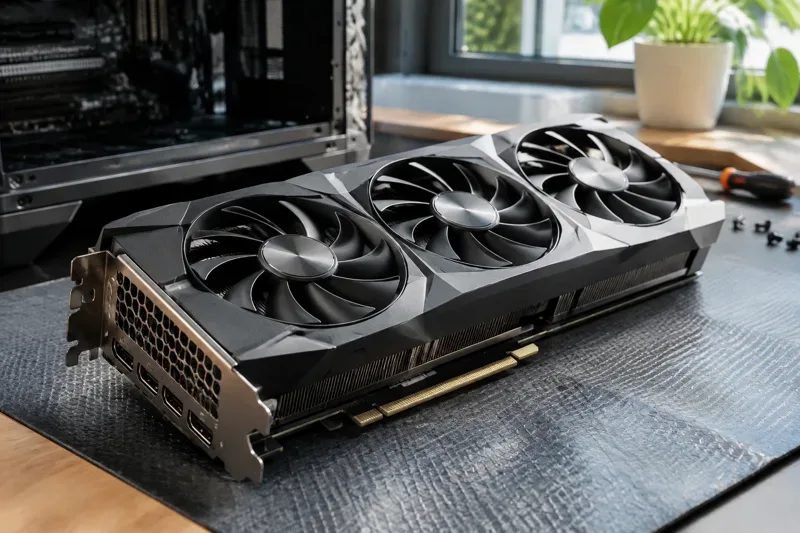
AI-generated editorial illustration of a desktop graphics card ready for installation; not a photograph of a specific NVIDIA model.
What changed in NVIDIA RTX on November 24?
In its November 24 GeForce announcement, NVIDIA confirmed that the open-world adventure Where Winds Meet has added neural rendering to its existing collection of DLSS features. Earlier integrations included NBA 2K27, Hogwarts Legacy and War Thunder. The November announcement is therefore another step in a continuing rollout across individual games rather than a simultaneous upgrade to every title in a PC library.
The feature uses information from the game's rendering pipeline to modify the appearance of lighting and materials. It is distinct from conventional upscaling, which reconstructs a higher-resolution output from a lower-resolution input, and from frame generation, which creates additional displayed frames between rendered ones.
The accompanying interview with Everstone Studio describes how artists and engineers evaluated the visual changes and their computational cost. That cost is important: better lighting does not automatically mean higher native rendering performance. Players should evaluate the feature enabled and disabled in the same scene, keeping resolution and other settings consistent.
What are the current RTX 50-series desktop specifications?
NVIDIA's official GeForce comparison lists the following desktop configurations. These are hardware specifications, not measured gaming benchmarks, and do not describe the laptop products carrying similar names.
GPU
CUDA cores
VRAM
Memory bandwidth
RTX 5090
21,760
32 GB GDDR7
1,792 GB/s
RTX 5080
10,752
16 GB GDDR7
960 GB/s
RTX 5070 Ti
8,960
16 GB GDDR7
896 GB/s
RTX 5070
6,144
12 GB GDDR7
672 GB/s
RTX 5060 Ti
4,608
8 or 16 GB GDDR7
448 GB/s
RTX 5060
3,840
8 GB GDDR7
448 GB/s
RTX 5050
2,560
8 GB GDDR6
320 GB/s
The RTX 5050 is the only listed desktop model in this family using GDDR6 instead of GDDR7. The two RTX 5060 Ti versions share a model designation but have different memory capacities. A software update cannot turn the 8 GB version into the 16 GB version. Similarly, a shared DLSS feature does not erase the differences in memory bandwidth or compute resources across the range.
Does DLSS 5 change performance expectations?
It changes the options available to compatible users, but the performance impact depends on the game and the settings. An advertised frame rate achieved using upscaling and generated frames is not directly comparable to a native-resolution result with those features disabled. Generated frames can improve perceived motion smoothness without increasing the rate at which a game processes player inputs by the same factor.
When reading launch coverage, check whether a test identifies the internal rendering resolution, frame-generation mode, graphics preset and latency. Also look for consistent frame pacing rather than relying exclusively on a peak frame-rate figure. This report does not claim to have independently benchmarked the new update.
What should Canadian RTX owners watch next?
For existing owners, the practical next step is to check the installed game version and graphics driver before assuming a missing menu option is a hardware problem. A feature advertised for an entire GPU family still requires the relevant game integration. An older RTX card may continue to benefit from supported upscaling features even if it cannot activate the newest neural rendering mode.
For shoppers comparing November promotions, keep the hardware model and the software announcement separate. Confirm the exact memory variant in the retailer listing, and compare the total in Canadian dollars including applicable provincial taxes, delivery and any additional power-supply requirements. A US advertised price is not a verified Canadian retail offer. No nationwide stock or price change has been established by this report.
Future hardware refreshes should be treated as unconfirmed until NVIDIA publishes a product announcement and corresponding specifications. New game integrations, driver release notes and official compatibility changes are the more immediate developments to follow. Neither a rumor about a successor nor a new software feature establishes a release date for another desktop graphics card.
Frequently Asked Questions
Did NVIDIA launch a new RTX desktop GPU on November 24, 2026?
No new desktop GPU launch was verified in the sources checked. The confirmed announcement concerns DLSS 5 in Where Winds Meet.
Does the RTX 5060 Ti come with 16 GB of memory?
Yes. NVIDIA lists both 8 GB and 16 GB GDDR7 desktop configurations.
Can an RTX 40-series card use DLSS 5 neural rendering?
NVIDIA's comparison lists that specific feature for RTX 50-series GeForce cards, not RTX 40-series cards. Older cards retain support for other compatible DLSS features.