01. Current Data
The current operating and valuation picture
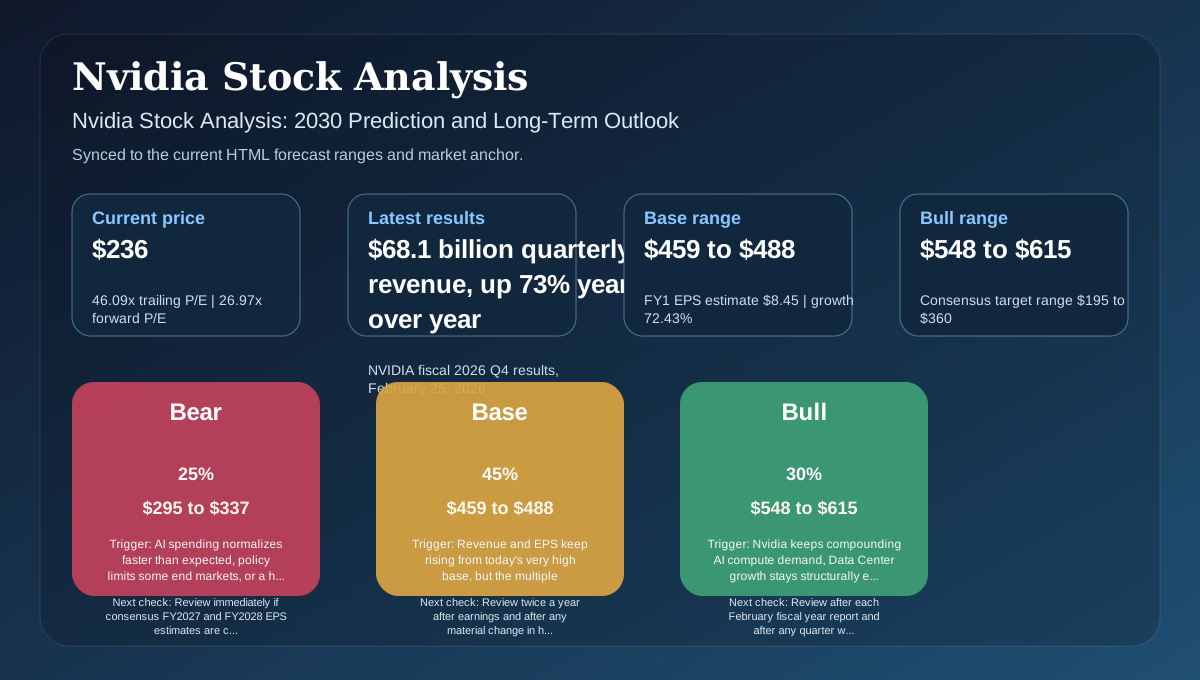
| Metric | Latest figure | Why it matters |
|---|---|---|
| Share price | $236 | Sets the market starting point for every scenario |
| Valuation | 46.09x trailing P/E; 26.97x forward P/E | Defines whether the stock still has room for multiple expansion |
| Latest results | $68.1 billion quarterly revenue, up 73% year over year | NVIDIA fiscal 2026 Q4 results, February 25, 2026 |
| EPS setup | TTM EPS $4.90; next-year consensus EPS $8.45 | Shows the bridge between current earnings and forward expectations |
| Consensus range | $273.43 average target; $195 low; $360 high | Frames how much upside the Street still sees from here |
| Capital allocation / guide | $78.0 billion Q1 FY2027 revenue guide, plus or minus 2% | Creates the next measurable checkpoints for the thesis |
Nvidia's base case remains bullish, but not because the stock is cheap. At $234.18, 46.09x trailing earnings and 26.97x forward earnings, the market is still underwriting a very strong AI infrastructure cycle. The stock can work from here, but it now needs more proof than promise.
That proof is still exceptional. Nvidia reported fiscal 2026 fourth-quarter revenue of $68.1 billion, up 73% year over year, and full-year revenue of $215.9 billion, up 65%. Data Center revenue reached $62.3 billion in the quarter, up 75% year over year. GAAP EPS was $1.76 for the quarter and $4.90 for the full year, and management guided fiscal Q1 2027 revenue to $78.0 billion plus or minus 2%, explicitly assuming no Data Center compute revenue from China.
The macro backdrop is still good enough for leaders, not good enough for complacency. U.S. real GDP rose 2.0% annualized in Q1 2026, while real final sales to private domestic purchasers increased 2.5% and the gross domestic purchases price index rose 3.6%. April 2026 CPI rose 3.8% year over year and core CPI rose 2.8%; March 2026 PCE inflation was 3.5% year over year and core PCE was 3.2%. On April 1, 2026, the IMF projected U.S. GDP growth of 2.4% on a Q4/Q4 basis for 2026 and said core PCE inflation should move back to 2% in the first half of 2027. That combination supports AI capex winners, but it also means multiple compression remains possible if inflation or yields re-accelerate while expectations are already high.
02. Key Factors
Five factors shaping the next move
Valuation is the first key force. Nvidia no longer needs only strong growth; it needs growth that stays ahead of a market already expecting consensus FY2027 EPS of $8.45 and FY2028 EPS of $11.45. The second force is estimate durability. If the Street keeps revising numbers up, a premium multiple can hold. If revisions flatten, the stock becomes far more sensitive to any earnings miss.
The third force is demand concentration. Nvidia still owns the strongest AI infrastructure revenue line in large-cap tech, but the investment case depends heavily on hyperscaler and enterprise spending holding up. The fourth force is balance-sheet strength, which remains excellent. The fifth is macro and regulatory risk, especially because management has already removed China Data Center compute revenue from its near-term outlook.
| Factor | Why it matters | Current Assessment | Bias | Current evidence |
|---|---|---|---|---|
| Valuation | Defines how much future AI demand is already priced in | Demanding but lower than trailing | 0 | 46.09x trailing P/E versus 26.97x forward P/E implies massive expected earnings growth |
| Recent earnings | Measures whether the AI narrative is still converting into revenue | Exceptional | + | $68.1 billion quarterly revenue and $62.3 billion Data Center revenue both grew more than 70% year over year |
| Estimate backdrop | Shows what the market needs next | Strong | + | Consensus FY2027 EPS is $8.45 and FY2028 EPS is $11.45, with an average price target of $273.43 |
| Demand visibility | Separates cyclical acceleration from one-off spikes | Strong but concentrated | + | $78.0 billion Q1 FY2027 guide while assuming no China Data Center compute revenue |
| Macro/regulation | Controls the discount rate and policy risk | Mixed | 0 | GDP is expanding, but inflation remains above target and export-policy risk has not disappeared |
03. Countercase
What could weaken the stock from here
The cleanest bear argument is not that Nvidia lacks growth. It is that expectations are so elevated that even good numbers can disappoint the stock. A forward P/E near 27x on consensus FY2027 EPS of $8.45 assumes another year of exceptional execution.
The second risk is concentration. Data Center represented $62.3 billion of fourth-quarter revenue, and the near-term guide still depends on AI infrastructure demand absorbing lost China compute revenue. If hyperscaler spending pauses or large customers digest capacity, the earnings cadence can slow faster than the long-term thesis changes.
The third risk is policy and rates. April CPI at 3.8% and March core PCE at 3.2% do not rule out a higher-for-longer yield regime. For a stock that has gained more than 80% over the past 52 weeks, that matters because the multiple can compress even if the company keeps growing.
| Risk | Latest data point | Why it matters now | What would confirm it |
|---|---|---|---|
| Expectation gap | Consensus FY2027 EPS is $8.45 | The stock still needs beats and upward revisions, not just in-line execution | Revenue lands near or below the low end of the $78.0 billion +/-2% guide |
| Concentrated demand | $62.3 billion Data Center revenue in Q4 | A small number of very large AI buyers still matter disproportionately | Data Center growth decelerates sharply or order lead times normalize |
| China/export risk | Q1 FY2027 outlook assumes no China Data Center compute revenue | It caps one source of upside and keeps policy sensitivity high | Further export restrictions or weaker mix offset gains elsewhere |
| Rates/multiple risk | April CPI 3.8%; March core PCE 3.2% | A higher discount rate can lower the justified multiple even with strong growth | Treasury yields rise while consensus numbers stop moving up |
04. Institutional Lens
How current source material changes the thesis
Nvidia's own disclosure is the first institutional anchor. On February 25, 2026, the company reported $68.1 billion of quarterly revenue, $215.9 billion of full-year revenue, and a Q1 FY2027 revenue guide of $78.0 billion plus or minus 2%. On April 29, 2026, Nvidia also confirmed that fiscal Q1 2027 results will be reported on May 20, 2026.
The sector backdrop is supportive, not blind. FactSet said on April 2, 2026 that total estimated S&P 500 Q1 earnings had increased 0.4% since December 31, with Information Technology showing the second-largest increase in expected dollar earnings at +8.0% and the highest count of positive EPS guidance at 33 companies. That matters for Nvidia because it suggests the market is not relying on one company alone to carry technology earnings. It is still a favorable revision environment, even if Nvidia remains the most extreme case.
Consensus remains constructive. As of May 14, 2026, StockAnalysis showed 37 analysts covering Nvidia with a Strong Buy rating, an average target of $273.43, and consensus EPS of $8.45 for FY2027. On April 1, 2026, the IMF projected U.S. GDP growth of 2.4% on a Q4/Q4 basis for 2026 and said core PCE inflation should move back to 2% in the first half of 2027. Put together, the institutional lens still favors the long side, but only with disciplined review around each earnings report.
| Source type | Concrete datapoint | Why it matters for the stock |
|---|---|---|
| NVIDIA release, February 25, 2026 | $68.1 billion quarterly revenue, $215.9 billion full-year revenue, $62.3 billion Data Center revenue | Shows the scale and mix of the current AI cycle |
| NVIDIA release, April 29, 2026 | May 20, 2026 confirmed earnings date for Q1 FY2027 | Defines the next hard review point |
| StockAnalysis snapshot, May 14, 2026 | 46.09x trailing P/E, 26.97x forward P/E, FY2027 EPS estimate of $8.45, average target of $273.43 | Sets the current valuation and consensus hurdle |
| FactSet, April 2, 2026 | Technology estimate revision breadth remained positive | Indicates Nvidia still sits inside a broader supportive sector tape |
| IMF, BLS, and BEA | GDP growth remained positive while inflation stayed above target | Explains why the multiple is still exposed to rates |
05. Scenarios
Scenario analysis with probabilities and review points
The 2030 range is best read as a function of earnings durability, not just demand headlines; the stock remains highly sensitive to whether estimates keep moving up.
Each scenario below is designed to be monitored with current valuation, earnings, and macro data rather than a vague long-term story. When the trigger changes, the range should change with it.
| Scenario | Probability | Range / implication | Trigger | When to review |
|---|---|---|---|---|
| Bull | 30% | $548 to $615 | Nvidia keeps compounding AI compute demand, Data Center growth stays structurally elevated, and the market continues to reward the company with a premium multiple on rising EPS | Review after each February fiscal year report and after any quarter where Data Center growth falls below the long-term thesis |
| Base | 45% | $459 to $488 | Revenue and EPS keep rising from today's very high base, but the multiple moderates as the company matures | Review twice a year after earnings and after any material change in hyperscaler capex trends |
| Bear | 25% | $295 to $337 | AI spending normalizes faster than expected, policy limits some end markets, or a higher-rate regime compresses the multiple | Review immediately if consensus FY2027 and FY2028 EPS estimates are cut for two consecutive quarters |
References
Sources
- NVIDIA Q4 and fiscal 2026 results
- NVIDIA sets fiscal Q1 2027 earnings date
- StockAnalysis NVIDIA statistics and valuation snapshot
- StockAnalysis NVIDIA analyst target and EPS forecast snapshot
- U.S. CPI April 2026 release
- U.S. Personal Income and Outlays March 2026
- U.S. GDP advance estimate for Q1 2026
- IMF 2026 U.S. Article IV consultation
- FactSet S&P 500 earnings season preview for Q1 2026