Home
» Today
»
Phoenix Mercury vs Portland Fire: Key Matchups to Watch and What the 87-85 Finish Revealed
Phoenix Mercury vs Portland Fire: Key Matchups to Watch and What the 87-85 Finish Revealed
Latest update: this matchup is no longer upcoming. The Portland Fire's official site now lists the September 17, 2026 game as a Phoenix Mercury 87-85 win in Portland. That changes the most useful way to read a "key matchups" preview: instead of pretending the result is still unknown, the better approach is to identify the tactical battles that made this series-deciding game worth watching and that remain useful when reviewing the replay or evaluating the teams' late-season play.
The context was meaningful even before tipoff. The WNBA's official watch page described Phoenix-Portland as a game with the season series tied, and Portland's September fan guide highlighted Kahleah Copper and Alyssa Thomas as two of the Mercury players to watch. Portland was also closing out the inaugural season of the revived Fire franchise, which returned to WNBA play in 2026. For official team information, see the Phoenix Mercury team page, the Portland Fire team page, and the Portland Fire official site.
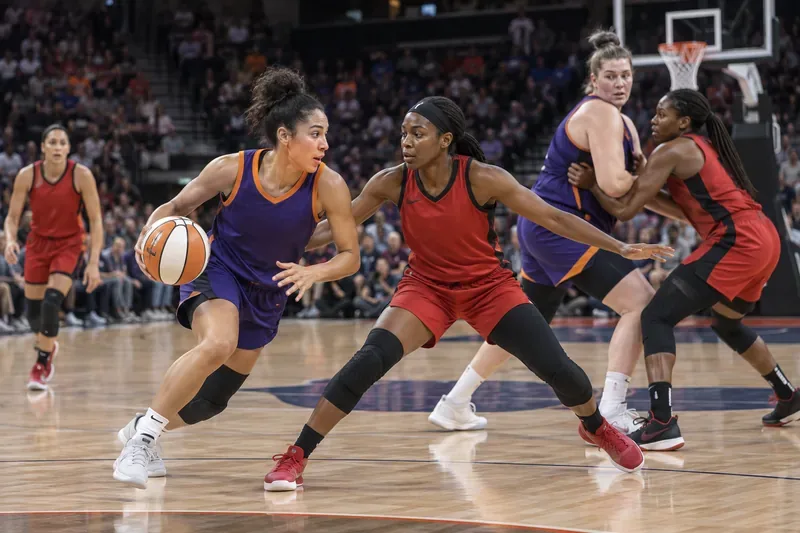
A perimeter drive, point-of-attack defense, and off-ball positioning illustrate the kinds of half-court battles that defined the Phoenix-Portland matchup.
1. Phoenix's downhill creators vs. Portland's point-of-attack defense
The first matchup to track is not simply one scorer against one defender. It is Phoenix's ability to get the ball moving downhill against Portland's first line of resistance. Kelsey Plum is listed by the WNBA as a guard on Phoenix's 2026 roster, while Kahleah Copper gives the Mercury a bigger wing threat who can pressure a defense from multiple spots. When either player forces the first defender to turn her hips, the possession changes: help has to arrive, a second defender becomes involved, and passing windows open behind the rotation.
For Portland, the key is whether the initial defender can keep the ball in front long enough for the rest of the defense to stay attached. The Fire roster includes guards such as Carla Leite, Jordan Harrison, Teja Oblak, Karlie Samuelson, and Holly Winterburn. The important viewing question is less about one permanent assignment and more about the quality of the first two defensive actions: can the on-ball defender absorb the drive, and can the next defender stunt or help without surrendering an uncontested kick-out?
If Phoenix reaches the paint repeatedly without having to run elaborate actions, the Mercury can dictate the geometry of the floor. If Portland keeps the ball outside the lane and makes Phoenix finish possessions late in the clock, the Fire can turn the game into a more difficult shot-making contest.
2. Alyssa Thomas as a connector vs. Portland's frontcourt decision-making
Alyssa Thomas creates a different problem because she can function as more than a conventional forward. Phoenix can use her as a screener, short-roll decision-maker, rebounder, and facilitator. That makes the matchup with Portland's frontcourt especially important. The Fire's official WNBA roster includes multiple bigger players, including Luisa Geiselsoder, Megan DiLeo, Serah Williams, Frieda Buhner, Nyadiew Puoch, and Emily Engstler.
The tactical question is what Portland does when Thomas catches the ball after the first layer of defense has already been compromised. If a big steps all the way up, cutters and weak-side shooters can become available. If the defense stays home, Thomas can attack the space herself or make a quick interior pass. This is where one possession can look ordinary on the stat sheet but reveal a lot about which team is controlling the matchup.
For viewers, watch the defender guarding the screener, not just the ball. Is she switching? Dropping? Showing and recovering? Is the weak-side low defender rotating early? Those details often determine whether Phoenix gets a clean look before a shot ever goes up.
3. Portland's ball movement vs. Phoenix's help-and-recover discipline
Portland's best counter is to avoid allowing Phoenix to load up on one creator. The Fire's roster is built with several guards and versatile forwards, and that gives them multiple ways to initiate offense. When the ball changes sides quickly, a defense that was organized on the first action can become vulnerable on the second or third.
Phoenix therefore has to win a less glamorous matchup: closeout discipline. The Mercury cannot overreact to the first drive, then arrive late to the next shooter or cutter. This matters particularly against a team that can put multiple passers on the floor at once. The possession to watch is the one in which Portland enters the paint, kicks the ball out, reverses it, and then attacks again. That second drive is often more dangerous than the first because the defense is already moving.
A simple test for the viewer is to count how often Portland creates a catch with an immediate advantage. If the receiver can shoot, drive, or pass before the defender is balanced, Portland has succeeded even if the final shot is missed. If Phoenix consistently forces catches that allow the defense to reset, the Mercury have won that phase.
4. Rebounding: first possession vs. second possession
Portland's WNBA team page lists rebounding as one of the club's weaker league-ranking categories this season, making the glass a natural pressure point. Against Phoenix, the challenge is two-sided. Portland needs enough defensive rebounds to prevent the Mercury from extending possessions, but it also needs selective offensive rebounding without compromising transition defense.
This is a matchup where player size matters, but positioning matters more. Thomas, Natasha Mack, Kyara Linskens, Maddy Westbeld, and other Phoenix frontcourt options can affect the paint in different ways. Portland's bigger players must make first contact, while its guards need to finish the possession by collecting long rebounds that bounce beyond the restricted area.
On replay, do not just count rebounds. Watch where the missed shot comes from and who has inside position when it leaves the shooter's hand. A team can be "out-rebounded" on a few bad bounces while still executing well, or it can post an acceptable total while repeatedly losing crucial box-outs. The most revealing rebounds are the ones that end a strong defensive possession or extend a possession after an initial stop.
5. Transition choices after live-ball turnovers
Close games are often decided by possessions that never settle into half-court offense. A live-ball turnover can become a layup, a foul, or an open three before the defense is organized. Both teams have guards and wings capable of pushing pace, so the matchup is partly about decision quality in the first three seconds after a change of possession.
Phoenix's advantage comes when an experienced ballhandler can immediately identify whether Portland has numbers back. Portland's opportunity comes when it can turn a deflection into early offense before Phoenix's stronger half-court defenders are set. The key is not simply "play fast." It is to play fast when the floor says to play fast and pull the ball out when the advantage is gone.
6. Late-game shot creation and defensive switching
An 87-85 final score is a reminder that late possessions matter disproportionately in a game this close. In the final minutes, teams often reduce the playbook and lean more heavily on their most trusted creators. That makes switching decisions, matchup hunting, and clock management easier to see.
For Phoenix, a late possession can be built around Plum's guard creation, Copper's size and scoring ability on the wing, or Thomas as a screener and playmaking hub. Portland's answer is to avoid giving away an obvious mismatch while also resisting the temptation to switch automatically. A switch that looks clean at the point of contact can still create a rebounding problem or leave a smaller defender isolated against a stronger finisher.
For Portland, the late-game objective is similar: get the ball to a player who can create an advantage without forcing a low-percentage attempt too early in the clock. The best defensive possessions from Phoenix are the ones that make Portland use an extra pass or dribble and push the decision deeper into the possession.
Quick matchup checklist
Matchup
What to watch
Why it matters
Phoenix guards and wings vs. Portland perimeter defense
Can Portland contain the first drive without heavy help?
Early paint touches create rotations and open passing lanes.
Alyssa Thomas vs. Portland's frontcourt
How Portland handles screens, short rolls, and help decisions
Thomas can punish both aggressive help and passive coverage.
Portland ball movement vs. Phoenix closeouts
Quality of the second and third actions in a possession
Side-to-side movement can create better shots than the initial set.
Rebounding
Box-outs, long rebounds, and second-chance opportunities
Extra possessions are especially valuable in a one-score game.
Late-game offense
Who creates the first advantage and how defenses switch
Small matchup edges become decisive in the final minutes.
What the latest result means
The most important verified update for readers on September 18, 2026 is the final score: Phoenix 87, Portland 85, as displayed on the Fire's official site. That means any preview published now should clearly acknowledge that the game has already been played. The practical value is in using these matchup lenses to understand why the contest stayed tight and what each team can carry into its remaining schedule.
The WNBA's 2026 schedule release established this season as the league's 30th and confirmed Portland as one of two new teams in the expanded league. That broader context matters because Portland's first season is still a learning process in roster construction, defensive communication, and closing games, while Phoenix is balancing established veteran creators with a 2026 roster that has changed from prior Mercury eras. The league's official announcement is available at the 2026 WNBA schedule release.
For anyone rewatching Phoenix Mercury vs. Portland Fire, focus less on isolated highlights and more on the sequence of advantages: who gets the first paint touch, which defender has to help, whether the offense finds the next pass, and who finishes the possession on the glass. In a two-point game, those small interactions are not background details. They are the game.